Science & TechnologyS


Moon

Indian scientists develop 'space bricks' for future construction projects on the moon

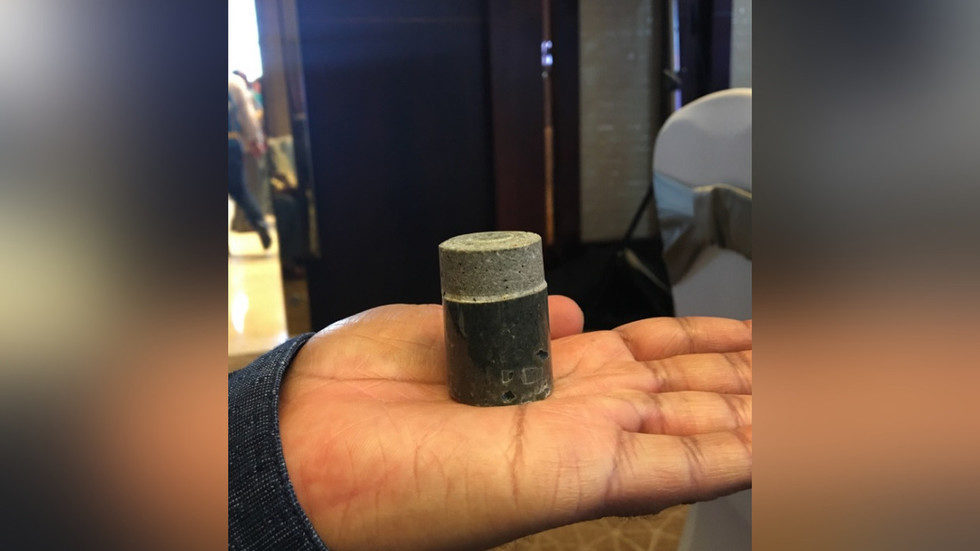
space brick' developed by ISRO and IISc
© Courtesy: Aloke KumarThe 'space brick' developed by ISRO and IISc
In what could be an important leap for lunar exploration, Indian scientists claim to have produced special bricks made from a material simulating the Moon's surface, based on samples brought back by NASA missions.

The Indian Institute of Science (IIS) teamed up with the Indian Space Research Organization (ISRO) to produce what they call "space bricks."

The invention, they say, as quoted by local media, will facilitate future construction projects on the Earth's satellite, including those that require the use of resources found on-site.

Comment:


Blue Planet

Wise oysters, galloping sea stars, and more: The biological marvels just keep coming

pearl oyster
© Okinawa Institute of Science and TechnologyJapanese pearl oyster, Pinctada fucata
Strong theories in science require fewer auxiliary hypotheses when new discoveries come to light. Design advocates can gain confidence when discoveries continue to illustrate the core principles of intelligent design, like irreducible complexity, meaningful information, and hierarchical design, while undermining the blind, gradualistic principles of Darwinian evolution. Here are some recent illustrations.

"Pearls of Wisdom"

That's the headline on news from the Okinawa Institute of Science and Technology, where the only thing said about evolution is that "From a genetic and evolutionary perspective, scientists have known little about the source of these pearls" in the Japanese pearl oyster, Pinctada fucata. By implication, don't look for pearls of wisdom from evolutionary theory. The research published in Evolutionary Applications only concerns genetic variations within the species and the geographic distributions of isolated populations. If it helps conserve these oysters with their magnificent mother-of-pearl nacre — the envy of materials scientists — well, it's wise to keep jewelry makers in business. Design scores as evolution fumbles.

Microscope 2

Human mutation rates steady across diverse groups - except the Amish

Amish
© ISTOCK.COM, DELMASLEHMANABOVE: An Amish horse and buggy in Lancaster County, Pennsylvania
The rate of new mutations in the human genome appear to be consistent across diverse populations, except one — the Old Order Amish of Lancaster, Pennsylvania. This group has a lower rate of developing new mutations, according to a study published January 21 in PNAS.

The lower mutation rate does not appear to have a genetic component, pointing to a possible role for environmental factors in modifying how fast human genomes accrue new mutations.

"It really looks like environmental differences might actually [have] the most significant effect on the number of mutations that you pass on to your offspring, rather than . . . there being some sort of gene" causing mutations, says Aylwyn Scally, a geneticist at the University of Cambridge who was not involved in the work. In a larger study than this one, researchers might be better able to detect a genetic contribution if there is one, he says. "But still it's surprising that it hasn't jumped out, and instead there's this curious effect that's bolstered by their finding about the Amish. Maybe different environments are actually the biggest factor."

Comment: See also:


Info

'Biorobotic hybrid heart' beats like the real thing

Biorobotic Heart
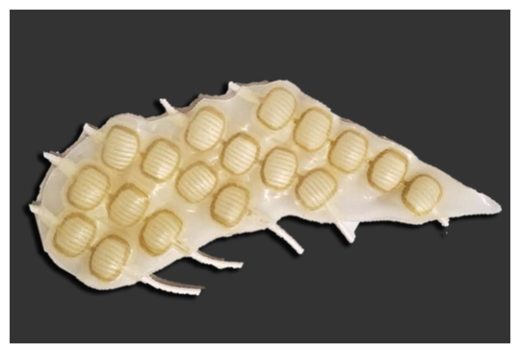
© ELLEN ROCHE, ET. ALA synthetic matrix of soft robotic actuators can be wrapped around a heart ventricle and inflated to squeeze and twist the heart in the same way a real heart pumps blood.
If you're unlucky enough to need a heart valve replacement, a pacemaker or an internal defibrillator, there's a new invention that could soon smooth the way.

Researchers led by Ellen Roche at the Massachusetts Institute of Technology in Cambridge, US, have made a "soft" robotic heart by encasing the innards of a pig heart in a pneumatic silicone shell, moulded to be a perfect replica of the original.

The result is a melding of pig and polymer the team calls a "biorobotic hybrid heart". It can pump at different rates and strengths, mimicking a range of human conditions all the way from healthy exercise to heart failure.

With development, the device could mean patients waiting for heart procedures get their ticker modelled in the lab beforehand, allowing surgeons to tailor-make interventions such as valve replacements.

Down the track, even people on the list for a heart transplant could benefit.

"[W]ith further tissue engineering, we could potentially see the biorobotic hybrid heart be used as an artificial heart," says co-lead author Christopher Nguyen, from Harvard Medical School in the US.

To manufacture their robo-heart, the team carefully dissected out the lining of a pig's heart.

This bit has a precise anatomy that is hard to imitate synthetically. There are the valves that stop blood flowing backwards, the slender fibrils that guide the valve leaflets to open and close, and the gullies or "trabeculae" that corrugate the lining of each chamber.

The researchers then took the outer, muscular layer of the heart, "unwrapped" it and laid it out flat to be scanned with a high-resolution version of MRI called diffusion tensor imaging (DTI).

Info

Antarctica: Mysterious spewing particles defy physics

Launch ANITA
© NASAResearchers launch the Antarctic Impulsive Transient Antenna (ANITA) experiment, which picked up signals of impossible-seeming particles as it dangled from its balloon.
Our best model of particle physics is bursting at the seams as it struggles to contain all the weirdness in the universe. Now, it seems more likely than ever that it might pop, thanks to a series of strange events in Antarctica.

The death of this reigning physics paradigm, the Standard Model, has been predicted for decades. There are hints of its problems in the physics we already have. Strange results from laboratory experiments suggest flickers of ghostly new species of neutrinos beyond the three described in the Standard Model. And the universe seems full of dark matter that no particle in the Standard Model can explain.

But recent tantalizing evidence might one day tie those vague strands of data together: Three times since 2016, ultra-high-energy particles have blasted up through the ice of Antarctica, setting off detectors in the Antarctic Impulsive Transient Antenna (ANITA) experiment, a machine dangling from a NASA balloon far above the frozen surface.

As Live Science reported in 2018, those events — along with several additional particles detected later at the buried Antarctic neutrino observatory IceCube — don't match the expected behavior of any Standard Model particles. The particles look like ultra high-energy neutrinos. But ultra high-energy neutrinos shouldn't be able to pass through the Earth. That suggests that some other kind of particle — one that's never been seen before — is flinging itself into the cold southern sky.

Microscope 1

More gene surprises: Cell codes contain information that goes far beyond DNA

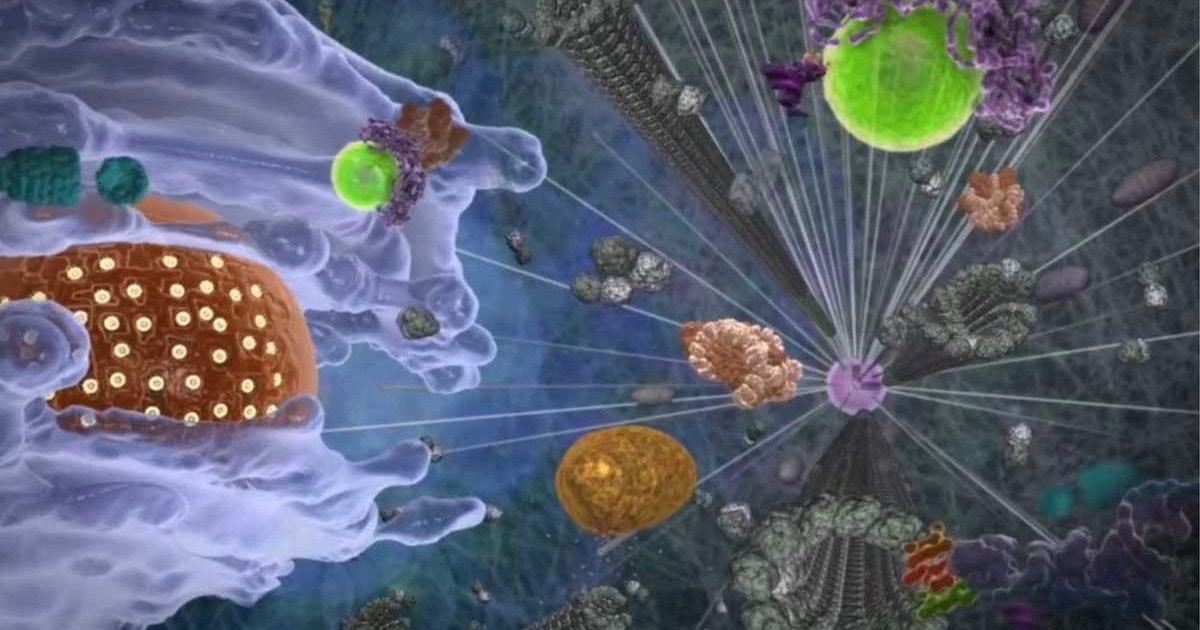
cell interior structure
© Illustra MediaInterior of a cell
Information is the stuff of life. Not limited to DNA, information is found in most biomolecules in living cells. Here are some recent developments.

Sugar Code

Certain forms of sugars (polysaccharides called chitosans) trigger the immune system of plants. Biologists at the University of Münster are "deciphering the sugar code." They describe the variables in chitosans that constitute a signaling system.
Chitosans consist of chains of different lengths of a simple sugar called glucosamine. Some of these sugar molecules carry an acetic acid molecule, others do not. Chitosans therefore differ in three factors: the chain length and the number and distribution of acetic acid residues along the sugar chain. For about twenty years, chemists have been able to produce chitosans of different chain lengths and with different amounts of acetic acid residues, and biologists have then investigated their biological activities. [Emphasis added.]

Comment:


Comet 2

NASA: 5 asteroids making close approach to Earth on January 30

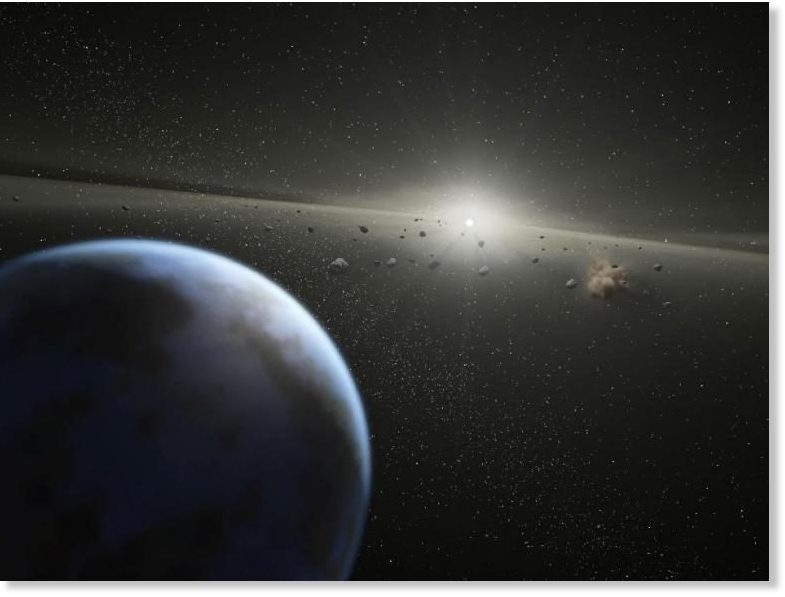
This artist's animation illustrates a massive asteroid belt in orbit around a star the same age and size as our Sun.
© NASA/JPL-CaltechThis artist's animation illustrates a massive asteroid belt in orbit around a star the same age and size as our Sun.
According to NASA, Earth will be visited by a total of five asteroids tomorrow. The biggest asteroid in the group is significantly larger than the Leaning Tower of Pisa in Italy.

As indicated in the data collected by NASA's Center for Near-Earth Object Studies (CNEOS), the first asteroid that will approach Earth is called 2018 AL12. This asteroid has an estimated diameter of 213 feet, making it the largest asteroid that will fly past Earth tomorrow.

CNEOS stated that 2018 AL12 will approach Earth on Jan. 30 at 3:13 a.m. EST at a speed of over 39,000 miles per hour. During its flyby, the asteroid will be about 0.04660 astronomical units or 4.3 million miles from the planet's center.

The second asteroid that will visit Earth's vicinity tomorrow is known as 2020 BL11. This asteroid is currently moving towards Earth at a speed of 7,000 miles per hour. CNEOS estimated that it is about 52 feet wide.

Solar Flares

NSF's newest solar telescope produces first images of the sun in never before seen detail

solar telescope sun image
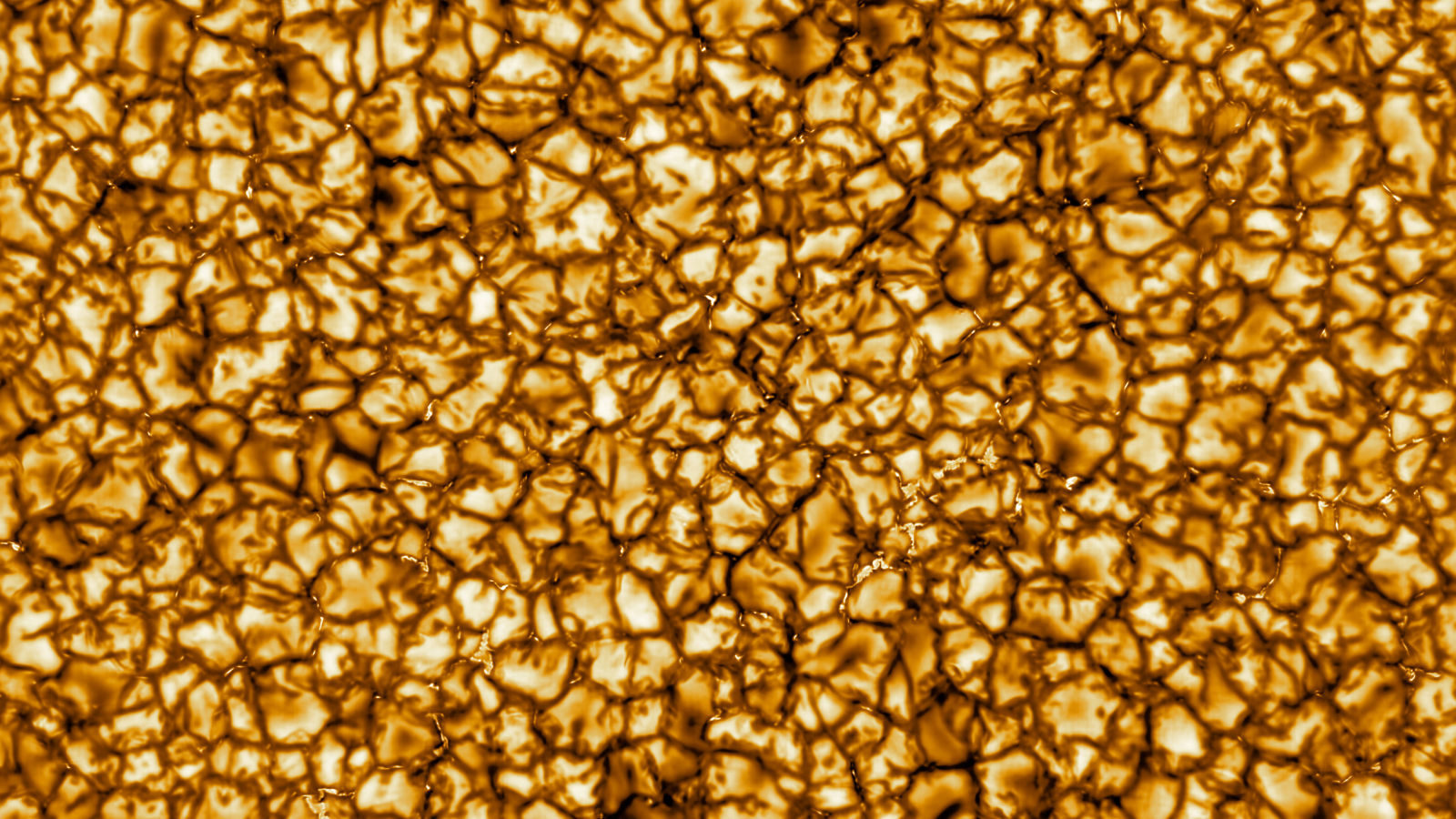
© NSO/AURA/NSFCropped section of the full field from NSF’s Inouye Solar Telescope’s first light image.
Just released first images from the National Science Foundation's Daniel K. Inouye Solar Telescope reveal unprecedented detail of the Sun's surface and preview the world-class products to come from this preeminent 4-meter solar telescope. NSF's Inouye Solar Telescope, on the summit of Haleakala, Maui, in Hawai'i, will enable a new era of solar science and a leap forward in understanding the Sun and its impacts on our planet.

Activity on the Sun, known as space weather, can affect systems on Earth. Magnetic eruptions on the Sun can impact air travel, disrupt satellite communications and bring down power grids, causing long-lasting blackouts and disabling technologies such as GPS.


Comment: It can also affect weather on Earth.


The first images from NSF's Inouye Solar Telescope show a close-up view of the Sun's surface, which can provide important detail for scientists. The images show a pattern of turbulent "boiling" plasma that covers the entire Sun. The cell-like structures — each about the size of Texas — are the signature of violent motions that transport heat from the inside of the Sun to its surface. That hot solar plasma rises in the bright centers of "cells," cools off and then sinks below the surface in dark lanes in a process known as convection. (See video available with this news release.)

"Since NSF began work on this ground-based telescope, we have eagerly awaited the first images," said France Córdova, NSF director. "We can now share these images and videos, which are the most detailed of our Sun to date. NSF's Inouye Solar Telescope will be able to map the magnetic fields within the Sun's corona, where solar eruptions occur that can impact life on Earth. This telescope will improve our understanding of what drives space weather and ultimately help forecasters better predict solar storms."

Wolf

Meet the rare 'sea wolves' who live off the ocean & are marathon swimmers

Sea wolves
The documented flora and fauna on Earth is truly astounding, having evolved from minuscule cells over millennia into the plants and animals we have today, estimated by biologists to be over 8.7 million species.

Although approximately 1 million new species are discovered every year, it is likely that millions more remain undiscovered. In the circle of life Mother Nature created, each found the perfect place to evolve and thrive and contribute to the wellbeing of the whole — resulting in a diversity of species that boggles the mind.

Unfortunately, the evolution of Homo sapiens was too successful, resulting in the continuous extinction of many species and putting many more at risk with the destruction of natural habitat, over fishing, hunting, and pollution.

Info

Latest on Betelgeuse, discovery of a new supernova and new comet Iwamoto

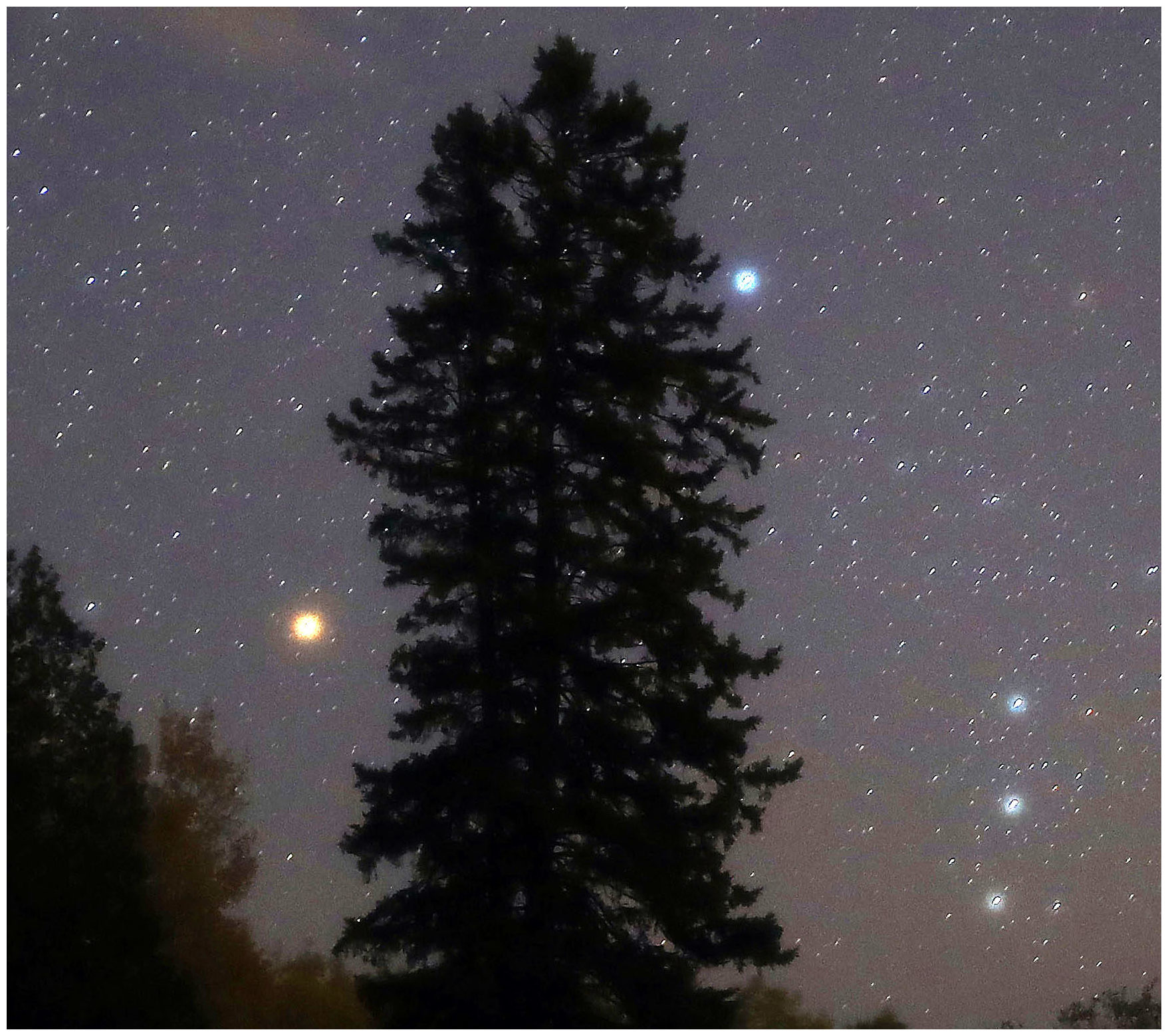
Betelgeuse
© Bob KingBetelgeuse (lower left) has cornered our attention this winter season.
The sky provides. This winter, the fading of Betelgeuse caught us all by surprise. Now, as January wraps up, we can add a new comet discovery and a supernova bright enough to see in a 6-inch telescope to an ever-growing list of seasonal sky wonders.

As astronomers turned their spectrographs toward Betelgeuse, skywatchers from beginners to seasoned amateurs thrilled to see the red supergiant fade before their eyes. With a little help from Aldebaran and Bellatrix, which served as comparison stars, Betelgeuse made hundreds if not thousands of new variable star observers.

I spoke with Elizabeth O. Waagen, senior technical assistant at the American Association of Variable Star Observers (AAVSO), and while she didn't have an exact number at her fingertips, she confirmed that Betelgeuse inspired new observers to contribute their magnitude estimates.