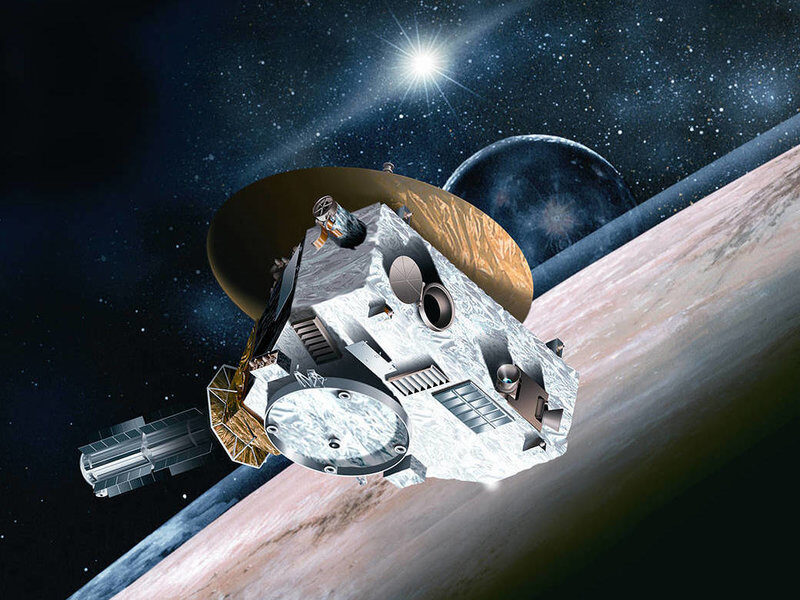
© NASA / Johns Hopkins University Applied Physics Laboratory/Southwest Research InstituteScientists have used the New Horizons spacecraft, billions of miles from Earth, to measure the darkness of space.
Look up at the night sky and, if you're away from city lights, you'll see stars. The space between those bright points of light is, of course, filled with inky blackness.
Some astronomers have wondered about that all that dark space--about how dark it really is."
Is space truly black?" says
Tod Lauer, an astronomer with the National Optical Astronomy Observatory in Arizona.
He says if you could look at the night sky without stars, galaxies, and everything else known to give off visible light, "does the universe itself put out a glow?"It's a tough question that astronomers have tried to answer for decades. Now, Lauer and other researchers with NASA's
New Horizons space mission say they've finally been able to do it, using a spacecraft that's travelling far beyond the dwarf planet Pluto. The group has
posted their work online, and it will soon appear in the
Astrophysical Journal.
New Horizons was originally designed to explore Pluto, but after whizzing past the dwarf planet in 2015, the intrepid spacecraft just kept going. It's now more than four billion miles from home — nearly 50 times farther away from the Sun than the Earth is.
That's important because it means the spacecraft is far from major sources of light contamination that make it impossible to detect any tiny light signal from the universe itself. Around Earth and the inner solar system, for example, space is filled with dust particles that get lit up by the Sun, creating a diffuse glow over the entire sky. But that dust isn't a problem out where
New Horizons is. Plus, out there, the sunlight is much weaker.
To try to detect the faint glow of the universe, researchers went through images taken by the spacecraft's simple telescope and camera and looked for ones that were incredibly boring.



















Comment: See also:
- The Probability of Evolution
- Darwinism, Creationism... How About Neither?
- Fossil upends "overly simplistic" theory of how sharks evolved, evolution of vertebrates now in question
And check out SOTT radio's: