Science & TechnologyS


Beaker

'Weird little molecule' detected on Titan - never been found in any atmosphere before

titan jupiter moon
© NASA/JPL-Caltech/University of Arizona/University of IdahoCassini's near-infrared view of Titan's lakes
Titan, the already pretty weird moon of Saturn, just got a little bit weirder. Astronomers have detected cyclopropenylidene (C3H2) in its atmosphere - an extremely rare carbon-based molecule that's so reactive, it can only exist on Earth in laboratory conditions.

In fact, it's so rare that it has never before been detected in an atmosphere, in the Solar System or elsewhere. The only other place it can remain stable is the cold void of interstellar space. But it may be a building block for more complex organic molecules that could one day lead to life.

"We think of Titan as a real-life laboratory where we can see similar chemistry to that of ancient Earth when life was taking hold here," said astrobiologist Melissa Trainer of NASA's Goddard Space Flight Center, one of the chief scientists set to investigate the moon in the upcoming Dragonfly mission launching in 2027.

Info

Common mutation leads to 'night owl' sleep disorder discovery

Cryptochrome
© Illustration by G. Carlo ParicoCryptochrome is one of four main clock proteins that drive daily biological rhythms. This illustration shows a “pocket” in the clock protein complex where binding of the “tail” of the cryptochrome protein helps regulate the timing of the biological clock.
A new study by researchers at UC Santa Cruz shows how a genetic mutation throws off the timing of the biological clock, causing a common sleep syndrome called delayed sleep phase disorder.

People with this condition are unable to fall asleep until late at night (often after 2 a.m.) and have difficulty getting up in the morning. In 2017, scientists discovered a surprisingly common mutation that causes this sleep disorder by altering a key component of the biological clock that maintains the body's daily rhythms. The new findings, published October 26 in Proceedings of the National Academy of Sciences, reveal the molecular mechanisms involved and point the way toward potential treatments.

"This mutation has dramatic effects on people's sleep patterns, so it's exciting to identify a concrete mechanism in the biological clock that links the biochemistry of this protein to the control of human sleep behavior," said corresponding author Carrie Partch, professor of chemistry and biochemistry at UC Santa Cruz.

Daily cycles in virtually every aspect of our physiology are driven by cyclical interactions of clock proteins in our cells. Genetic variations that change the clock proteins can alter the timing of the clock and cause sleep phase disorders. A shortened clock cycle causes people to go to sleep and wake up earlier than normal (the "morning lark" effect), while a longer clock cycle makes people stay up late and sleep in (the "night owl" effect).

Jupiter

Sprites and elves discovered in the upper atmosphere of Jupiter

NASA's Juno spacecraft has detected brief, powerful flashes of ultraviolet light in the upper atmosphere of Jupiter. They are believed to be the Jovian counterparts of sprites and elves on Earth — electric phenomena in the atmosphere that can sometimes be seen high above powerful lightning discharges.
Sprites and Elves on Io
© NASA / JPL-Caltech / SwRIA sprite — a bright, brief, flash — is circled in yellow in this ultraviolet image of Jupiter's south pole from NASA's Juno spacecraft. The UV image also captures the auroral ring around the pole, as well as the magnetic "footprint" of the moon Io.
Scientists found the flashes in data from Juno's ultraviolet imaging spectrograph, Rohini Giles (Southwest Research Institute) told the virtual meeting of the Division of Planetary Sciences (DPS) on October 27th. Between August 2016 and July 2020, Juno saw a total of 11 UV flashes.

They can't be lightning bolts themselves, explains Giles. "Jupiter's atmosphere is very opaque to ultraviolet radiation, so the flashes must originate much higher" than the planet's ammonium-rich thunderclouds, she says — probably some 260 kilometers (160 miles) above the 1-bar pressure level in the atmosphere.

Each flash lasts for just a few milliseconds and looks like a point source to Juno, which means the source cannot be larger than 1,000 kilometers across or so. The flashes occur above turbulent regions in the atmosphere known to host thunderstorms.

Sheeple

'Super White' paint that reflects 95.5% of sunlight created

white paint
© Caspar Benson/Getty Images
Scientists have created a super white paint that is the yin to Vantablack's yang.

While ultra black materials can today absorb more than 99.96 percent of sunlight, this new super white coat can reflect 95.5 percent of all the photons that hit it.

Instead of warming up under direct light, objects painted with this new acrylic material can remain cooler than their surrounding temperature even under the Sun, which could allow for a new energy-efficient way to control temperature inside buildings.

Other "heat rejecting paints" we currently have can only reflect 80 to 90 percent of sunlight and cannot achieve lower-than-ambient temperatures.

Comment: See also:


Satellite

3% of Starlink satellites have failed so far

starlink satellite
SpaceX has drawn plenty of praise and criticism with the creation of Starlink, a constellation that will one-day provide broadband internet access to the entire world. To date, the company has launched over 800 satellites and (as of this summer) is producing them at a rate of about 120 a month. There are even plans to have a constellation of 42,000 satellites in orbit before the decade is out.

However, there have been some problems along the way as well. Aside from the usual concerns about light pollution and Radio Frequency Interference (RFI), there is also the rate of failure these satellites have experienced. Specifically, about 3% of its satellites have proven to be unresponsive and are no longer maneuvering in orbit - which could prove hazardous to other satellites and spacecraft in orbit.

In order to prevent collisions in orbit, SpaceX equips its satellites with krypton Hall-effect thrusters (ion engines) to raise their orbit, maneuver in space, and deorbit at the end of their lives. However, according to two recent notices SpaceX issued to the Federal Communications Commission (FCC) over the summer (mid-May and late-June), several of their satellites have lost manoeuvring capability since they were deployed.

Comment: Earth's magnetic field and the conditions in the atmosphere are evidently changing, and there's been a significant uptick in space rocks, and so one wonders what impact this will have on orbiting objects:


Fireball 2

'Fireball' meteorite contains pristine extraterrestrial organic compounds

The meteorite fragment that fell on Strawberry Lake which contains pristine extraterrestrial organic compounds
© Field MuseumThe meteorite fragment that fell on Strawberry Lake which contains pristine extraterrestrial organic compounds.
On the night of January 16, 2018, a fireball meteor streaked across the sky over the Midwest and Ontario before landing on a frozen lake in Michigan. Scientists used weather radar to find where the pieces landed and meteorite hunters were able to collect the meteorite quickly, before its chemical makeup got changed by exposure to liquid water. And, as a new paper in Meteoritics & Planetary Science shows, that gave scientists a glimpse of what space rocks are like when they're still in outer space — including a look at pristine organic compounds that could tell us about the origins of life.

"This meteorite is special because it fell onto a frozen lake and was recovered quickly. It was very pristine. We could see the minerals weren't much altered and later found that it contained a rich inventory of extraterrestrial organic compounds," says Philipp Heck, a curator at the Field Museum, associate professor at the University of Chicago, and lead author of the new paper. "These kinds of organic compounds were likely delivered to the early Earth by meteorites and might have contributed to the ingredients of life."

Comment: Michigan Meteor Event: Fireball Numbers Increased Again in 2017


Cassiopaea

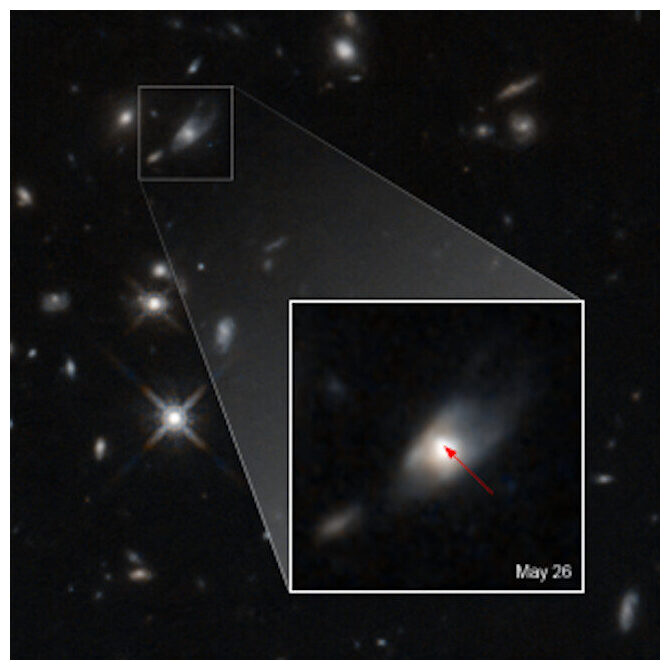
Discovery of a new nova in M31

A new M31 nova candidate was independently discovered on 2020 Oct. 21.741 (by K. Hornoch and H. Kucakova), on 2020 Oct. 21.92 UT (by A. Catapano, L. Izzo, E. Guido, A. Noschese, F. Coccia, L. D'Avino) and 2020 Oct. 22.550 UT (by M. Zhang and X. Gao) and designated as PNV J00423733+4120519 = AT2020xyv = M31N 2020-10e (ATel #14114). This possible nova was first reported on 2020 Oct. 22.56 by Zhang and Gao as a new source of G ~ 16.9 mag on CBAT "Transient Object Followup Reports" (TOCP PNV J00423733+4120519).

Spectroscopic observations of AT2020xyv (PNVJ00423733+4120519) were obtained with the 3.58m TNG telescope equipped with LRS at Observatorio del Roque de los Muchachos in La Palma (Spain) by L. Izzo et al. (ATel #14116). Observations started on October 24 at 01:12:54 UT and they consisted of three exposures of 600s each: "The combined spectrum (covering the range 3,500-8,000 AA, resolving power R = 585) shows bright emission lines of H-alpha and H-beta, the presence of O I 7773 and Fe II lines (multiplet 42 and blended multiplets 37 and 38). From the H-alpha profile, we measure an FWHM of ~4,000 km/s. H-alpha and H-beta lines show P-Cygni profiles (although not prominent) with a minimum at ~ -2,800 km/s. The spectrum is then consistent with a broad-line Fe IIb Classical Nova in M31".

On 2020 Oct. 22.6, we reported on the TOCP our independent discovery of this nova in M31 on a 180-s R-band CCD frame taken on 2020 Oct. 21.92 UT with the 0.5 m f/8 Ritchey Chretien + CCD FLI PL4240 at MPC Code L07 (Osservatorio Salvatore di Giacomo, Agerola, ITALY) at the following coordinates:

R.A. = 00 42 37.33, Decl.= +41 20 52.1 (equinox 2000.0; Gaia DR2).

Our discovery image (click on it for a bigger version):
New Nova in M31
© Remanzacco Blogspot

Blackbox

How deadly is covid-19? Not very!

child mask
September 2020 was the least deadly month in Swedish history, in terms of number of deaths per 100,000 population. Ever. And I don't mean the least deadly September, I mean the least deadly month. Ever. To me, this is pretty clear evidence of two things. First, that covid is not a very deadly disease. And second, that Sweden has herd immunity.


When I posted this information on my twitter feed, the response from proponents of further lockdown was that the reason September was such an un-deadly month, was because everyone has already died earlier in the pandemic. To me, that seems like a pretty self-defeating argument. Why?

Because 6,000 people have died of covid in Sweden, a country with a population of 10,000,000 people. 6,000 people is 0,06% of the population. If it is enough for that tiny a fraction of a population to die of a pandemic for the pandemic to peter out so completely that a country can have its least deadly month ever, then the pandemic was never that deadly to begin with.

In August, I wrote an article where I proposed that the mortality for covid is only 0,12%, roughly the same as influenza. That number was based on a back-of-the-envelope calculation. I figured that, since the death rate had dropped continuously for months and was at very low levels, Sweden must have reached a point where it had herd immunity. And I figured that at least 50% of the population must have been infected for herd immunity to have been reached. 50% of Sweden's population is five million people. 6,000 / 5,000,000 = 0,12%

At the beginning of October, one of the World Health Organisation's executive directors, Mike Ryan, said that the WHO estimated that 750 million people had so far been infected with covid. At that point, one million people had died of the disease. That gives a death rate for covid of 0,13% . So the WHO said that the death rate is 0,13% . Not too far off my earlier back-of-envelope estimation. This of course begs the question why there are continued lockdowns for a disease that is no worse than the flu.

Moon

NASA's SOFIA observatory discovers water spread out across Moon's sunlit surface

moonrise moon
© Reuters / Lucy Nicholson
The US space agency confirmed it has found indisputable proof of something that was previously considered impossible - "massive hydration" of the Moon's sunlit surface by water, that still only exists as separate molecules.

NASA announced that its latest study has helped to resolve the mystery of whether water exists on the Moon once and for all. It is not that claims about the discovery of water on Earth's natural satellite have never been made before but, until recently, the scientists were not entirely sure if it was really water they were talking about.

Now, thanks to the space agency's Stratospheric Observatory for Infrared Astronomy (SOFIA), this issue is finally clear. An infrared camera of SOFIA's telescope mounted on a modified Boeing 747SP aircraft has detected a specific wavelength unique to water molecules while surveying the Moon's surface. The study results were published in Nature Astronomy.

Comment: The moon is rusting and scientists are trying to figure out why


Info

New study says 'exosomes' can't be distinguished from viruses

Exosomes
© Anti-Aging and Wellness Medical
In the world of science, beliefs typically die a long, slow death. Such is the case with the germ theory, which really took off in the late 1800s.

At that time, the main proponents of the germ theory, including the Frenchman Louis Pasteur and the German Robert Koch, ardently believed that all the bacteria in living organisms, including human beings, were invaders from the outside. In other words, from our skin inward, we were sterile, except if we had been invaded by a pathogen. Today, 150 years later, this idea seems laughably incorrect and naïve.

Almost everyone now knows that trillions of bacteria live in and on every surface of our bodies. Some people have even attempted to demonstrate that most of our genetic material is bacterial rather than human in origin. We now have conclusive evidence that these trillions of bacteria living in us help digest our food, synthesize crucial nutrients, participate in detoxification functions, help regulate and control our emotions and, in some ways, participate in every normal human function. The early proponents of the germ theory were not only completely inaccurate in their conclusions about the role of bacteria in the human organism, but, more important, they established a framework that postulated that human beings were somehow separate from nature. This insidious and unscientific conclusion, which continues to the present time, has caused grave harm to all living systems.

In the case of viruses, a similar shift is just beginning to happen in the scientific community. The old paradigm about viruses is that we are essentially "virus-free" in our healthy, natural state, and the only viruses that are inside us must be pathogens that came from the outside. This belief was, of course, never proven; it was just stated as dogma, and it dovetailed nicely with the narrative of "nature is out to get us."