In September 2019, my colleague Anna Kapinska gave a presentation showing interesting objects she'd found while browsing our new radio astronomical data. She had started
noticing very weird shapes she couldn't fit easily to any known type of object.Among them, labelled by Anna as
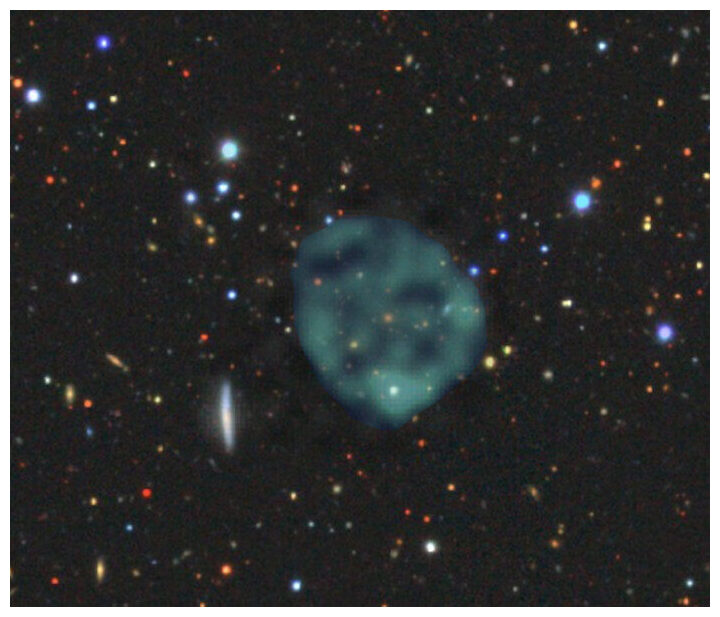
WTF?, was a picture of a ghostly circle of radio emission, hanging out in space like a cosmic smoke-ring.
None of us had ever seen anything like it before, and we had no idea what it was. A few days later, our colleague Emil Lenc found a second one, even more spooky than Anna's.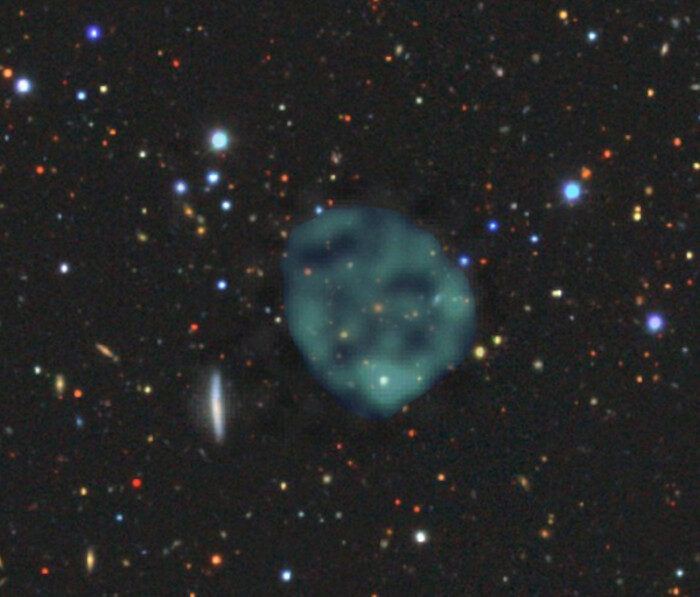
© Image by Bärbel Koribalski, based on ASKAP data, with the optical image from the [Dark Energy Survey](https://www.darkenergysurvey.org), Author providedThe ghostly ORC1 (blue/green fuzz), on a backdrop of the galaxies at optical wavelengths. There’s an orange galaxy at the centre of the ORC, but we don’t know whether it’s part of the ORC, or just a chance coincidence.
Anna and Emil had been examining the new images from our pilot observations for the
Evolutionary Map of the Universe (EMU) project, made with CSIRO's revolutionary new
Australian Square Kilometre Array Pathfinder (ASKAP) telescope.
EMU plans to boldly probe parts of the Universe where no telescope has gone before. It can do so because ASKAP can survey large swathes of the sky very quickly, probing to a depth previously only reached in tiny areas of sky, and being especially sensitive to faint, diffuse objects like these.
I predicted a
couple of years ago this exploration of the unknown would probably make unexpected discoveries, which I called WTFs. But none of us expected to discover something so unexpected, so quickly. Because of the enormous data volumes, I expected the discoveries would be made using machine learning. But these discoveries were made with good old-fashioned eyeballing.
















Comment: 'Superbolts' detected above atmosphere are over 1,000 times brighter than normal lightning