Science & TechnologyS


Rocket

FedEx requests FAA permission to add anti-missile laser system to cargo planes

radar images
© Unknown
FedEx is looking to add laser technology to some cargo planes that would counter incoming heat-seeking missiles.

The company asked for permission from the Federal Aviation Administration to equip some of its cargo planes with a missile defense system that would "emit infrared laser energy" outside of the aircraft as a "countermeasure against heat-seeking missiles," according to a public notice filed with the Federal Register. The filing states:
"In recent years, in several incidents abroad, civilian aircraft were fired upon by man-portable air defense systems (MANPADS). This has led several companies to design and adapt systems like a laser-based missile-defense system for installation on civilian aircraft."
One of FedEx's competitors, DHL, was the victim of such an incident in 2003 when one of its cargo jets was hit by a missile after taking off in Baghdad. The crew was unharmed, according to CNN.
Soldier with manpad
© USAF/TSgt MaylllSoldier with manpad

Comment: One such system, attached to the underside of the plane, uses lasers to confuse heat-seeking missiles:
airplane countermeasure device
© Elbit SystemsInfrared countermeasure device fitted to the underside of commercial aircraft is an option.
Infrared countermeasure device fitted to the underside of commercial aircraft is an option. Most airliner shootdowns are caused by man-portable air defence systems (MANPADS). According to the US Transportation Safety Administration, 40 civilian aircraft have been struck by MANPADS missiles since 1975, causing about 28 crashes and more than 800 deaths.
See also:


Info

Your gut senses the difference between real sugar and artificial sweetener

Sugar preference isn't just a matter of taste - it's deeper than that

A section of mouse intestines
© Borhoquez Lab, DukeA section of mouse intestines shows in green the relatively scarce neuropod cells in the epithelium that are responsible for communicating conditions inside the gut to the nervous system outside.
DURHAM, N.C. - Your taste buds may or may not be able to tell real sugar from a sugar substitute like Splenda, but there are cells in your intestines that can and do distinguish between the two sweet solutions. And they can communicate the difference to your brain in milliseconds.

Not long after the sweet taste receptor was identified in the mouths of mice 20 years ago, scientists attempted to knock those taste buds out. But they were surprised to find that mice could still somehow discern and prefer natural sugar to artificial sweetener, even without a sense of taste.

The answer to this riddle lies much further down in the digestive tract, at the upper end of the gut just after the stomach, according to research led by Diego Bohórquez, an associate professor of medicine and neurobiology in the Duke University School of Medicine.

In a paper appearing Jan. 13 in Nature Neuroscience, "we've identified the cells that make us eat sugar, and they are in the gut," Bohórquez said. Infusing sugar directly into the lower intestine or colon does not have the same effect. The sensing cells are in the upper reaches of the gut, he said.

Having discovered a gut cell called the neuropod cell, Bohórquez with his research team has been pursuing this cell's critical role as a connection between what's inside the gut and its influence in the brain. The gut, he argues, talks directly to the brain, changing our eating behavior. And in the long run, these findings may lead to entirely new ways to treat diseases.

Bizarro Earth

Word goes woke: Microsoft introduces politically correct feature that suggests alternatives for 'offensive' phrases like 'mankind'

Microsoft
© Mike Segar/Reuters
Microsoft has included a new function in the latest version of its Word software that acts as a checker for inclusivity and offers PC alternatives to phrases which could upset others.

Traditionally, Microsoft Word has offered tools to its 250million users such as checking software for spelling, punctuation and grammar.

But now, the tech giant has added an additional feature which reads through a user's work and examines whether the language used may offend an individual.

The Sun reports it does this by highlighting phrases focusing on gender, age, sexual orientation, ethnicity of 'socioeconomic status'.

Comment: Twitter user Kaya Masters makes an excellent point:


Laptop

Teenage hacker takes control of more than 20 Teslas through a flaw in third-party software

tesla electric car
© Reuters / Sarah MeysonnierTesla on the road
A 19-year-old hacker claims to have taken over more than 20 Tesla vehicles in 10 countries through a software vulnerability.

David Colombo, who is based in Germany, shared the feat on Twitter saying the fault does not fall on the Elon Musk-founded company, but on owners of the Teslas.

The flaw is said to have been found in third-party software that allowed Colombo to unlock doors and windows, start the cars without keys and disable security systems.

He also tweeted the vulnerability lets him use the internal Tesla cameras to spy on the driver.

Butterfly

Study of hydras indicates there was sleep before there were brains

hydra organism freshwater
© Proyecto Agua/FlickrHydra is a genus of small, fresh-water organisms of the phylum Cnidaria and class Hydrozoa.
Studies of sleep are usually neurological. But some of nature's simplest animals suggest that sleep evolved for metabolic reasons, long before brains even existed.

The hydra is a simple creature. Less than half an inch long, its tubular body has a foot at one end and a mouth at the other. The foot clings to a surface underwater — a plant or a rock, perhaps — and the mouth, ringed with tentacles, ensnares passing water fleas. It does not have a brain, or even much of a nervous system.

And yet, new research shows, it sleeps. Studies by a team in South Korea and Japan showed that the hydra periodically drops into a rest state that meets the essential criteria for sleep.

On the face of it, that might seem improbable. For more than a century, researchers who study sleep have looked for its purpose and structure in the brain. They have explored sleep's connections to memory and learning. They have numbered the neural circuits that push us down into oblivious slumber and pull us back out of it. They have recorded the telltale changes in brain waves that mark our passage through different stages of sleep and tried to understand what drives them. Mountains of research and people's daily experience attest to human sleep's connection to the brain.

Eye 1

Sheldrake vindicated. The Morphogenic Field is real and scientists show how to use it to understand nature

Shell Spiral
© Unknown
In a new study, Chris Jeynes and Michael Parker pose the question: How does nature produce such stunning symmetry and order in many systems observed across enormous scales? Under the microscope, a snowflake shows intricate patterning and remarkable symmetry, and in a telescope the same is observed for spiral galaxies up to half a million light years across.

Both of these systems are made of innumerable subunits (be they water molecules or stars and planets) which should behave completely oblivious to the overall configuration of the conglomerate. That is to say, the behavior of these systems at the scales that matter — the fundamental units of which they are composed — should be completely random aside from some formative causation arising from intermolecular or inter-gravitational interactions, which are not long-range.

Info

Newly discovered type of 'strange metal' could lead to deep insights

A new discovery could help scientists to understand "strange metals," a class of materials that are related to high-temperature superconductors and share fundamental quantum attributes with black holes.
Strange Metal
© Brown UniversityUsing a material called yttrium barium copper oxide arrayed with tiny holes, researchers have discovered "strange metal" behavior in a type of system where charge carriers are bosons, something that's never been seen before.
Providence, R.I. [Brown University] — Scientists understand quite well how temperature affects electrical conductance in most everyday metals like copper or silver. But in recent years, researchers have turned their attention to a class of materials that do not seem to follow the traditional electrical rules. Understanding these so-called "strange metals" could provide fundamental insights into the quantum world, and potentially help scientists understand strange phenomena like high-temperature superconductivity.

Now, a research team co-led by a Brown University physicist has added a new discovery to the strange metal mix. In research published in the journal Nature, the team found strange metal behavior in a material in which electrical charge is carried not by electrons, but by more "wave-like" entities called Cooper pairs.

While electrons belong to a class of particles called fermions, Cooper pairs act as bosons, which follow very different rules from fermions. This is the first time strange metal behavior has been seen in a bosonic system, and researchers are hopeful that the discovery might be helpful in finding an explanation for how strange metals work — something that has eluded scientists for decades.

"We have these two fundamentally different types of particles whose behaviors converge around a mystery," said Jim Valles, a professor of physics at Brown and the study's corresponding author. "What this says is that any theory to explain strange metal behavior can't be specific to either type of particle. It needs to be more fundamental than that."

Cassiopaea

Solar Cycle 25 sunspot count exceeds expectations for 15 straight months - NOAA

New sunspot counts from NOAA confirm that the young solar cycle is outperforming the official forecast. You are here:
sunspot count solar cycle 25
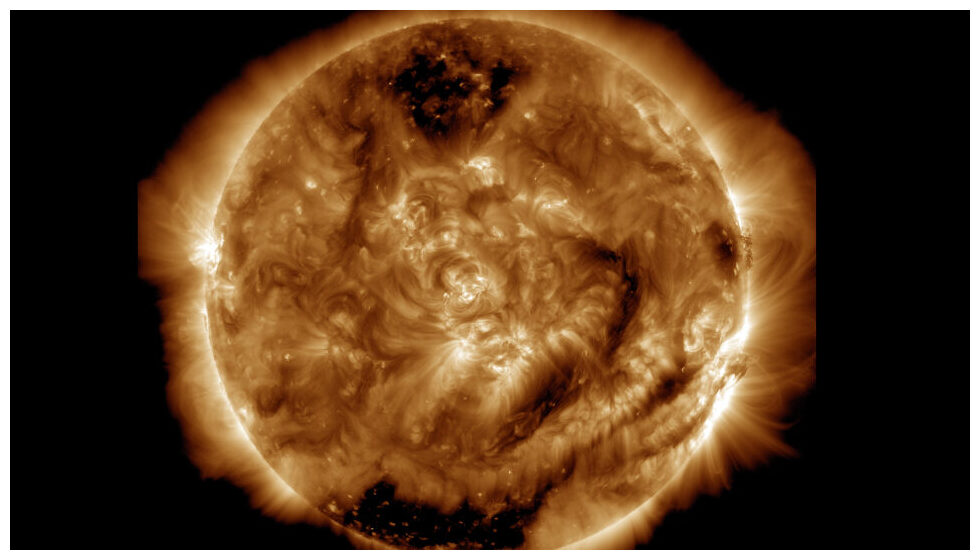
Sunspot counts have exceeded predictions for 15 straight months. The monthly value at the end of December 2021 was more than twice the forecast, and the highest in more than 5 years.

The "official forecast" comes from the Solar Cycle Prediction Panel representing NOAA, NASA and International Space Environmental Services (ISES). Using a variety of leading indicators, the Panel predicted that Solar Cycle 25 would peak in July 2025 as a relatively weak cycle, similar in magnitude to its predecessor Solar Cycle 24. Instead, Solar Cycle 25 is shaping up to be stronger.

Sky watchers have already noticed the change. "We are definitely seeing the effects on the ground in the Arctic!" reports Chad Blakley of the Swedish tour guide service Lights over Lapland. "Auroras now are the best in years."

Comment: On our planet we've seen a rise in unusual phenomena, extreme weather and increasingly erratic seasons, meanwhile an uptick in unusual activity has also been documented occurring in our solar system, and beyond: Also check out SOTT radio's:


Yoda

Premature rejection in science: The case of the Younger Dryas Impact Hypothesis

james powell geology younger dryas cometary impact
Dr. James Lawrence Powell
James Lawrence Powell publishes masterful takedown of the YD impact deniers

Dr. James Powell published an extraordinary review paper this week revealing and carefully detailing the premature (and pathological imho) rejection of the YDIH. When combined with Martin Sweatman's work from earlier this year, the whole sorry story of the unprofessional knee jerk opposition to the theory has finally been told. And what a wonderful and welcome documentarian we have in Powell. While "eminent" is an overused describing scientists, here the word is appropriate. Unlike the critics, James Lawrence Powell is not a press release scientist:
From Simon Shuster:

James Lawrence Powell graduated from Berea College with a degree in geology. He earned a PhD in geochemistry from the Massachusetts Institute of Technology and has several honorary degrees, including Doctor of Science degrees from Berea College and from Oberlin College. He taught geology at Oberlin College for over twenty years and served as Acting President of Oberlin, President of Franklin and Marshall College, President of Reed College, President of the Franklin Institute Science Museum in Philadelphia, and President and Director of the Los Angeles County Museum of Natural History. President Reagan and later, President George H. W. Bush, appointed him to the National Science Board, where he served for twelve years. Asteroid 1987 SH7 is named for him. In 2015, he was elected a Fellow of the Committee for Skeptical Inquiry (CSI).

Comment:


Info

Chemists use DNA to build the world's tiniest antenna

Developed at Université de Montréal, the easy-to-use device promises to help scientists better understand natural and human-designed nanotechnologies - and identify new drugs.

NanoAntenna
© CAITLIN MONNEYLike a two-way radio that can both receive and transmit radio waves, the fluorescent nanoantenna designed by Alexis Vallée-Bélisle and his team receives light in one colour and depending on the protein movement it senses, then transmits light back in another colour, which we can detect. One of the main innovations of these nanoantennas is that the receiver part of the antenna (bright green) is also employed to sense the molecular surface of the protein studied via molecular interaction.
Researchers at Université de Montréal have created a nanoantenna to monitor the motions of proteins.

Reported this week in Nature Methods, the device is a new method to monitor the structural change of proteins over time - and may go a long way to helping scientists better understand natural and human-designed nanotechnologies.

"The results are so exciting that we are currently working on setting up a start-up company to commercialize and make this nanoantenna available to most researchers and the pharmaceutical industry," said UdeM chemistry professor Alexis Vallée-Bélisle, the study's senior author.