Science & TechnologyS


Galaxy

Monster black hole spotted on dwarf galaxy 'giving birth' to stars

black hole star formation Henize 2-10
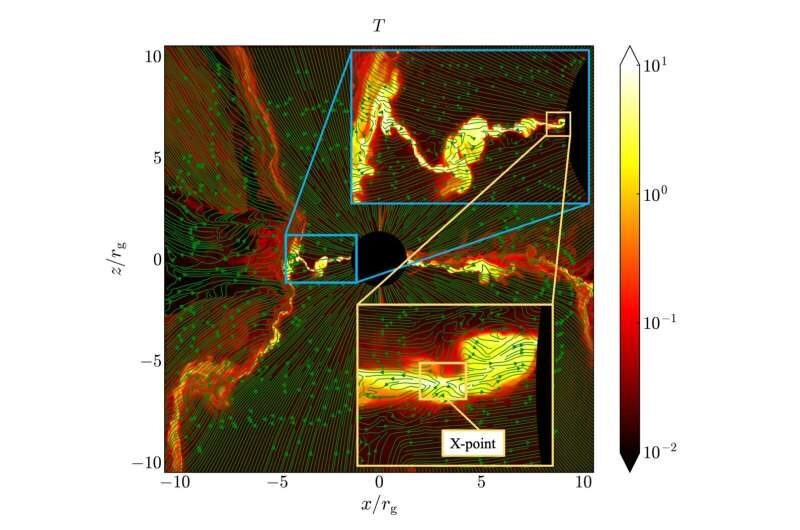
© NASA/ESA/Zachary Schutte/Amy ReinesA Hubble Space Telescope image shows the Henize 2-10 galaxy, with a hidden supermassive black hole at its centre. A pullout of the central region of dwarf starburst galaxy Henize 2-10 traces an outflow, or bridge of hot gas 230 light-years long, connecting the galaxy's massive black hole and a star-forming region
The Hubble telescope just spotted a 500-light-year-long 'umbilical cord' for baby stars

A black hole has been spotted 'giving birth' to stars in a nearby dwarf galaxy - suggesting the voids aren't as violent as previously thought, NASA has revealed.

Black holes are often described as 'destructive monsters' because they tear apart stars, consuming anything that comes too close, and hold light captive. But new evidence from NASA's Hubble Space Telescope shows a black hole at the heart of the dwarf galaxy Henize 2-10 that's creating stars, not gobbling them up.

Info

'Strange history' of photons challenges our understanding of quantum interactions

Photons and Atoms
© iStock/MickeyCZStraight on through: atoms can be excited by photons that do not appear to interact with the medium
A surprising property of how resonant photons interact with an absorbing medium has been uncovered by physicists in Canada. They say they have found that even photons passing straight through the medium energize atoms within it, causing atoms to spend nearly as much time in their excited states as those that have absorbed photons. They see their result as a challenge to theorists trying to describe how light interacts with matter quantum mechanically.

Aephraim Steinberg and colleagues at the University of Toronto made the discovery while investigating what happens to a beam of photons passing through a cloud of atoms when the photons' frequency is equal to that of one of the atomic transitions. Intuitively, they say, it would be expected that those photons exciting atoms within the cloud would be absorbed and then at best re-emitted in a random direction. As such, the flux of photons coming from excited atoms that are detected in the forward direction would be miniscule.

Indeed, they point out, this idea that only absorbed, or "lost", photons contribute to the excitation springs naturally from theory that tells us the total time atoms spend in the excited state is directly proportional to the number of photons that are lost.

Laptop

Quantum computing in silicon hits 99 per cent accuracy

UNSW team
© UNSW/Kearon de ClouetThe UNSW team: Dr Asaad Serwan, Prof. Andrea Morello and Dr Mateusz Madzik.
Australian researchers have proven that near error-free quantum computing is possible, paving the way to build silicon-based quantum devices compatible with current semiconductor manufacturing technology.

"Today's publication shows our operations were 99 per cent error-free," says Professor Andrea Morello of UNSW, who led the work with partners in the US, Japan, Egypt, and at UTS and the University of Melbourne.

"When the errors are so rare, it becomes possible to detect them and correct them when they occur. This shows that it is possible to build quantum computers that have enough scale, and enough power, to handle meaningful computation."

The team's goal is building what's called a 'universal quantum computer' that won't be specific to any one application.

"This piece of research is an important milestone on the journey that will get us there," Prof. Morello says.

Microscope 2

Tech bros propose replacing women with 'synthetic wombs'

Pregnant woman
© Getty Images / JGI; Tom Grill
Taking away the responsibility of pregnancy from women could result in less wealth inequality by gender, one billionaire argued.

Several prominent tech entrepreneurs discussed the possibility of replacing natural birth with synthetic wombs, arguing that such technology would remove the "burden" of pregnancy and allow women to work more.

After Tesla and SpaceX CEO Elon Musk warned on Tuesday that society "should be much more worried about population collapse," Musk's fellow tech leaders came up with one solution for declining birth rates.
"We should be investing in technology that makes having kids much faster/easier/cheaper/more accessible... Synthetic wombs, etc," proposed Sahil Lavingia, the founder of digital product trading platform Gumroad.

Comment: This idea will contribute even more to dehumanisation of the humanity. Children needs the love and connection with their parents. It plays a very important role in their development.

This will indeed create a Matrix like dystopian society of robotized and emotionless population. A free army of slaves for the PTB that can be even more controllable.

See also:


Beaker

Genetic risk factor found for risk of smell and taste loss from Covid-19

man smelling flowers
Six months after contracting Covid, as many as 1.6 million people in the U.S. are still unable to smell or have experienced changes in their ability to smell.

Scientists are piecing together why some people lose their sense of smell after contracting Covid-19.

A study published Monday in the journal Nature Genetics identified a genetic risk factor associated with the loss of smell after a Covid infection, a discovery that brings experts closer to understanding the perplexing pattern and may point the way toward much-needed treatments.

Six months after contracting Covid, as many as 1.6 million people in the United States are still unable to smell or have experienced a change in their ability to smell. The precise cause of sensory loss related to Covid is not known, but scientists do think it stems from damage to infected cells in a part of the nose called the olfactory epithelium. These cells protect olfactory neurons, which help humans smell.

Robot

Chinese scientists develop electronic skin with haptic feedback

Diagrams
© UnknownDiagrams of skin patch with haptic feedback
Researchers in China developed a wireless flexible skin patch that enables the exchange of tactile stimuli between a human operator and a robot.

Crafted by a team of scientists from City University of Hong Kong, Dalian University of Technology, Tsinghua University, and the University of Electronic Science and Technology of China, the device is sensitive enough to capture movement and stress factors, for instance twisting and turning.

Engineers have been developing robots that can be controlled remotely by a human operator, but, as the researchers note, most such systems are bulky and difficult to control. They also generally provide little feedback other than a video stream. In this new effort, the researchers in China sought to develop a more user-friendly system. To that end, they created what they call an electronic skin — a flexible skin patch that can be applied to the skin of a human controller that captures both movement and stress factors such as twisting and turning, TechXplore reported.

Car Black

Bill would give US government 'kill switch' in all new cars

LA traffic
© RB/Bauer-Griffin via Getty Images
A piece of legislation that was quietly included in the infrastructure bill signed by Biden would give the U.S. government access to a 'kill switch' linked to law enforcement in all new vehicles from 2026.

Under a section in the bill that talks about 'impaired driving technology', the new system would "passively monitor the performance of a motor vehicle to accurately identify whether that driver may be impaired."

If a blood alcohol level above the limit is detected, the system would "prevent or limit motor vehicle operation."

Comment: Sure, hackers are an issue, but so is the idea that government agencies including the police would have remote access to your car. Do we really want the police to have that level of control over your movements?


Attention

Earth's interior is cooling faster than expected

Researchers at ETH Zurich have demonstrated in the lab how well a mineral common at the boundary between the Earth's core and mantle conducts heat. This leads them to suspect that the Earth's heat may dissipate sooner than previously thought.
Earth's Interior
The evolution of our Earth is the story of its cooling: 4.5 billion years ago, extreme temperatures prevailed on the surface of the young Earth, and it was covered by a deep ocean of magma. Over millions of years, the planet's surface cooled to form a brittle crust. However, the enormous thermal energy emanating from the Earth's interior set dynamic processes in motion, such as mantle convection, plate tectonics and volcanism.

Still unanswered, though, are the questions of how fast the Earth cooled and how long it might take for this ongoing cooling to bring the aforementioned heat-​driven processes to a halt.

One possible answer may lie in the thermal conductivity of the minerals that form the boundary between the Earth's core and mantle.

Rose

Intelligent design at work? Plant biologist finds "mutation is very non-random"

Arabidopsis thaliana
© Marie-Lan Nguyen / Wikimedia Commons / CC-BY 2.5.Arabidopsis thaliana, the thale cress, mouse-ear cress or arabidopsis, is a small flowering plant native to Eurasia and Africa
Many people I know in the ID community are strongly interested in rethinking mutation, understanding it as a designed or regulated process. They will be encouraged by a new open-access paper in Nature, concerning the characteristics of mutations in a widely studied plant species. See, "Mutation bias reflects natural selection in Arabidopsis thaliana."

For considering the implications of the paper, an easy place to start is a Science Daily news story, "Study challenges evolutionary theory that DNA mutations are random." Paragraphs such as this make me smile, on this cold January afternoon in Chicago (my emphasis):
"We always thought of mutation as basically random across the genome," said Grey Monroe, an assistant professor in the UC Davis Department of Plant Sciences who is lead author on the paper. "It turns out that mutation is very non-random and it's non-random in a way that benefits the plant. It's a totally new way of thinking about mutation."

Comment: Its small size, quick growth and relatively simple genome makes Arabidopsis one of the most powerful tools available to plant scientists. It is the plant research world's equivalent of the mouse.


Star

1,000-light-year wide bubble surrounding Earth is source of all nearby, young stars

Illustration bubble
© unknownArtist's illustration of the Local Bubble with star formation occurring on the bubble's surface.
The Earth sits in a 1,000-light-year-wide void surrounded by thousands of young stars — but how did those stars form?

In a paper appearing Wednesday in Nature, astronomers at the Center for Astrophysics | Harvard & Smithsonian (CfA) and the Space Telescope Science Institute (STScI) reconstruct the evolutionary history of our galactic neighborhood, showing how a chain of events beginning 14 million years ago led to the creation of a vast bubble that's responsible for the formation of all nearby, young stars.

"This is really an origin story; for the first time we can explain how all nearby star formation began," says astronomer and data visualization expert Catherine Zucker who completed the work during a fellowship at the CfA.