Science & TechnologyS


Comet

'Christmas' comet E3 ZTF to become visible to the unaided eye

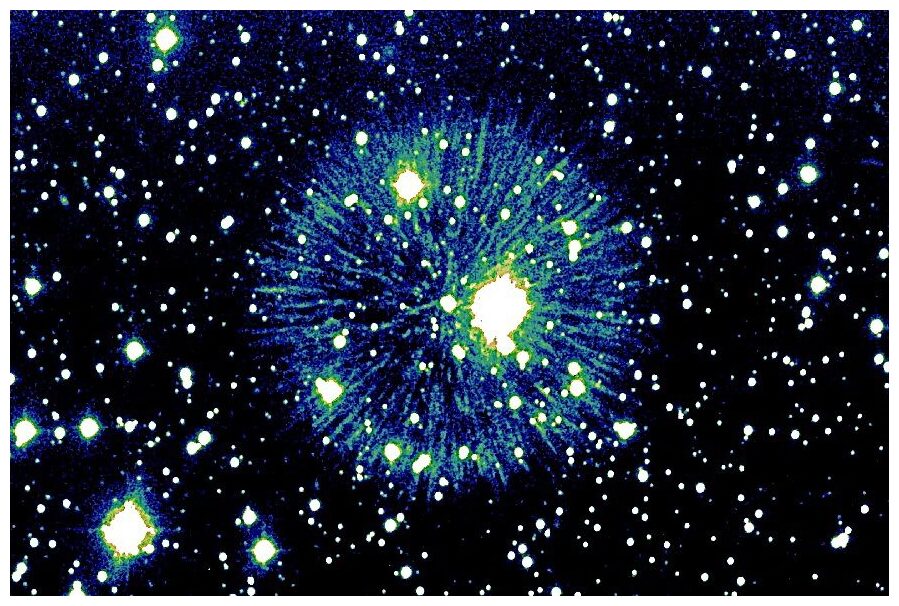
Comet C/2022 E3 ZTF
© Michael JaegerComet C/2022 E3 ZTF
Taken by Michael Jaeger on December 22, 2022 @ Jauerling, Austria
If it's not too late, ask for a telescope for Christmas. Comet ZTF (C/2022 E3) is approaching Earth for a close encounter next month, and it already looks great. Michael Jaeger of Martinsberg, Austria, photographed the two-tailed interplanetary snowball on Dec. 22nd.

"This comet has become an exciting object," says Jaeger, "Although it will not reach maximum brightness until late January or February, it already shows two tails and a bright green atmosphere."

Discovered in March 2022 by the Zwicky Transient Facility, Comet ZTF is falling in from the outer solar system. Perihelion (closest approach to the sun) will occur on Jan. 12, 2023, at a distance of 1.11 AU. Closest approach to Earth follows on Feb. 1, 2023, at a distance of 0.28 AU. Between those two dates, the comet could hit magnitude 5 or 6, technically visible to the unaided eye.

Comment: See also:


Snowflake

Beautiful: The highest resolution photos ever taken of snowflakes

high resolution photograph snowflakes
© Nathan Myhrvold / Modernist Cuisine Gallery, LLC"Yellowknife Flurry," a photograph by Nathan Myhrvold, captures the intricate structure of snowflakes.
Photographer and scientist Nathan Myhrvold has developed a camera that captures snowflakes at a microscopic level never seen before

The first chill of a winter storm is enough to send most people indoors, but not Nathan Myhrvold. The colder the weather, the better his chances are of capturing a microscopic photograph of a snowflake. Now, nearly two years in the making, Myhrvold has developed what he bills as the "highest resolution snowflake camera in the world." Recently, he released a series of images taken using his creation, a prototype that captures snowflakes at a microscopic level never seen before.

Myhrvold, who holds a PhD in theoretical mathematics and physics from Princeton University and served as the Chief Technology Officer at Microsoft for 14 years, leaned on his background as a scientist to create the camera. He also tapped into his experience as a photographer, most notably as the founder of Modernist Cuisine, a food innovation lab known for its high-resolution photographs of various food stuffs published into a five-volume book of photography of the same name that focuses on the art and science of cooking. Myhrvold first got the idea to photograph snowflakes 15 years ago after meeting Kenneth Libbrecht, a California Institute of Technology professor who happened to be studying the physics of snowflakes.

Magnify

Scientists achieve a breakthrough in nuclear fusion

National Ignition Facility at California's Lawrence Livermore National Laboratory
© Damien Jemison, Lawrence Livermore National LabratoryThe fusion record was achieved at the National Ignition Facility at California's Lawrence Livermore National Laboratory, which ignites fusion fuel with an array of 192 lasers. These lasers reach high energies thanks in part to devices called preamplifiers (seen here).
A U.S. lab has successfully sparked a fusion reaction that released more energy than went into it. But there's still a long way to go toward fusion as a clean energy source.

For more than 60 years, scientists have pursued one of the toughest physics challenges ever conceived: harnessing nuclear fusion, the power source of the stars, to generate abundant clean energy here on Earth. Today, researchers announced a milestone in this effort. For the first time, a fusion reactor has produced more energy than was used to trigger the reaction.

On December 5, an array of lasers at the National Ignition Facility (NIF), part of the Lawrence Livermore National Laboratory in California, fired 2.05 megajoules of energy at a tiny cylinder holding a pellet of frozen deuterium and tritium, heavier forms of hydrogen. The pellet compressed and generated temperatures and pressures intense enough to cause the hydrogen inside it to fuse. In a tiny blaze lasting less than a billionth of a second, the fusing atomic nuclei released 3.15 megajoules of energy — about 50 percent more than had been used to heat the pellet.

Comment: See also:


Mars

NASA Mars lander InSight falls silent after 4 years

Mars Lander
© NASANASA's InSite Lander
It could be the end of the red dusty line for NASA's InSight lander, which has fallen silent after four years on Mars.

The lander's power levels have been dwindling for months because of all the dust coating its solar panels. Ground controllers at California's Jet Propulsion Laboratory knew the end was near, but NASA reported that InSight unexpectedly didn't respond to communications from Earth on Sunday.

"It's assumed InSight may have reached the end of its operations," NASA said late Monday, adding that its last communication was Thursday. "It's unknown what prompted the change in its energy."

The team will keep trying to contact InSight, just in case.

InSight landed on Mars in 2018 and was the first spacecraft to document a marsquake. It detected more than 1,300 marsquakes with its French-built seismometer, including several caused by meteoroid strikes. The most recent marsquake sensed by InSight, earlier this year, left the ground shaking for at least six hours, according to NASA. The seismometer readings shed light on Mars' interior.

Comet

Comet impacts could bring ingredients for life to Europa's ocean

Jupiter's moon Europa
© NASA/JPL-CaltechAn artist's concept of a comet or asteroid impact on Jupiter's moon Europa.
Comet strikes on Jupiter's moon Europa could help transport critical ingredients for life found on the moon's surface to its hidden ocean of liquid water — even if the impacts don't punch completely through the moon's icy shell.

The discovery comes from a study led by researchers at The University of Texas at Austin, where researchers developed a computer model to observe what happens after a comet or asteroid strikes the ice shell, which is estimated to be tens of kilometers thick.

The model shows that if an impact can make it at least halfway through the moon's ice shell, the heated meltwater it generates will sink through the rest of the ice, bringing oxidants — a class of chemicals required for life — from the surface to the ocean, where they could help sustain any potential life in the sheltered waters.

The researchers compared the steady sinking of the massive melt chamber to a foundering ship.

"Once you get enough water, you're just going to sink," said lead author and doctoral student Evan Carnahan. "It's like the Titanic times 10."

Water

Using machine learning to better understand how water behaves

Water Molecules
© Georgia Institute of TechnologyMolecular simulation results showing how water molecules move and structure around one another in the high density liquid phase.
Water has puzzled scientists for decades. For the last 30 years or so, they have theorized that when cooled down to a very low temperature like -100C, water might be able to separate into two liquid phases of different densities. Like oil and water, these phases don't mix and may help explain some of water's other strange behavior, like how it becomes less dense as it cools.

It's almost impossible to study this phenomenon in a lab, though, because water crystallizes into ice so quickly at such low temperatures. Now, new research from the Georgia Institute of Technology uses machine learning models to better understand water's phase changes, opening more avenues for a better theoretical understanding of various substances. With this technique, the researchers found strong computational evidence in support of water's liquid-liquid transition that can be applied to real-world systems that use water to operate.

"We are doing this with very detailed quantum chemistry calculations that are trying to be as close as possible to the real physics and physical chemistry of water," said Thomas Gartner, an assistant professor in the School of Chemical and Biomolecular Engineering at Georgia Tech. "This is the first time anyone has been able to study this transition with this level of accuracy."

The research was presented in the paper, "Liquid-Liquid Transition in Water From First Principles," in the journal Physical Review Letters, with co-authors from Princeton University.

Better Earth

A new type of bottlenose dolphin has evolved in the Pacific Ocean

new sub-species dolphinTursiops truncatus nuuanu
© NOAA/NMFS/SWFSCThe new common bottlenose dolphin subspecies, known as the Eastern Tropical Pacific bottlenose dolphin (Tursiops truncatus nuuanu). This subspecies is smaller than other common bottlenose dolphins.
A new subspecies of common bottlenose dolphin found only in the tropical regions of the eastern Pacific Ocean has been identified by researchers.

An analysis of several specimens conducted by Ana Costa — a marine researcher with the Rosenstiel School of Marine, Atmospheric, and Earth Science at the University of Miami — and colleagues found that the new subspecies is smaller than other common bottlenose dolphins.

In a study published in the Journal of Mammalian Evolution, the scientists named the new subspecies the Eastern Tropical Pacific (ETP) bottlenose dolphin, or Tursiops truncatus nuuanu in scientific terms.

Common bottlenose dolphins are found in temperate, subtropical, and tropical oceans around the world, with the global population estimated to number around 600,000 individuals.

Arrow Down

Fusion works, but uses a supernova budget to make a mini sun for a fraction of a second

Solar Flare
© NASA’s Solar Dynamics Observatory (SDO)Eruption of a solar flare by NASA’s Solar Dynamics Observatory (SDO). Enhanced by rawpixel.
Fusion reactors will one day be the ultimate in "free energy", but judging by the latest news of holy grail moments, it won't be soon. The bonanza of energy that everyone wants was never going to come by catching photons from the sun with a million square kilometer PV net, but from recreating the source of those photons here on Earth. It's the energy released if we can smack two atoms together and make them fuse which requires extreme temperatures and pressures (a bit like the sun) and do it efficiently, reliably, and millions of times a day.

In the latest nuclear news round, the mini sun experiment at the Lawrence Livermore National Laboratory California gave back slightly more energy than was directly put in, which seems very exciting, but systemic total costs and energy used to "make this moment" happen are in a Supernova category all by themselves.
UPDATE: Just after publishing this blog post, news came out of a newer experiment just ten days ago:

The US's National Ignition Facility (NIF) has announced it successfully used a 192-beam laser to turn a tiny amount of hydrogen into enough energy to power about 15 - 20 kettles. This means that - for the first time - scientists were able to generate more power than the lasers put in to the experiment. — BBC

On Dec. 5, 2022, the National Ignition Facility shot a pellet of fuel with 2 million joules of laser energy - about the amount of power it takes to run a hair dryer for 15 minutes - all contained within a few billionths of a second. This triggered a fusion reaction that released 3 million joules. That is a gain of about 1.5, smashing the previous record of a gain of 0.7 achieved by the facility in August 2021. — The Conversation

The newer numbers are slightly better than the ones released last week. This is the same lab. The energy gain appears to have improved from 20% to 50%.

Better Earth

Giant arthropods dominated the seas 470 million years ago, fossil site reveals

anthropod fossil
© Emmanuel MartinFossils from the Fezouata Shale. From left to right, a non-mineralized arthropod (Marrellomorpha), a palaeoscolecid worm and a trilobites.
Discoveries at a major new fossil site in Morocco suggest giant arthropods — relatives of modern creatures including shrimps, insects and spiders — dominated the seas 470 million years ago.

Early evidence from the site at Taichoute, once undersea but now a desert, records numerous large "free-swimming" arthropods.

More research is needed to analyse these fragments, but based on previously described specimens, the giant arthropods could be up to 2m long.

Comment: See also: Loss of ecological niche caused downfall of dinosaurs following asteroid impact, new study claims


Black Magic

EctoLife Artificial Womb Facility: if they get the opportunity, they will transform our society into a dystopian hellscape

The EctoLife Artificial Womb Facility
If the elite get their way, our world will eventually look far more bizarre than any science fiction author ever imagined. If you haven't figured it out by now, the elite are control freaks, and they are envisioning a future in which they are in control of all of our lives from birth to death. Instead of being born and raised the traditional way, humans will be mass produced in "birthing pods". Those that are genetically superior will be permitted to live, while those that are genetically inferior will be "harvested" and any spare parts that are not of value for scientific research will be discarded. As children grow, education will be a top priority, but only material specifically approved by the elite will be permitted. In fact, "free thought" and "free speech" will be a thing of the past if the elite get total control. Everyone will think the same way, because no other alternative will be allowed. And anyone that shows signs of rebellion will quickly have their digital currency privileges revoked. I know that all of this may sound quite strange to many of you, but this is what our society will look like if the wildest hopes and dreams of the elite actually come to fruition.

This week, an incredibly creepy concept video that was created by a German molecular biologist named Hashem Al-Ghaili is making headlines all over the globe.

In this video, children are grown in a huge facility that contains hundreds of transparent "birthing pods"...

Comment: Like so much else that is transhumanist in nature, we are being sold on the promise that technology will make our lives and our selves better for it - when, upon closer inspection, we learn that innovations of this "nature" are in fact anti-human - and ultimately tools of control.

Thsi story reminds us all too well of another prescient vision of dystopia: