Science & TechnologyS


Comet 2

Possible naked-eye comet will visit Earth for first time in 50,000-years

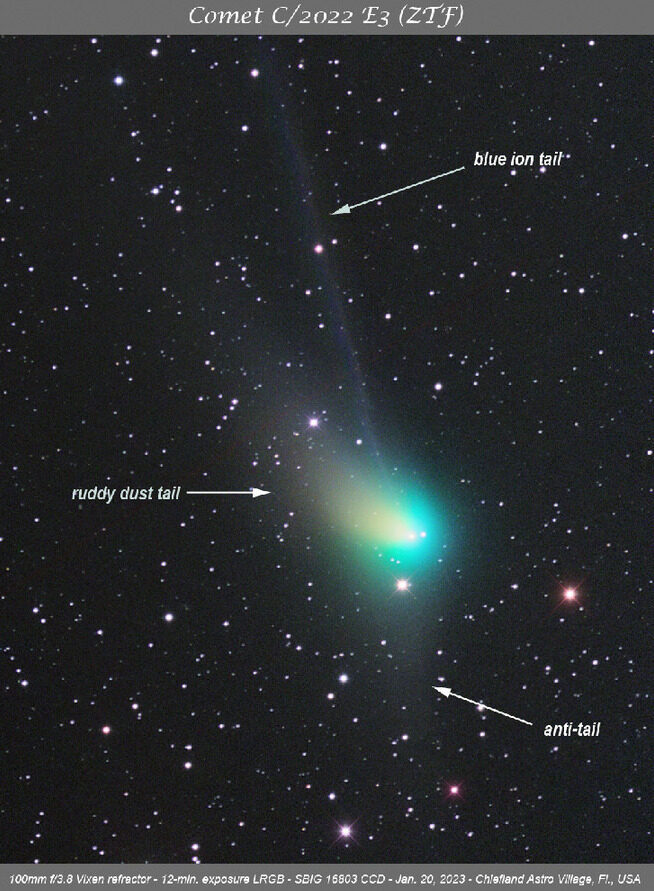
The comet C/2022 E3 (ZTF) could be bright enough to be spotted with the naked eye as it passes the sun and Earth at the end of the first month of 2023.
Comet C/2022 E3 (ZTF)
© Hisayoshi Sato via NASA/JPL-CaltechAn image of the Comet C/2022 E3 (ZTF) taken by astrophotographer Hisayoshi Sato as seen in a still image from a NASA video.
At the start of 2023 Earth will be visited by a newly discovered comet that may just be bright enough to be spotted with the naked eye.

The comet, named C/2022 E3 (ZTF), is currently passing through the inner solar system. It will make its closest approach to the sun, or perihelion, on Jan. 12, and will then whip past Earth making its closest passage of our planet, its perigee, between Feb. 1 and Feb. 2.

If the comet continues to brighten as it currently is, it could be visible in dark skies with the naked eye. This is difficult to predict for comets, but even if C/2022 E3 (ZTF) does fade it should still be visible with binoculars or a telescope for a number of days around its close approach.

According to NASA, observers in the Northern Hemisphere will be able to find the comet in the morning sky, as it moves in the direction of the northwest during January. C/2022 E3 (ZTF) will become visible for observers in the Southern Hemisphere in early February 2023.

Arrow Up

Newfound kind of supernova can tear apart a planet's atmosphere

Exoplanet
© titoOnz via Getty ImagesAn artist's depiction of an exoplanet.
Supernovas are bad news. They can wreck biospheres and flood planets with deadly radiation. And now, a recent study has added a new potential threat: a special type of supernova that can destroy a planet's ozone layer years after the initial explosion.

When giant stars die in massive explosions called supernovas, they temporarily become some of the most luminous objects in the universe. A single supernova can outshine the combined light of hundreds of billions of stars.

To give you some perspective, the nearby star Betelgeuse is going to explode any day now. (That's an astronomical "any day," meaning sometime within the next few million years.) Even though the star is over 600 light-years from us, when it goes supernova, it will be the brightest object in our sky, second only to the sun. Betelgeuse will be visible during the day, shining brighter than a full moon. For a few weeks, during the peak of the blast, it will be so bright that it will cast shadows in the middle of the night.

Despite the fearsome brightness, the visible light portion of a supernova represents only a tiny fraction of all the energy output. And besides, while intense amounts of visible light may cause blindness, it doesn't have a lot of other serious effects. What's more worrisome is the high-energy radiation associated with the supernova, usually in the form of X-rays and gamma-rays.

Snowflake Cold

W. Hudson Bay polar bear population decline stories are unethical and ignore critical caveats

Polar Bear Population
© Unknown
From Polar Bear Science

Dr. Susan Crockford

Canadian government scientists created headline news worldwide last week when they told the media that Western Hudson Bay polar bear numbers appeared to have declined by 27% between 2017 and 2021, based on a survey report that has not been made public. This is called 'science by press release'. Its practice is rightfully considered unethical, as it is usually associated with "people promoting scientific 'findings' of questionable scientific merit who turn to the media for attention when they are unlikely to win the approval of the professional scientific community."

Info

Spontaneous baby movements have purpose

Seemingly random movements in newborns are important for development of coordinated sensorimotor system.
Spontaneous movements.
© 2022 Kanazawa et al.Spontaneous movements. The markers for the motion capture camera were gently applied to the baby’s limbs and head and belly, enabling the team to capture the full range of movement.
Spontaneous, random baby movements aid development of their sensorimotor system, according to new research led by the University of Tokyo. Detailed motion capture of newborns and infants was combined with a musculoskeletal computer model, to enable researchers to analyze communication among muscles and sensation across the whole body. Researchers found patterns of muscle interaction developing based on the babies' random exploratory behavior, that would later enable them to perform sequential movements as infants. Better understanding how our sensorimotor system develops could help us gain insight into the origin of human movement as well as earlier diagnosis of developmental disorders.

If you've spent time with a baby, you'll probably have noticed that they hardly keep still. Right from birth — and even in the womb — babies start to kick, wiggle and move seemingly without aim or external stimulation. These are called "spontaneous movements" and researchers believe that they have an important role to play in the development of the sensorimotor system, i.e., our ability to control our muscles, movement and coordination. If we can better understand these seemingly random movements and how they are involved in early human development, we might also be able to identify early indicators for certain developmental disorders, such as cerebral palsy.

Currently, there is limited knowledge about how newborns and infants learn to move their body. "Previous research into sensorimotor development has focused on kinematic properties, muscle activities which cause movement in a joint or a part of the body," said Project Assistant Professor Hoshinori Kanazawa from the Graduate School of Information Science and Technology. "However, our study focused on muscle activity and sensory input signals for the whole body. By combining a musculoskeletal model and neuroscientific method, we found that spontaneous movements, which seem to have no explicit task or purpose, contribute to coordinated sensorimotor development."

Telescope

Stunning photo shows every visible planet in the solar system lining up across the night sky

all planets in sky
© Dr Gianluca MasiDr Gianluca Masi took the image from the roof of the building where he lives last night, using a camera with special lenses. It shows Venus, Mercury, Saturn, Jupiter, Mars and the Moon
Stargazers have been capturing some spectacular images of a rare astronomical event that means every planet in the solar system is visible in the night sky at the same time.

Mercury, Venus, Mars, Jupiter and Saturn can all be seen with the naked eye, while Uranus and Neptune are possible to spot with binoculars or a telescope.

Astronomer Dr Gianluca Masi shared a picture he took of the five planets that could be seen with the naked eye, while other skywatchers across the world also captured images of the 'planet parade'. He took it from the roof of a building in Rome, Italy last night, using a camera with special lenses.

Info

40-year study finds mysterious patterns in temperatures at Jupiter

Scientists have completed the longest-ever study tracking temperatures in Jupiter's upper troposphere, the layer of the atmosphere where the giant planet's weather occurs and where its signature colorful striped clouds form. The work, conducted over four decades by stitching together data from NASA spacecraft and ground-based telescope observations, found unexpected patterns in how temperatures of Jupiter's belts and zones change over time. The study is a major step toward a better understanding of what drives weather at our solar system's largest planet and eventually being able to forecast it.
Jupiter Temperature Changes
© ESO / L.N. Fletcher, NAOJFigure 1: (Left) Color composite images of Jupiter in the wavelengths of 8.6 and 10.7 microns, obtained by the VLT in February, and March 2016, respectively. The colors represent the temperatures and cloudiness: The darker areas are cold and cloudy, and the brighter areas are warmer and cloud-free. (Right) Jupiter at a wavelength of 18 microns obtained in May 2019 with COMICS on the Subaru Telescope.
Jupiter's troposphere has a lot in common with Earth's: It's where clouds form and storms churn. To understand this weather activity, scientists need to study certain properties, including wind, pressure, humidity, and temperature. They have known since NASA's Pioneer 10 and 11 missions in the 1970s that, in general, colder temperatures are associated with Jupiter's lighter and whiter bands (known as zones), while the darker brown-red bands (known as belts) are locations of warmer temperatures.

But there weren't enough data sets to understand how temperatures vary over the long-term. An international research team of planetary scientists from the National Astronomical Observatory of Japan (NAOJ), Jet Propulsion Laboratory (JPL) of NASA, University of Leicester (UK), and other institutes broke new ground by studying images of the bright infrared glow (invisible to the human eye) that rises from warmer regions of the atmosphere (upper troposphere), directly measuring Jupiter's temperatures above the colorful clouds. The scientists collected these images at regular intervals over three of Jupiter's orbits around the Sun, each of which lasts 12 Earth years.

Display

Scientists digitally reconstruct 'handsome' face of Ramses II

ramses III
© Dominio público
Researchers used CT software to "digitally unwrap" the mummy of one of ancient Egypt's greatest pharaohs of Egyptian history

Egyptian and British scientists have unveiled a facial reconstruction of Ramses II, having used computer tomography (CT) software to "digitally unwrap" the mummy of the famous Ancient Egyptian pharaoh. The joint scientific project allowed historians for the first time to observe what the ruler looked like at different points in his life.

The researchers say they used earlier CT scans of the pharaoh's mummy and applied them to analysis software. They were then able to differentiate between the skull and other materials used during the embalming process and produce a 3D rendering of the skull. They then applied the average facial muscle layer measurements believed to be appropriate for ancient Egyptians to reconstruct the pharaoh's face.

2 + 2 = 4

How much of science is reproducible?

scientific formulae
Reproducibility is the most fundamental yardstick in science. If a result can't be replicated, it doesn't count as science.

Yet in recent years, there has been much talk of a 'replication crisis'. Many results that we assumed were robust simply cannot be replicated. The term is typically used in the context of psychology and medicine, though it may apply to other fields as well.

So how much of science is reproducible? One way of tackling this question is to select a large number of studies from a particular field and then attempt to replicate them. This has been done several times.

Comment: See also:


Info

HAARP to bounce signal off asteroid in NASA experiment

HAARP in Alaska
© UAF/GI photo by JR AnchetaWith temperatures falling to 40 degrees below zero, a frosty landscape surrounds antennas at the High-frequency Active Auroral Research Program site in Gakona, Alaska, on Dec. 20, 2022. HAARP conducted a run-through on that date to prepare for the Dec. 27 asteroid bounce experiment.
An experiment to bounce a radio signal off an asteroid on Dec. 27 will serve as a test for probing a larger asteroid that in 2029 will pass closer to Earth than the many geostationary satellites that orbit our planet.

The High-frequency Active Auroral Research Program research site in Gakona will transmit radio signals to asteroid 2010 XC15, which could be about 500 feet across. The University of New Mexico Long Wavelength Array near Socorro, New Mexico, and the Owens Valley Radio Observatory Long Wavelength Array near Bishop, California, will receive the signal.

This will be the first use of HAARP to probe an asteroid.

"What's new and what we are trying to do is probe asteroid interiors with long wavelength radars and radio telescopes from the ground," said Mark Haynes, lead investigator on the project and a radar systems engineer at NASA's Jet Propulsion Laboratory in Southern California. "Longer wavelengths can penetrate the interior of an object much better than the radio wavelengths used for communication."

Knowing more about an asteroid's interior, especially of an asteroid large enough to cause major damage on Earth, is important for determining how to defend against it.

"If you know the distribution of mass, you can make an impactor more effective, because you'll know where to hit the asteroid a little better," Haynes said.

Many programs exist to quickly detect asteroids, determine their orbit and shape and image their surface, either with optical telescopes or the planetary radar of the Deep Space Network, NASA's network of large and highly sensitive radio antennas in California, Spain and Australia.

Rocket

Russia begins deployment of new state-of-the-art Sarmat ICBM

missile
© Global Look Press/Russian Defense MinistryRS-28 Sarmat Intercontinental ballistic missile test launch
Russia's first new silo-based Sarmat intercontinental ballistic missiles (ICBM) will be deployed into service next year, Defense Minister Sergey Shoigu has said at a meeting of Russia's senior defense officials with President Vladimir Putin on Wednesday.
"Successful launches of the new heavy Sarmat missile system during state-run tests made it possible to begin work on its deployment."
In total, some 22 new strategic nuclear missile launchers, including the silo-based Sarmat, as well as the Avangard and Yars systems, are set to be deployed to the country's Strategic Missile Forces (SMF) next year, the minister revealed.

Putin said that efforts would continue to improve the country's SMF, adding that
"The share of modern types of weapons in [Russia's] strategic nuclear forces has exceeded 91% this year. We will continue to maintain and improve the combat-readiness of our nuclear triad. This is the main guarantee for preserving our sovereignty and territorial integrity, strategic parity, and the general balance of power in the world."