
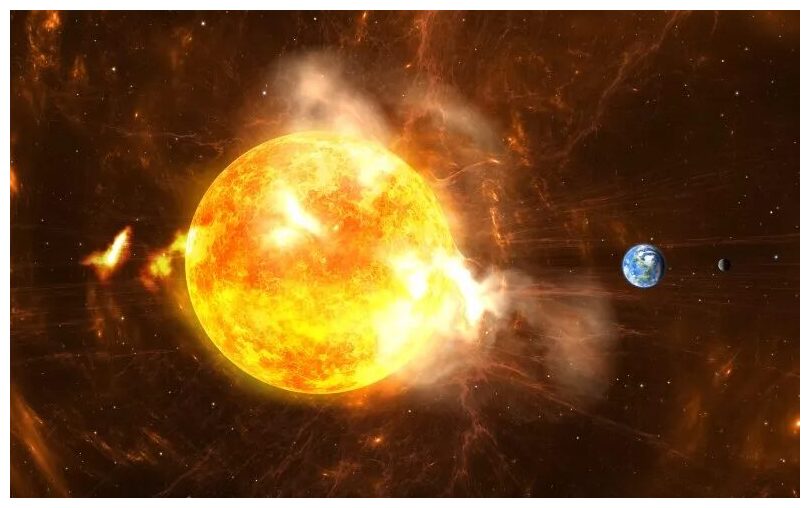
© PITRIS/GETTYA stock photo shows a concept of cosmic radiation. Scientists have found a link between cosmic radiation and earthquakes.
So I went to look at the underlying study, Observation of large scale precursor correlations between cosmic rays and earthquakes with a periodicity similar to the solar cycle by P. Homola and 43 others.
Hmmm, sez I. Willis's Rule of Authors says that the strength of a scientific study is inversely proportional to the number of authors ... but I digress. The Abstract says:
The search for correlations between secondary cosmic ray detection rates and seismic effects has long been a subject of investigation motivated by the hope of identifying a new precursor type that could feed a global early warning system against earthquakes.The study says:
Here we show for the first time that the average variation of the cosmic ray detection rates correlates with the global seismic activity to be observed with a time lag of approximately two weeks, and that the significance of the effect varies with a periodicity resembling the undecenal solar cycle, with a shift in phase of around three years, exceeding 6 σ at local maxima.
The precursor characteristics of the observed correlations point to a pioneer perspective of an early warning system against earthquakes.
Here we report on an observation of the correlations between variation of the average rates of secondary cosmic ray fluxes measured locally and global seismic activity, and we also point to the periodicity of these correlations (or their observability) which corresponds to sunspot number observations back to the 1960s.They describe their method as:
... an alternative, novel approach on which we report here: comparing the absolute average variabilities of secondary cosmic radiation to the average global sum of earthquake magnitudes.And their conclusion was:
We have demonstrated for the first time that the variation of the absolute average detection rates of secondary cosmic radiation correlates with the global seismic situation (sum of the magnitudes of earthquakes with magnitudes greater-than or equal to 4, occurring at all locations) that takes place approximately two weeks later than the relevant cosmic ray data. The size of the shift in time between the cosmic and seismic data sets reveals the precursor character of the correlation effect.
















Comment: See also: