Science & TechnologyS


Robot

China Flexes Robot Wolves With Machine Guns And A "Collective Brain"

Chinese robot dogs
Four years of hyperdevelopment, battlefield testing, and deployment of FPVs, ground robots, AI-enabled kill chains, and soon humanoid robots have permanently altered the course of the modern battlefield, as war technologies once viewed as 2030s-era weapons are being pulled forward into the present day and are now proliferating across battlefields stretching from the Eastern European theater to the Gulf theater, as Eurasia appears to be at war.

The latest reminder is that, regardless of the battlefield across Eurasia, there will increasingly be large swaths of land, miles deep, effectively forming a new kind of no-man's-land controlled by FPVs and ground robots operating with AI kill chains. In Ukraine, that no-go zone stretches 15 miles wide and already means a quick death for any biological soldier, with FPVs able to detect, track, and strike.

A new form of attritional warfare is emerging in which FPVs and robots are cheap and disposable, while soldiers are mainly exposed only when they have to hold, clear, or occupy terrain.

Beaker

Researchers discover the breaking point where liquids can be made to fracture like solids

liquids fracture like solids
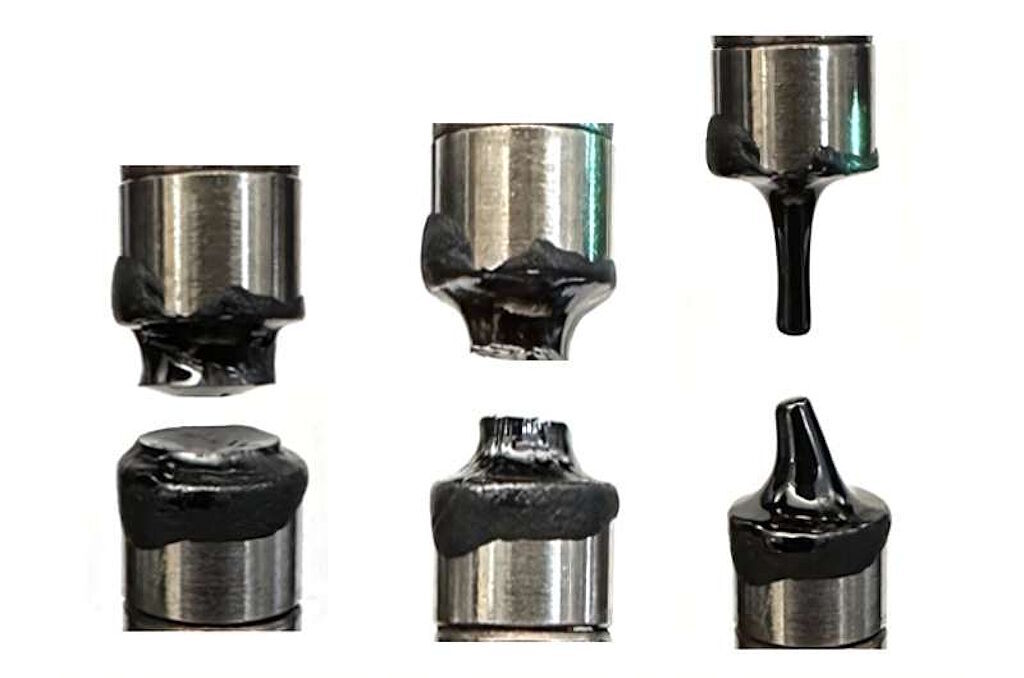
© Drexel UniversityNew research from Drexel University shows how simple liquids, like the hydrocarbon liquid shown here, can actually fracture like a solid object if stretched with enough force.
In a development that could shift our basic understanding of fluid mechanics, researchers from Drexel University have reported that, given the right circumstances, it is possible to induce a simple liquid to fracture like a solid object. Recently published in the journal Physical Review Letters, the research shows how viscous liquids can suddenly break if stretched with enough force.

The fracturing behavior suggests that viscosity — a liquid's resistance to flowing — may play a more prominent role in its mechanical properties than previously understood. It also raises new possibilities for how liquids might be manipulated in everything from hydraulics to 3D printers to blood vessels.

"Our findings show that if pulled apart with enough force per area, a simple liquid — a liquid that flows — will reach what we call a point of 'critical stress," when it will actually fracture like a solid. And this is likely true for all simple liquids, including common examples, such as water and oil," said Thamires Lima, Ph.D., an assistant research professor in Drexel's College of Engineering, who helped to lead the research. "This fundamentally changes our understanding of fluid dynamics."

Moon

Chinese lander reveals giant 'cavity' of radiation between Earth and the moon: It could change how lunar exploration is done

gamma ray cavity in earth magnetic field
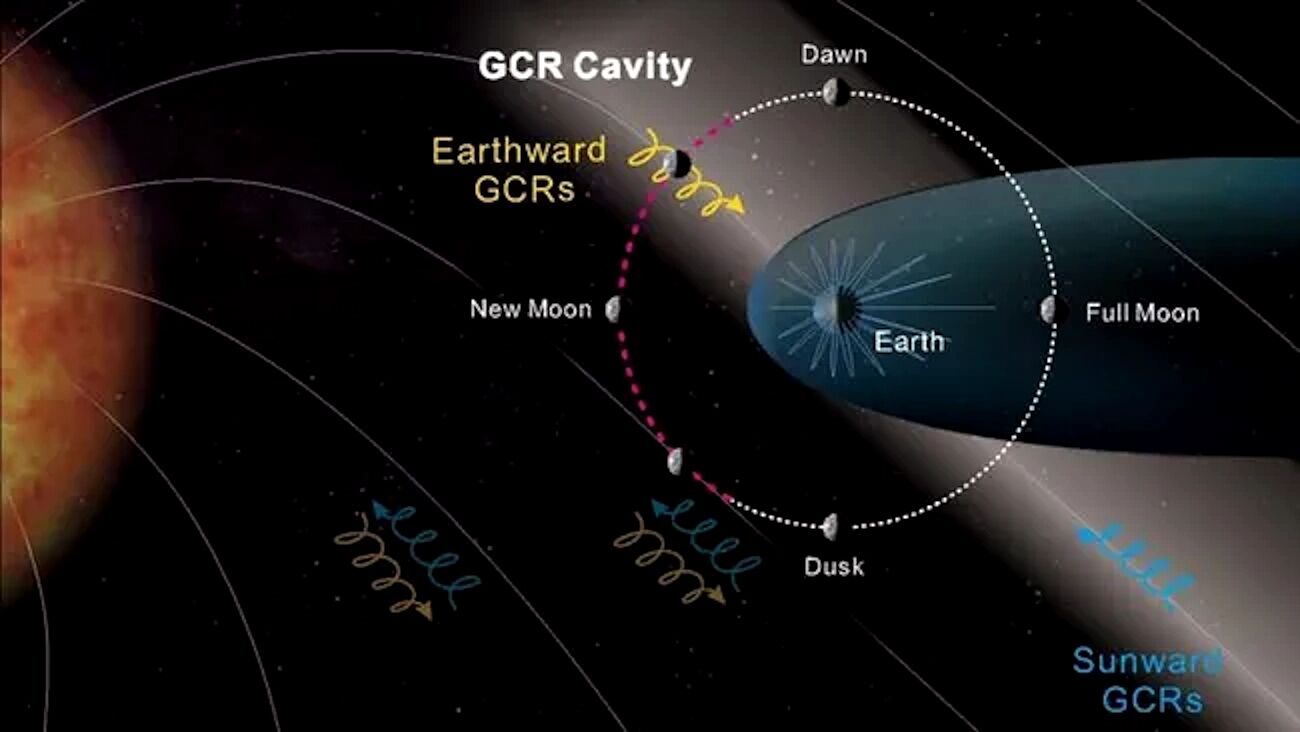
© Shang et al., Sci. Adv. 12, eadv1908An illustration showing how the gamma-ray cavity forms near Earth's magnetic field.
A new study using data from China's Chang'e-4 moon lander found an area of reduced radiation from cosmic rays near the moon. The findings could be used to improve the safety of lunar explorations.

Could being a "morning person" improve your health ... on the moon? Scientists have identified what appears to be a "cavity" of reduced cosmic radiation near Earth's moon. The finding could help lower astronauts' exposure to harmful radiation on future lunar missions by timing some surface operations for local morning hours.

The discovery, based on data from China's Chang'e-4 lunar lander, suggests Earth's magnetic field may affect distances in space farther than scientists previously expected. According to the researchers, the finding challenges the long-held assumption that galactic cosmic rays are roughly uniform throughout the space between Earth and the moon outside our planet's protective magnetic field.

Cosmic rays are among the biggest radiation hazards for astronauts traveling beyond low Earth orbit. These high-energy particles can penetrate spacecraft and human tissue, in turn damaging DNA and increasing the risk of cancer. With more crewed trips planned to the moon, starting with NASA's Artemis II mission launching as soon as April 1, researchers said a better map of radiation intensity could help mission planners reduce astronauts' radiation exposure during surface explorations.

Snowflake Cold

Shock new evidence showing no link between CO2 and temperature over last three million years stumps net zero activists

examining ice cores
© screenshotExamining ice cores
The climate science world ('settled' division) is in shock following the discovery in ancient ice cores that levels of carbon dioxide remained stable as the world plunged into an ice age around 2.7 million years ago. Levels of CO2 at around 250 parts per million (ppm) were said to be lower than often assumed with just a 20 ppm movement recorded for the following near three million-year period. In addition, no changes in methane levels were seen in the entire period. Massive decreases in temperature with occasional interglacial rises appear to have occurred without troubling 'greenhouse' gas levels, and this revelation has caused near panic in activist circles.

The assumed level three million years ago of CO2 was around 400 ppm, a convenient mark that has been used to explain the subsequent ice age and a drop to 250 ppm. Due to the recently published paper, this explanation has become more problematic and natural climate variation is correctly noted to have occurred with the temperature changes. Alas, similar explanations are mostly ignored in discussing today's climate changes in the interests of promoting the Net Zero fantasy. Some cling desperately to a dominant CO2 role, including one of the authors of the findings published in Nature. The co-author states that the results suggest even greater climate sensitivity to the warming effect of CO2. In short, there is a great deal of applying the laws of physics and chemistry to one era, but failing to extend the same courtesy to another.

Comet 2

Comet break-up caught action

The Hubble Space Telescope caught a long-period comet breaking up just after it passed the Sun.
Comet Break-Up
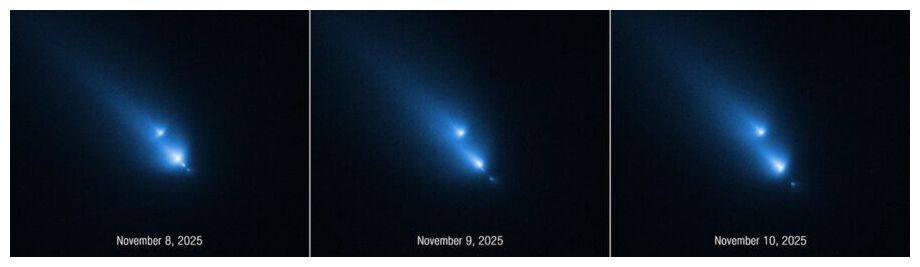
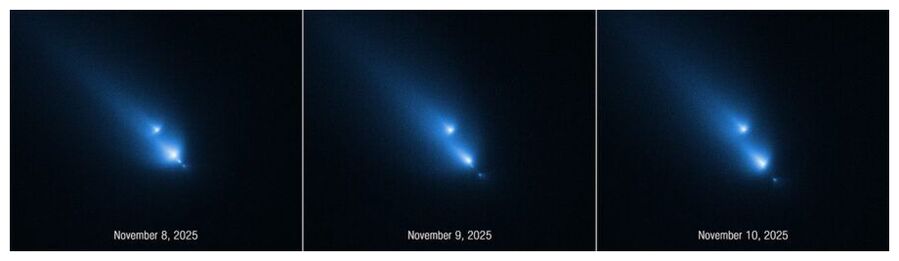
© NASA, ESA, Dennis Bodewits (AU); Image Processing: Joseph DePasquale (STScI)This series of images from the Hubble Space Telescope shows the progressive disintegration of Comet C/2025 K1 (ATLAS), or K1 for short, as seen over the course of three consecutive days in November 2025.
The Hubble Space Telescope is more than 30 years old and has just one functional gyroscope left to steer it, yet the iconic observatory is still making incredible findings. Hubble has now caught a rare, close-up look at a comet that broke into several pieces during a close approach to the Sun. These observations have given us a unique front-row seat to the swan song of one of these icy wanderers.

Caching this event required a good deal of luck. The team of researchers behind the finding originally requested time to observe a different comet — the brightest at the time — but it was moving too fast for Hubble to track. When telescope operators asked for a backup target, the team suggested C/2025 K1 (ATLAS) simply because the comet was in the right place at the right time.

So when the researchers looked at the images, several days after they were taken, they were shocked to find five objects in the frame. The comet had broken apart.

"We were like, 'Whoa, what's that?'" says Dennis Bodewits (Auburn University), who led the study published in Icarus. "It was both exciting and frustrating," he says, because while they'd clearly found a rare event, they couldn't turn Hubble fast enough to see more.

Even without Hubble, though, the team had other ways to look at the break-up. Ground-based telescopes had been tracking the comet, such as the 1-meter telescope at Las Cumbres Observatory Outbursting Objects Key (LOOK) Project. By combining Hubble's high-resolution images with ground-based data, they estimated the breakup started about eight days prior to when Hubble took the images.

Before it fragmented, K1 ATLAS was about 8 kilometers (5 miles) across, slightly larger than the average comet. Hubble captured three 20-second images, one each day starting on November 8, 2025. It witnessed one of K1 ATLAS's smaller pieces break up during that period.

As the comet broke apart, its brightness increased. "From the ground, they could see it was flaring up, and eventually the parts were separating, but we saw four or five different parts" with Hubble, Bodewits explains, "and they went on and off like little fireworks."

Fireball

Earth is facing an unexplained surge of massive, booming daytime fireballs in early 2026

Fireball
© Jared Rackley via XStill from video captured by NWS Pittsburgh’s Jared Rackley via X.
On a Saturday afternoon this past March, a piece of the solar system plummeted toward a home in north Houston.

The one-ton space rock broke apart nearly 30 miles above the city, unleashing a violent sonic boom equivalent to 26 tons of TNT. A dark, jagged fragment smashed through a residential roof and even ricocheted around a bedroom like a cosmic pinball.

This would have been stunning in itself, except there were more such meteor strikes. During the first three months of 2026, our planet waded through an unusually dense shooting gallery. The American Meteor Society (AMS) has tracked a staggering wave of large, bright meteors — known as fireballs — lighting up skies from California to Germany.

Earth sweeps up tons of space dust every day. Usually, this material is the size of a grain of sand and burns up harmlessly in the upper atmosphere. But right now, we are colliding with much bigger rocks. And scientists are scrambling to figure out why.

Mike Hankey, a researcher who manages fireball reporting tools for the AMS, analyzed data stretching back to 2011. He shared his findings in a recent AMS report, noting this meteorite season is distinctly visible.

"After years of stable baseline activity, something appears to have shifted," Hankey wrote in the AMS report. "The signal is consistent across multiple metrics."

Meteor

Flashback Scientist reveals cause of lost magnetism at meteorite site

lost magnetism
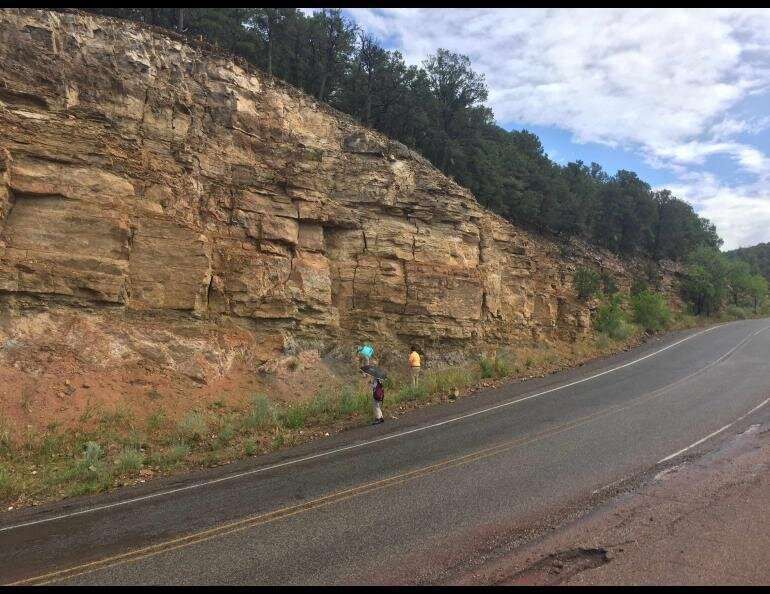
© Gunther KletetschkaGeologists inspect an outcrop near the sample collection site.
A University of Alaska Fairbanks scientist has discovered a method for detecting and better defining meteorite impact sites that have long lost their telltale craters. The discovery could further the study of not only Earth's geology but also that of other bodies in our solar system.

The key, according to work by associate research professor Gunther Kletetschka at the UAF Geophysical Institute, is in the greatly reduced level of natural remanent magnetization of rock that has been subjected to the intense forces from a meteor as it nears and then strikes the surface.

Rocks unaltered by manmade or non-Earth forces have 2% to 3% natural remnant magnetization, meaning they consist of that quantity of magnetic mineral grains — usually magnetite or hematite or both. Kletetschka found that samples collected at the Santa Fe Impact Structure in New Mexico contained less than 0.1% magnetism.

Moon

Large new crater discovered on the moon - Impact likely occurred in last 2 years

New crater moon 2
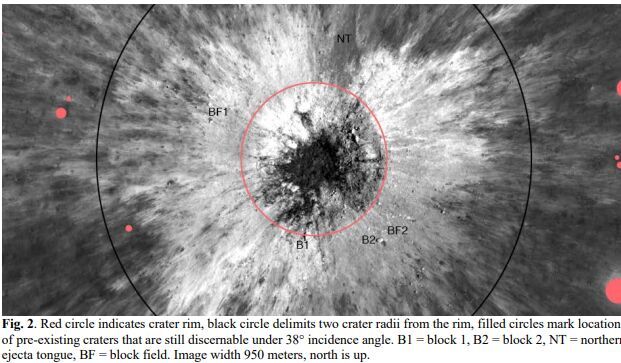
© Intuitive MachinesRed circle indicates crater rim, black circle delimits two crater radii from the rim, filled circles mark locations
of pre-existing craters that are still discernable under 38° incidence angle. B1 = block 1, B2 = block 2, NT = northern ejecta tongue, BF = block field. Image width 950 meters, north is up.
A once-in-a-century crater formed on the moon right under our noses. A routine search of images from NASA's Lunar Reconnaissance Orbiter camera found a fresh crater as wide as two American football fields, planetary scientist Mark Robinson reported March 17 at the Lunar and Planetary Sciences Meeting in The Woodlands, Texas.

The crater is 225 meters wide and formed in April or May 2024, Robinson said. According to predictions based on other lunar landmarks, a crater that big should form only once in 139 years. The discovery can help highlight the risks impacts pose to future astronauts.

Comment: Careful with the 'once-in-a-century' assumption. In fact, now that this new bar has been set, here's a 'joke' for moon researchers: expect more lunar impacts in the coming years, and maybe months.

See also: The mystery of the Ohio and Texas fireballs


Tornado1

Surviving inside a tornado

tornado with tornado chaser
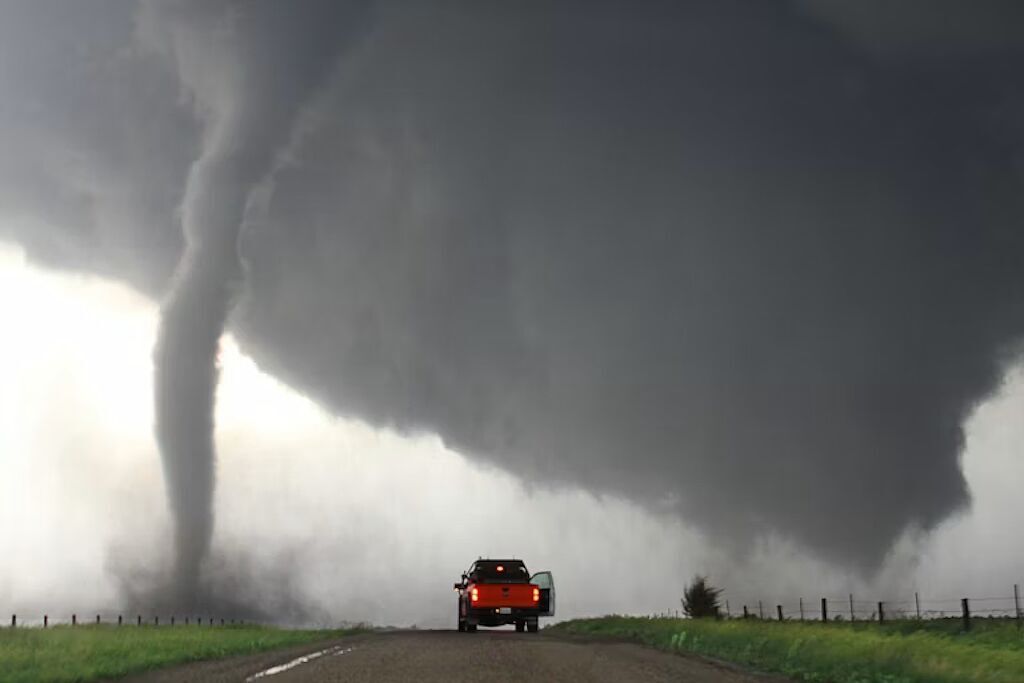
© Brent Koops/NOAA Weather in Focus Photo Contest 2015Tornadoes can be erratic and extremely dangerous.
This scientist did by accident - he's lucky to be alive

I have seen the center of a monster. Most people describe the sound of a tornado as like a freight train, but up close, it's more like a thousand screaming jet engines. I am one of the few people on Earth who has driven into a tornado and lived to tell the tale.

While it might sound like a scene from a Hollywood blockbuster involving a high-tech armored truck, my experience was much more dangerous and terrifying.

I am an atmospheric scientist who studies tornadoes, but I am only alive today because of split-second decisions and a massive amount of dumb luck. Believe me, I do not want to ever be in that situation again.

Fireball

Naked-eye comet on the way

A visitor from the outermost reaches of the solar system is about to become a naked-eye object. Introducing Comet Pan-STARRS (C/2025 R3):

Comet Pan-STARRS (C/2025 R3)
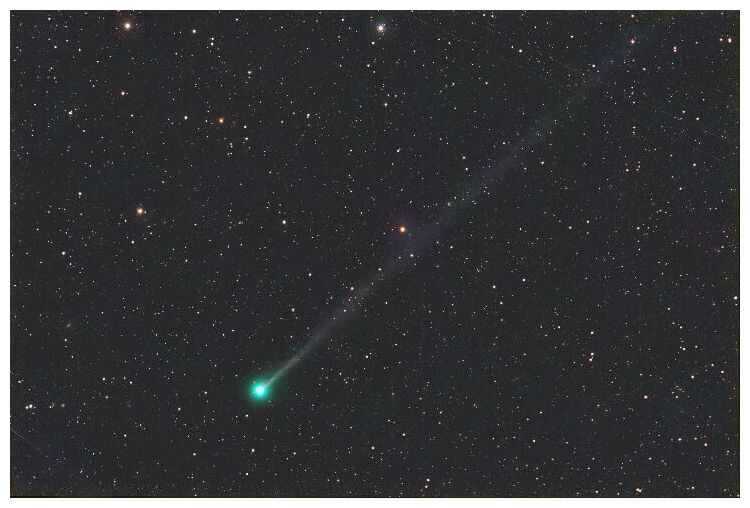
© Taken by Michael Jaeger, Gerald Rhemann on March 23, 2026 @ Weißenkirchen, AustriaOne week after the full moon in April, Comet C/2025 R3 Panstarrs is expected to become visible to the naked eye. On March 23, it reached a magnitude of 7.8 for the first time, and its brightness has increased significantly in recent weeks. It will not reach its perihelion—nor its closest approach to Earth—for another month. The image was taken with an 11"RASA and a color CMOS camera
Michael Jaeger and Gerald Rhemann photographed the comet (magnitude +7.8) from Weißenkirchen, Austria: "The comet's brightness has increased significantly in recent weeks," they say. "One week after the full moon in April, it is expected to become visible to the naked eye."

Discovered by the Pan-STARRS survey in Sept. 2025, the comet is diving toward its closest approach to the sun (0.50 AU) on April 19th, bringing it well inside the orbit of Venus. If current trends continue, the comet could brighten to magnitude +2, easily seen and photographed in the pre-dawn sky.