
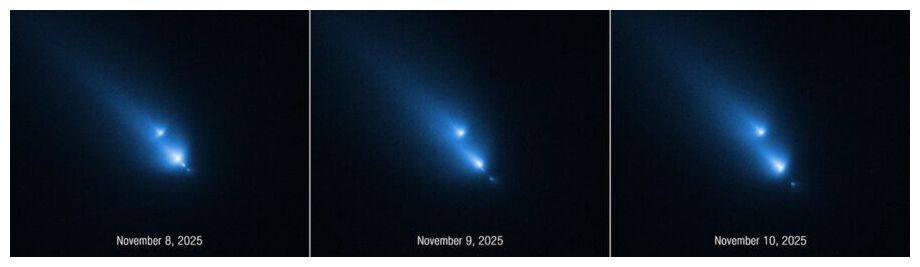
© NASA, ESA, Dennis Bodewits (AU); Image Processing: Joseph DePasquale (STScI)This series of images from the Hubble Space Telescope shows the progressive disintegration of Comet C/2025 K1 (ATLAS), or K1 for short, as seen over the course of three consecutive days in November 2025.
Caching this event required a good deal of luck. The team of researchers behind the finding originally requested time to observe a different comet — the brightest at the time — but it was moving too fast for Hubble to track. When telescope operators asked for a backup target, the team suggested C/2025 K1 (ATLAS) simply because the comet was in the right place at the right time.
So when the researchers looked at the images, several days after they were taken, they were shocked to find five objects in the frame. The comet had broken apart.
"We were like, 'Whoa, what's that?'" says Dennis Bodewits (Auburn University), who led the study published in Icarus. "It was both exciting and frustrating," he says, because while they'd clearly found a rare event, they couldn't turn Hubble fast enough to see more.
Even without Hubble, though, the team had other ways to look at the break-up. Ground-based telescopes had been tracking the comet, such as the 1-meter telescope at Las Cumbres Observatory Outbursting Objects Key (LOOK) Project. By combining Hubble's high-resolution images with ground-based data, they estimated the breakup started about eight days prior to when Hubble took the images.
Before it fragmented, K1 ATLAS was about 8 kilometers (5 miles) across, slightly larger than the average comet. Hubble captured three 20-second images, one each day starting on November 8, 2025. It witnessed one of K1 ATLAS's smaller pieces break up during that period.
As the comet broke apart, its brightness increased. "From the ground, they could see it was flaring up, and eventually the parts were separating, but we saw four or five different parts" with Hubble, Bodewits explains, "and they went on and off like little fireworks."
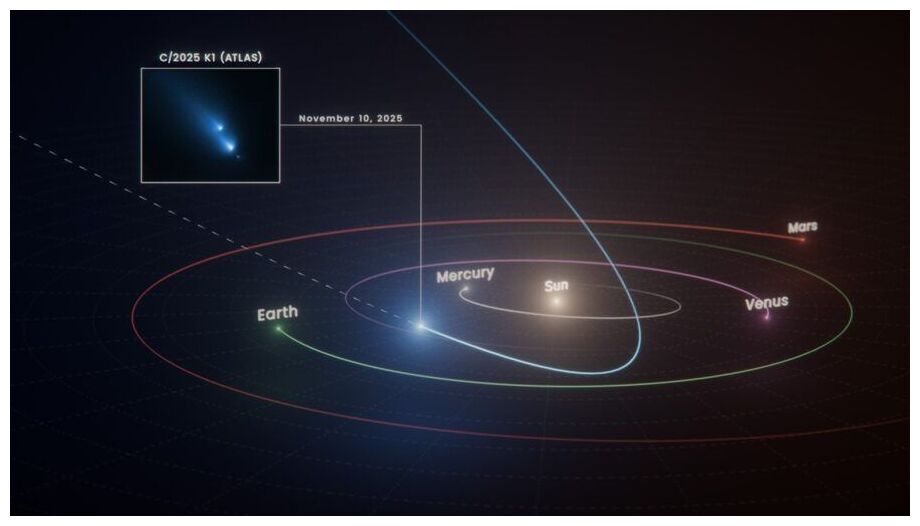
© NASA / ESA / Ralf Crawford (STScI)This diagram shows the path the long-period comet C/2025 K1 (ATLAS) took as it swung past the Sun and began its journey out of the solar system. Hubble's images caught it fragmenting after perihelion.
While some researchers have suggested these winglets are caused by escaping ammonia, which could immediately break into molecular pieces such as the amino radical (NH2). Others, including Bodewits's team, instead think that the winglets mark escaping dust. A clue came from tracing the fragments' trajectories backwards in time; in doing so, the team measured a two- or three-day delay between the comet's fragmentation and its subsequent brightening.
The team proposes two possibilities that can explain the delay. In the case of the escaping ammonia, the Sun's heat might need to penetrate a few meters inside new cometary fragments before enough gas pressure builds up to allow escape in an expanding shell. Or, if it's dust, maybe new fragments have surfaces that are too clean, and it takes time to build up a layer of dry, dusty material. That dusty layer is what we might be seeing from Earth.
Foreseeable break-up
The researchers weren't surprised to see a comet shatter as it slingshotted past the Sun, just at the fact that they caught it on camera. Comet K1/ATLAS came within 0.3 au of the Sun — well inside Mercury's orbit — and there was a good chance it wasn't going to survive. "These fragments are like fluffy snow barely held together," Bodewits says. Because comet nuclei are so loosely packed, the Sun's intense heat releases gases that act like thrusters. The resulting uncontrolled spins tends to cause to break-ups.
That basic idea is accepted in the field. "I think it is consistent with the idea that small comets are destroyed by outgassing torques," says David Jewitt (UCLA), who wasn´t part of the new study. "They spin themselves up to the point where centrifugal forces exceed their own (weak) strength and they fall apart." This is different from a previous theory that suggested that comets disappeared when they ran out of ice. "Instead of fading away, they fall apart," Jewitt adds.
A Chemical Puzzle
Still, the demise of C/2025 K1 (ATLAS) showed some particularities. Ground-based observations revealed that the comet seems to be lacking cyanide (CN) and dicarbon (C2), both common in more typical comets. Dicarbon, in fact, is what gives comets their green color in amateur photos.
Scientists know that some of these compounds form from the degradation of parent molecules. When sunlight hits these molecules, they break into molecular fragments known as radicals. "But we don't always know which parent molecule [the radicals] come from," Bodewits says. "Sometimes the math just doesn't add up."
A Chemical Puzzle
The big question now is: Did the chemical makeup change after the comet cracked open? Is the inside just as depleted in cyanide and dicarbon as the outside? Figuring that out is going to take more detective work, especially since tracking five different pieces outgassing at once is requires careful analysis.
"The problem is that of course as soon as you crack it open, it starts to evolve," Bodewits says. Still, "this is the experiment we always wanted to do and it just happened right in front of our eyes."



Reader Comments