OF THE
TIMES


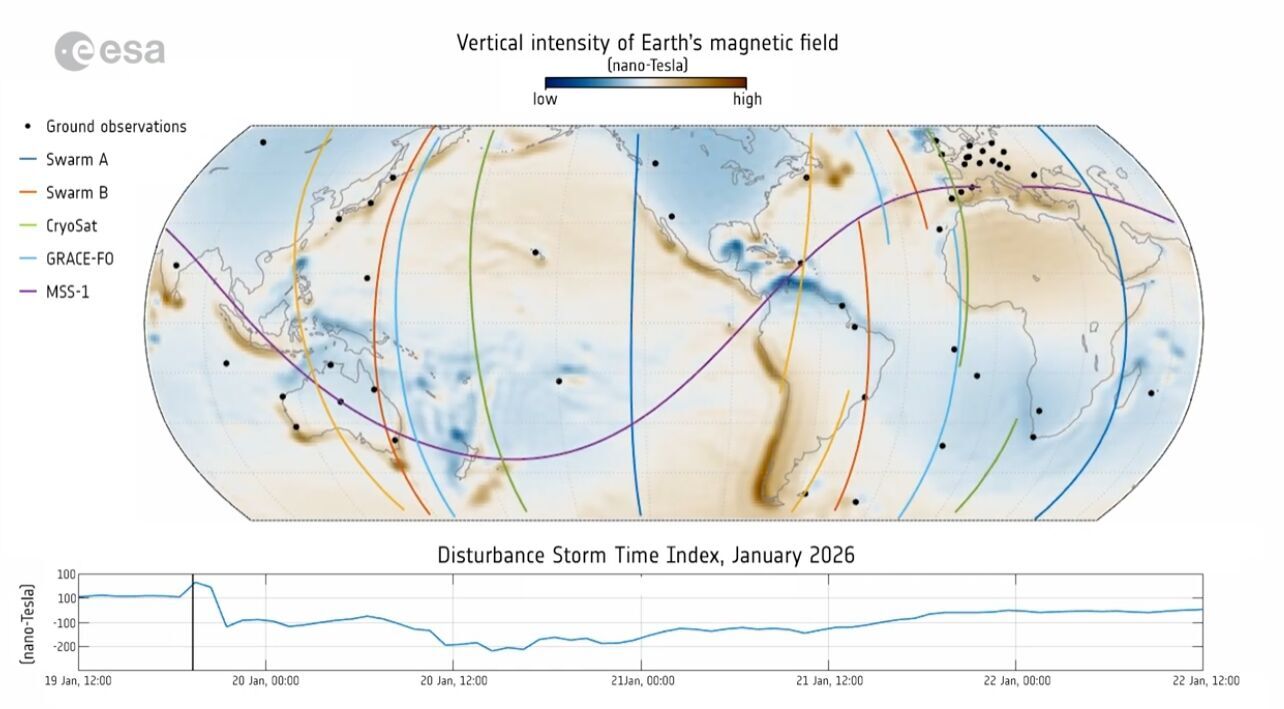
The storm was a reaction to an X1.9 solar flare, the most powerful category, which occurred on Sunday, 18 January at around 21:00 Moscow Time. The event was registered in active region 4341, which had previously produced two large explosions in the first half of the month while still on the far side of the Sun. By the 18th, due to the Sun's rotation around its axis, it had moved to the side visible from Earth, and at the time of the explosion it was located precisely on the Sun-Earth line. This positioning partially explains the exceptional strength of the subsequent impact on the planet, but not entirely, as a number of facts are extremely difficult to reconcile with basic concepts of solar activity.
The main, difficult-to-explain consequence of the explosion was an exceptionally powerful radiation storm, accompanied by the strongest increase in the number of energetic protons (with energies above 10 MeV) in the vicinity of Earth in the 21st century. Within 24 hours, the density values rose to 37,000 units, which exceeded the "red level" thresholds by a thousand times and the indicators of the strongest flares of the current cycle by 20 times. The seemingly unbreakable records of the beginning of the century, recorded after the largest flares of the current century (about 30,000 units), were surpassed, and only slightly fell short of breaking the absolute record of 43,000 units, recorded back in the 20th century. The causes and consequences of this event (including the amount of radiation received by spacecraft during this period) are still to be investigated. It can only be noted that the increase in protons knocked out the sensors of the ACE spacecraft, which measures the speed of solar plasma in orbit, and for this reason, the speed of the plasma ejection that reached Earth is still unknown.

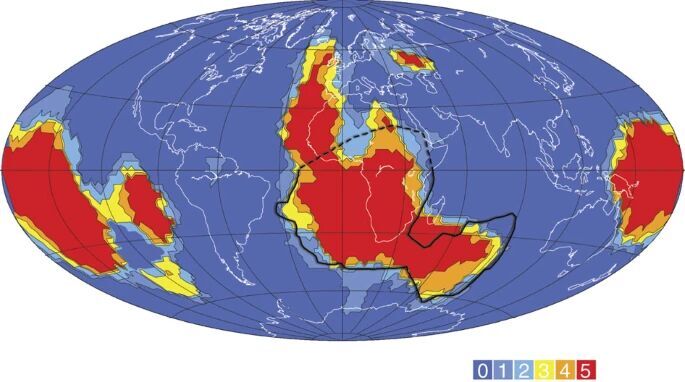
Published this month in Physics of the Earth and Planetary Interiors, the latest results from the Swarm mission reveal that while the South Atlantic Anomaly expanded steadily between 2014 and 2025, a region of the Atlantic Ocean southwest of Africa has experienced an even faster weakening of Earth's magnetic field since 2020.
"The South Atlantic Anomaly is not just a single block," says lead author Chris Finlay, Professor of Geomagnetism at the Technical University of Denmark. "It's changing differently towards Africa than it is near South America. There's something special happening in this region that is causing the field to weaken in a more intense way."
This behaviour is linked to strange patterns in the magnetic field at the boundary between Earth's liquid outer core and its rocky mantle, known as reverse flux patches.
Prof. Finlay explains, "Normally we'd expect to see magnetic field lines coming out of the core in the southern hemisphere. But beneath the South Atlantic Anomaly we see unexpected areas where the magnetic field, instead of coming out of the core, goes back into the core. Thanks to the Swarm data we can see one of these areas moving westward over Africa, which contributes to the weakening of the South Atlantic Anomaly in this region."

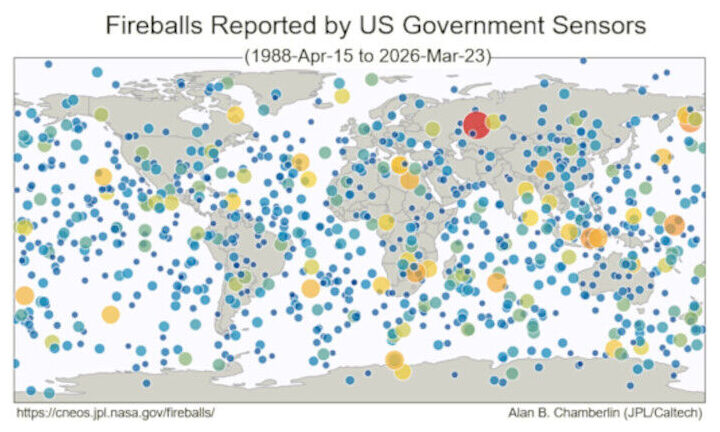
Comment: The previous narrative used to be 'once in a lifetime'. Fast forward to multiple witnesses in over 15 states, as well as in Canada, Europe and Russia, all within less than one month. The narrative is obviously now "it's nothing unusual". See also:
Fire in the Sky
Caltech astrophysicist fatally shot on porch of his rural home