Science & TechnologyS


Nebula

Astronomers spot 'time-warped' supernovas whose light both has and hasn't reached Earth

Will two rare supernovas finally tell us how fast the universe is expanding? Perhaps, but we'll have to wait for it for them to 'reappear'.
Two Supernovas
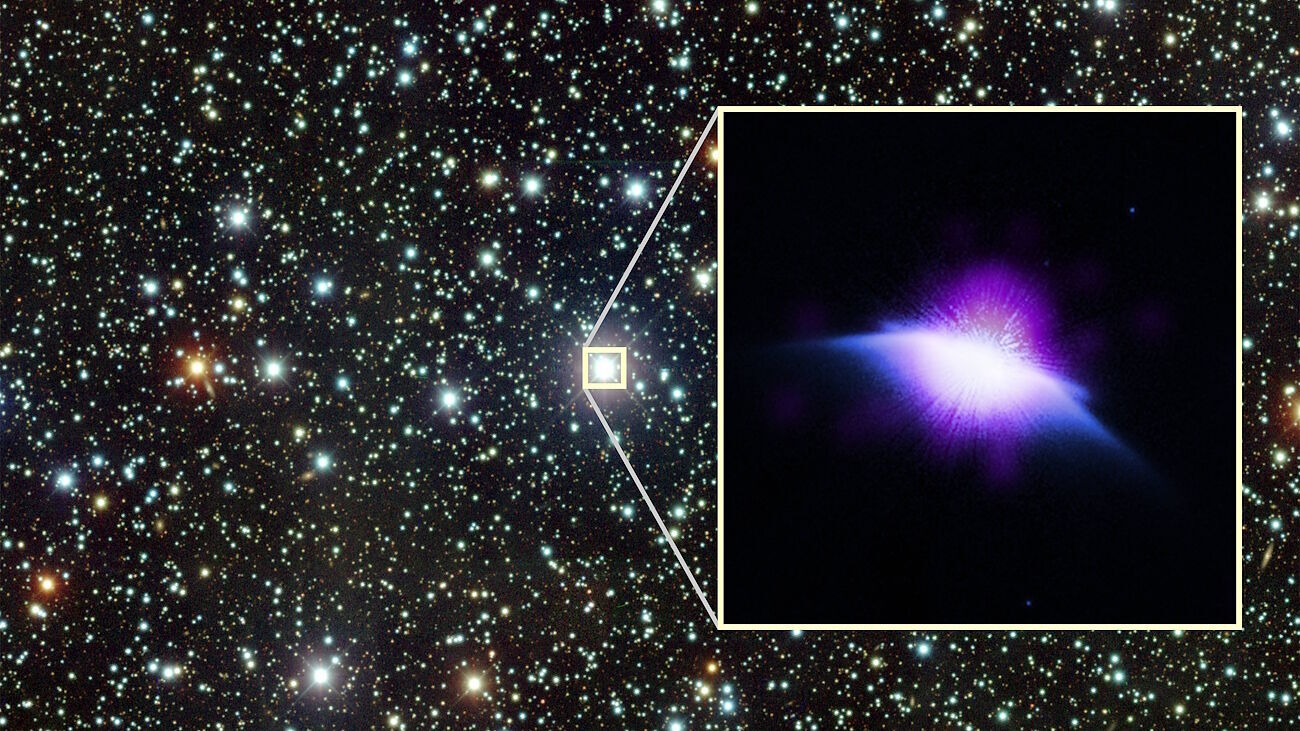
© NASA/ESA/CSA/image processing: Gavin FarleyThe massive MJ0308 galaxy cluster in the foreground produces a gravitational lensing effect, which causes multiple images of SN Ares to appear.
Two incredibly rare supernovas that erupted billions of years ago provide a unique opportunity to explain cosmology's biggest mystery — How fast is the universe expanding?

But there's a twist: Even though astronomers have already observed these exploding stars, we will have to wait up to 60 years for their light to reach us again.

A phenomenon called gravitational lensing has split the light from these obliterated stars into multiple images, each of which travels a different path through space-time to reach us. As a result, researchers will one day be able to measure the delay between these ghostly images to offer an unprecedented constraint on the expansion rate of the universe — a problem that has long bedeviled scientists, as the universe appears to be expanding at different rates depending on where they look.

Conor Larison, a postdoctoral researcher at the Space Telescope Science Institute, presented the discovery of the two gravitationally lensed supernovas, named SN Ares and SN Athena, at a news conference at the 247th meeting of the American Astronomical Society in Phoenix.

Ice Cube

Marine sediments provide clues for future impact of climate change

Retreating Glaciers
© Skyimages/Adobe Stock
An international team of scientists has uncovered evidence glaciers in the Southern and Northern hemispheres were synchronous during the last ice age.

The finding challenges prevailing theories and provides critical information to help model how today's ice sheets will respond to a changing climate.

Researchers from The University of Queensland, Ifremer, NIWA, the University of New South Wales, the Alfred Wegener Institute and CNRS, constructed the first complete record of glacial fluctuations in the Southern Alps of New Zealand by analysing a marine sediment core.

Professor Helen Bostock from UQ's School of the Environment said when the evolution of the New Zealand glaciers was compared to their European and North American counterparts, they were found to retreat simultaneously.

"Our work shows a period of global warming, likely caused by an increase in the global energy imbalance, preceded glacial retreats in both hemispheres at the same time," Professor Bostock said.

"The finding challenges previous theories of an inter-hemispheric 'bipolar seesaw'."

Eye 1

Chinese researchers develop eye surgery robot

Eye surgery robotics
© UnknownChinese Eye Surgery Robotics
A team of Chinese researchers has developed an autonomous robotic system capable of performing delicate eye injections within the confined space of the human eye, potentially enhancing the precision and safety of surgeries used to treat debilitating retinal diseases.

The surgery robot, developed by a team from the Institute of Automation under the Chinese Academy of Sciences, successfully performed subretinal and intravascular injections in animal tests with 100 percent success, according to a study published recently in the journal Science Robotics.

Eye surgery, particularly involving the retina, is highly challenging due to the organ's tiny, soft structures. The new system uses a suite of algorithms for 3D spatial perception, cross-scale precise positioning, and trajectory control to guide a robotic arm.

Snowflake

Why snow isn't actually white

forest snow sunrise
© DepositPhotosFew languages have as many distinct words for snow as Japanese, which has words like miyuki or "beautiful snow."
Winter wonderlands are only possible thanks to a sparkly light trick.

When someone says "as white as snow," it's easy to envision what they're talking about. We often think of snow as a dazzling white, the same way we immediately conjure up a color when someone says "blood red" or "ocean blue."

But here's the thing: snow isn't actually white. It's just tiny ice crystals, afterall, and ice, like water, looks clear to the naked eye. So why, then, does snow appear white? We talked to a couple of experts to find out: Their answers might surprise you.

Comet 2

Halley's Comet wrongly named: 11th-century English monk predates British astronomer

Bayeux Tapestry.
© Wikimedia CommonsThe oldest known depiction of Halley’s Comet on the Bayeux Tapestry.
The British astronomer and mathematician Edmond Halley was not, after all, the first to understand the cycle of the comet that now bears his name. This is shown by research conducted by, among others, Professor Simon Portegies Zwart. It was the monk Eilmer of Malmesbury who, as early as the 11th century, linked two observations of the comet.

The events are described by the 12th-century chronicler William of Malmesbury, but until now this has gone unnoticed by scholars. Portegies Zwart and Lewis now argue that Aethelmaer witnessed both appearances of the comet. Their findings have been published in the book 'Dorestad and Everything After. Ports, townscapes & travellers in Europe, 800-1100'.

Halley identifies the comet's periodicity

Halley discovered that the very bright periodic comet later named after him, 1P/Halley, observed in 1531, 1607 and 1682, was in fact the same comet, returning approximately every 76 years.

Satellite

Satellite captures images of giant underwater plumes triggered by 7-story waves off the coast of Nazaré, Portugal

underwater plumes nazare giant ocean waves
© Lauren Dauphin/NASA Earth Observatory/Landsat 8The Portuguese coast surrounding the town of Nazaré is famous for its giant waves, which also unleash giant underwater plumes as they crash along the shore. Taken by the Landsat 8 satellite Oct. 29, 2020
This striking satellite snap highlights the immense power of 7-story waves crashing along the Portuguese coast and ejecting massive sediment plumes under the sea. The same day this photo was taken, a local 18-year-old surfer set a new world record by riding one of the colossal crests.

The Landsat 8 satellite captured this epic scene near the town of Nazaré in western Portugal, a region famous for having some of the tallest waves on Earth. Nazaré is home to around 15,000 people and regularly hosts "big-wave" surfing competitions, which attract surfers from around the world. The swells there are so big that surfers often have to be towed into the breaking waves with a jet ski.

The monster waves in the image likely reached heights of around 80 feet (24 meters), which is roughly equivalent to a 7-story building. This is exceptionally tall — even for Nazaré, where waves usually peak up to 50 feet (15m) at this time of year — and would usually be considered too dangerous to surf.

Nebula

Giant rotating string of galaxies is 'probably the largest spinning object' in the known universe

rotating cosmic structure galaxies
© Lyla JungA figure showing the rotation of neutral hydrogen (right) in galaxies spotted in a giant filament of the cosmic web (middle)
A giant rotating filament of the cosmic web may be the largest spinning structure ever seen, and could help reveal how galaxies form.

Astronomers have spotted what is likely the "largest spinning object" ever discovered, and its rotation could hold important clues about how galaxies develop.

The whirling structure, located 140 million light-years from Earth, is a long, threadlike string of gas that's about 5.5 million light-years long and 117,000 light-years wide — wider than our Milky Way galaxy. The cosmic filament has 14 hydrogen-rich galaxies linked to it in a chain, like charms on a bracelet. These galaxies were what gave away the filament's existence, the researchers explained in a paper published today (Dec. 3) in the journal the Monthly Notices of the Royal Astronomical Society.

Comment: What is not touched on is the impetus for the rotation. What set it in motion and keeps it there? The Electric Universe Theory, which incorporates the existence of Birkland currents, fits the bill nicely. It would also seem our solar system is caught up in a similar rotating structure. Two videos illustrate:


Horse

Horses can smell human fear when we sweat

Horses
© bbcearth.com
Horses can smell your fear. If you are experiencing this emotion while standing near a horse, they will be able to detect it through your scent alone, which changes their behavior and physiology. That's the conclusion of a new study published in the journal PLOS One.

Scientists already know that dogs can smell human stress. But a team from the National Research Institute for Agriculture, Food and the Environment (INRAE) in France wanted to see if the same is true for horses, another domesticated animal that has lived alongside us for thousands of years.

Galaxy

What if space is actually a 'sticky fluid'?

Carina Nebula
Carina Nebula, captured in infrared light by the Near-Infrared Camera (NIRCam) on the NASA/ESA/CSA James Webb Space Telescope, July 2022
Our best models of the cosmos don't add up — but that could change if the universe is actually made of a viscous 'fluid,' a new paper suggests.

Recent observations have revealed that our understanding of the cosmos is flawed, but it may be because the universe is "stickier" than we assumed, new research proposes.

In a paper that was published on the arXiv preprint server but has not been peer-reviewed, Muhammad Ghulam Khuwajah Khan, a researcher at the Indian Institute of Technology, suggests that space may possess a property called bulk viscosity.

Viscosity is a measure of how much a fluid resists flowing or changing shape — like the difference between pouring water versus honey. In this case, we are talking about the bulk viscosity of the vacuum itself, a ghostly resistance that occurs when space expands.

Satellite

How Iran jammed Starlink

Starlink
© ifeelstock / Legion-Media
After shutting down the internet, the Iranian government is now attempting to jam the Starlink satellite service made free to Iranians by the company. Iranians are now seeking ways to circumvent this latest wave of censorship.

Iranian authorities cut the public's access to the internet and telephone communications on January 8. The networks were later partially reinstated, but with severe restrictions. The Iranian regime has been facing a series of protests since late December. In an attempt to crush the movement, the Iranian government also tried to break the last international communication link available to Iranians: Starlink.

Starlink, which provides internet access through a constellation of satellites, was thought to be out of the Iranian authorities' reach for censorship. However, in recent days, Starlink has been subject to a jamming campaign that has seriously impaired its use.