
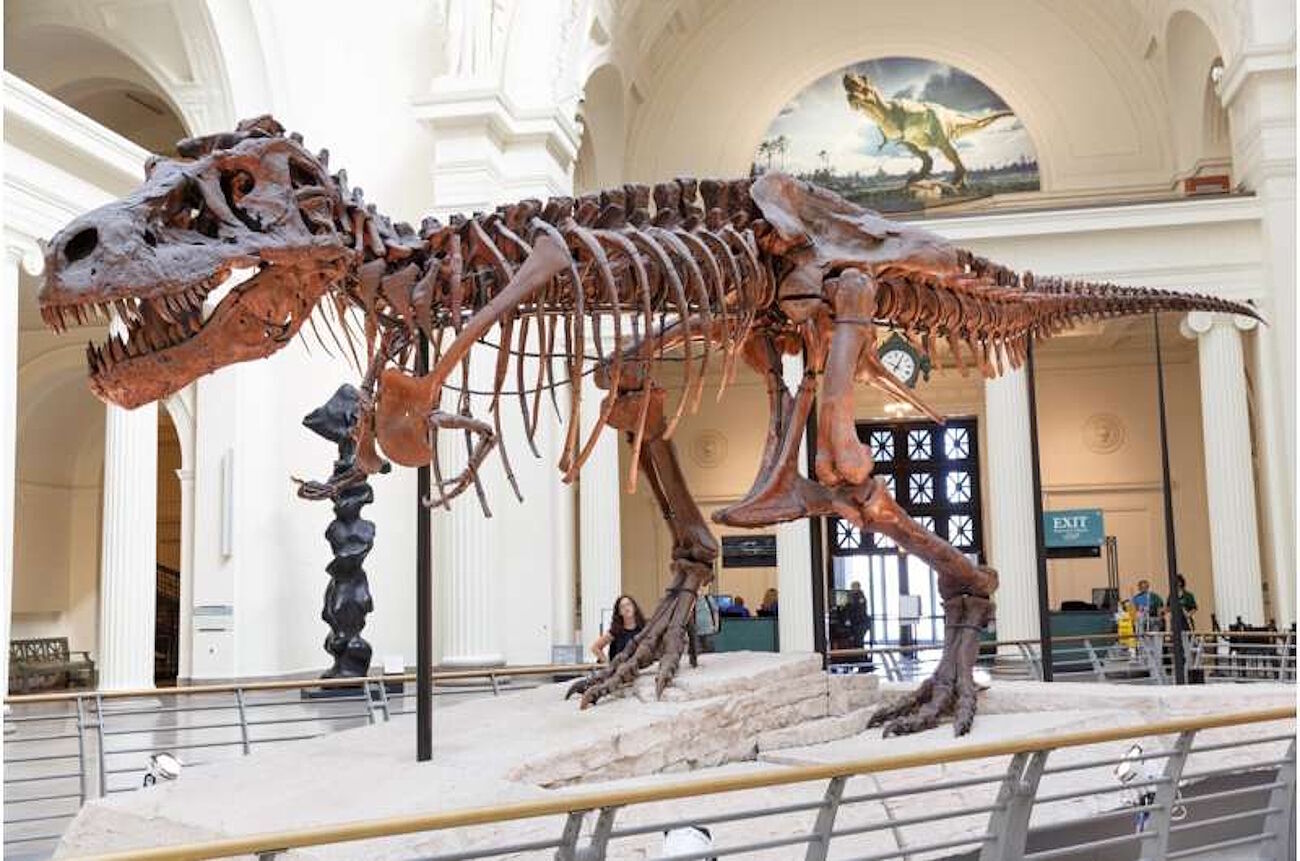
Tyrannosaurus rex skeleton called Sue in The Field Museum in Chicago.
The T. rex fossil record is rich and has given us many insights into how these animals hunted and grew. But little is known about one aspect of its locomotion and that is how its foot struck the ground. So a team led by the College of the Atlantic in Maine studied the feet of four well-preserved T. rex specimens.
Foot strikes
The scientists started by taking precise measurements of leg and foot bones and plugging the numbers into three equations used to estimate animal speeds. Next, they modeled three ways the foot could hit the ground. These were landing on the rear of the foot, the middle or on tiptoes. To see which style was most likely, they compared these models to data from humans and ostriches.
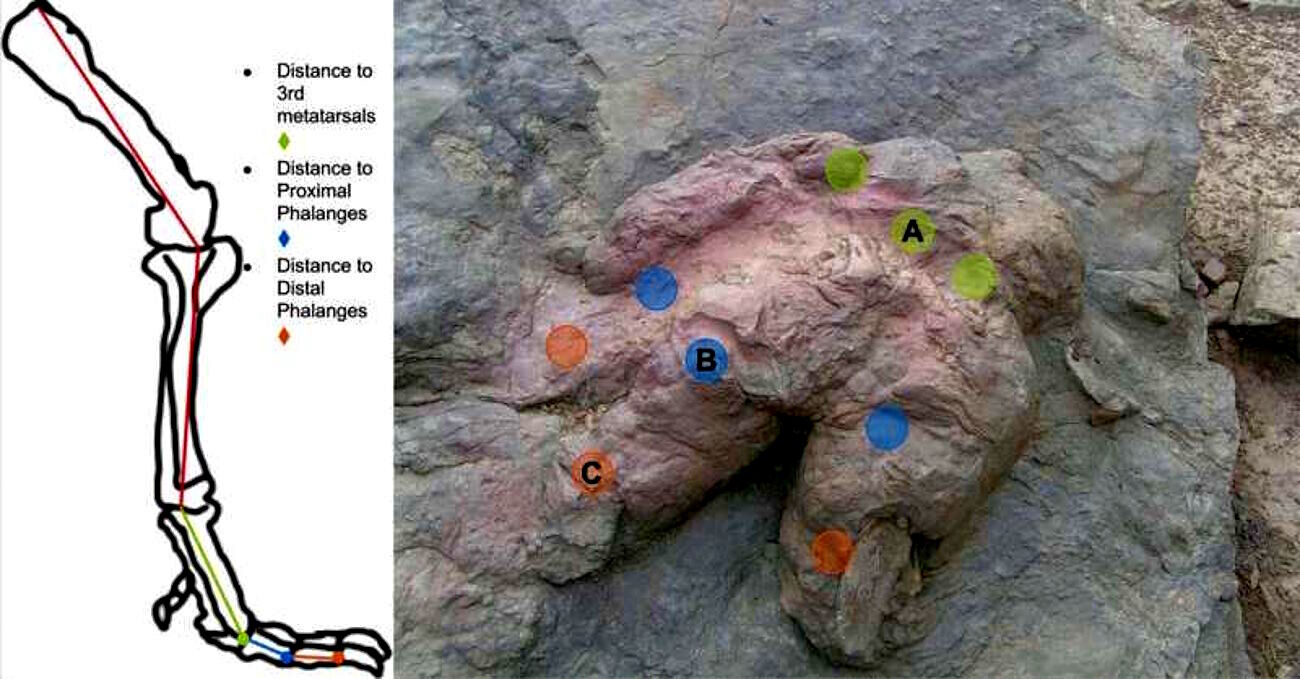
© Rufus Crown-Sparrow (photo); H. F. Osborn (outline)Measurements of a T. rex leg including leg length remaining in articulation with the acetabulum, distance to the third metatarsals, proximal phalanges and distal phalanges of digits I, II and III. Locations have been superimposed onto the ichnospecies Tyrannosauripus pillmorei.
When the team compared their models, they discovered that moving on tiptoes would have been the most effective for faster movement. It allowed the dinosaur to take more steps in less time, potentially increasing its estimated top speed by about 20%. A flat-footed T. rex would have been much slower.
Dainty giants
According to the scientists, a tiptoeing T. rex could reach speeds of between 5 and 11 meters per second, which is approximately 11 to 25 miles per hour. So this giant predator, weighing in at approximately 10 tons, would have moved with a more bird-like gait similar to modern ground birds.
"Our study represents, to our knowledge, the first quantitative biomechanical analysis of the effects of foot-strike patterns on the gait of Tyrannosaurus. We find that the pes [the foot] of T. rex functioned similarly to the foot of a bird," wrote the scientists in their paper.
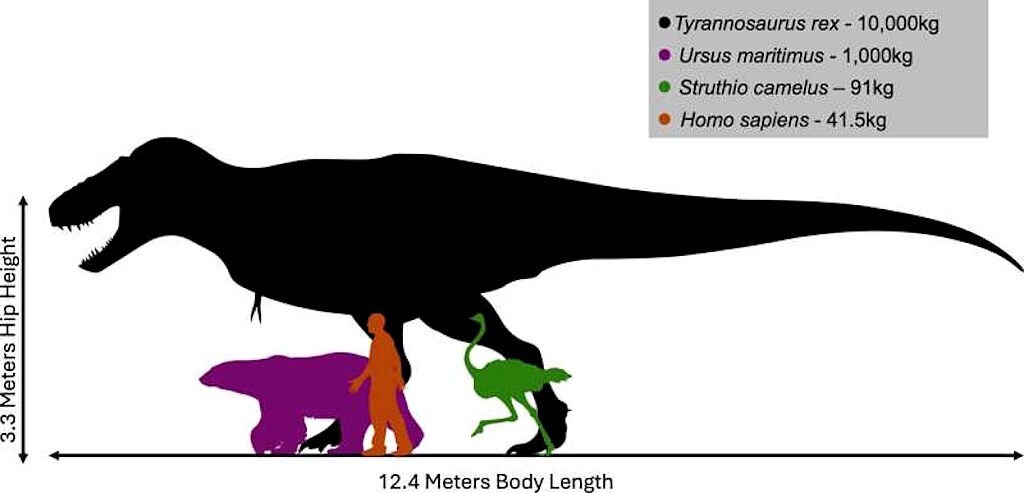
© Royal Society Open Science (2026). DOI: 10.1098/rsos.252139.Size comparison between T. rex and several extant terrestrial vertebrates. Silhouettes are sourced from Phylopic (Phylopic.org).
If the study authors are correct, many museum curators and documentary and movie makers will have to rethink their designs and animations.
Reference: Adrian Tussel Boeye, Kyle Logan Atkins-Weltman, J. Logan King, Scott Swann; Evidence of bird-like foot function in Tyrannosaurus. R Soc Open Sci. 1 February 2026; 13 (2): 252139. doi.org/10.1098/rsos.252139




Reader Comments
Another theory.
Trust the science eh.
Where have we heard that BS before