
© NASA
"Spring is fireball season," says Bill Cooke of the NASA Meteoroid Environment Office. "For reasons we don't fully understand, the rate of very bright meteors climbs 10% to 30% during weeks around the vernal equinox."
The Ohio and Texas meteors landed squarely in the middle of the season. Onlookers saw the Ohio fireball on March 17th only 3 days before the equinox. The Texas fireball appeared one day after the equinox on March 21st. Both were visible in broad daylight, with sonic booms and meteorites. One fragment reportedly punched through the roof of a home in suburban Houston.
"Meteorite falls--fragments that actually hit the ground--are more common in spring as well," says Cooke.
Although researchers have known about the spring surge for 30+ years, no one is sure what causes it. There seems to be an intrinsic variation in the meteoroid population along Earth's orbit, with a roughly February-to-June peak in large, fireball-producing debris. The source of the extra debris is unknown.
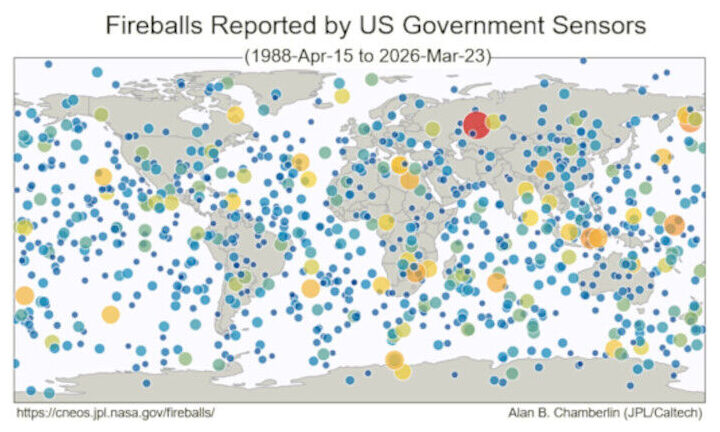
Although the spring surge is real, it may not be required to explain these recent fireballs. Three decades of data from US government sensors shows that an Ohio-class fireball hits Earth roughly once a month, but almost all of them go unnoticed because they occur over oceans or remote regions. The Ohio and Texas fireballs are roughly consistent with these statistics.
Finally, we note that the Texas and Ohio fireballs did not come from the same place despite arriving during the same "spring surge."
"The two fireballs had completely different orbits," says Cooke. "Plus, the meteorites they produced are quite different. Ohio finds are probably eucrites, whereas the recovered Texas meteorite appears to be an ordinary chondrite."
So, nothing unusual--but still a little mysterious. Keep looking up.


Comment: The previous narrative used to be 'once in a lifetime'. Fast forward to multiple witnesses in over 15 states, as well as in Canada, Europe and Russia, all within less than one month. The narrative is obviously now "it's nothing unusual". See also:
Fire in the Sky
Caltech astrophysicist fatally shot on porch of his rural home