
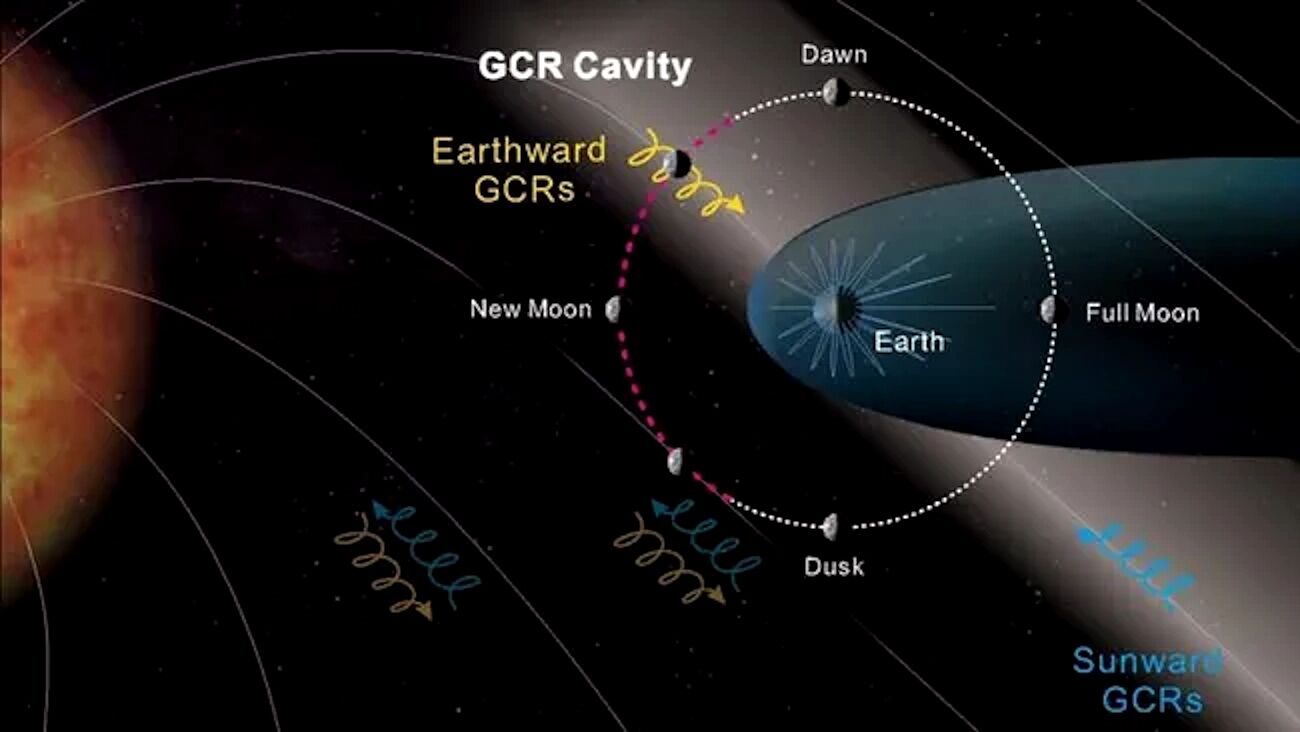
© Shang et al., Sci. Adv. 12, eadv1908An illustration showing how the gamma-ray cavity forms near Earth's magnetic field.
Could being a "morning person" improve your health ... on the moon? Scientists have identified what appears to be a "cavity" of reduced cosmic radiation near Earth's moon. The finding could help lower astronauts' exposure to harmful radiation on future lunar missions by timing some surface operations for local morning hours.
The discovery, based on data from China's Chang'e-4 lunar lander, suggests Earth's magnetic field may affect distances in space farther than scientists previously expected. According to the researchers, the finding challenges the long-held assumption that galactic cosmic rays are roughly uniform throughout the space between Earth and the moon outside our planet's protective magnetic field.
Cosmic rays are among the biggest radiation hazards for astronauts traveling beyond low Earth orbit. These high-energy particles can penetrate spacecraft and human tissue, in turn damaging DNA and increasing the risk of cancer. With more crewed trips planned to the moon, starting with NASA's Artemis II mission launching as soon as April 1, researchers said a better map of radiation intensity could help mission planners reduce astronauts' radiation exposure during surface explorations.
"The next landings will probably be in the polar regions," which can be permanently sunlit, Robert Wimmer-Schweingruber, a professor at the Institute of Experimental and Applied Physics at Kiel University in Germany and a corresponding author of the study, told Live Science in an email. He said lunar morning appears to be the best time for excursions because it reduces the amount of radiation on astronauts' skin by about 20% compared to average radiation levels on the moon.
Calculating cosmic rays
To find this cosmic-ray cavity, the researchers analyzed data collected over 31 lunar cycles from January 2019 to January 2022, focusing on quiet times in the solar cycle, when the measured space radiation was predominantly from galactic cosmic rays. They looked for repeated changes in Chang'e-4's measured proton counts from the rays as the moon moved through different parts of its orbit around Earth.
The Lunar Lander Neutron and Dosimetry instrument recorded galactic cosmic ray protons in two energy ranges, which the researchers then grouped by lunar local time. They found that the lower-energy protons, in the 9.18 to 34.14 mega-electron-volt range, dropped by about 20% during the moon's local morning, during the moon's waxing gibbous phase (in the period between a new moon and a full moon) compared with later hours.
Because the decrease showed up in a specific, recurring part of the moon's waxing phase rather than across all times, the team inferred that the moon was passing through a real region of reduced cosmic ray radiation, which they believed was being created as Earth's magnetic field blocked some high-energy protons. To investigate this idea, they ran simulations of the protons' movement through the moon's orbit and found the same cavity.
"I had not expected to see this 'shadow' or cavity," Wimmer-Schweingruber said. "It makes absolute sense in retrospect, but I was very skeptical when I first saw this result," and that's why the team performed so many tests, he added.
Stretching Earth's magnetic influence
The findings point to a new picture of how cosmic radiation behaves between Earth and the moon. Scientists had generally believed that, once galactic cosmic rays crossed Earth's magnetosphere, they were spread fairly evenly throughout the Earth-moon space and were only minimally affected by Earth's magnetic field.
"Basically this result means that the Earth's magnetosphere influences space even beyond its extension," Wimmer-Schweingruber said. The team expected Earth to affect the moon in the magnetotail, the long stream of magnetic field extending away from the sun on Earth's nightside, he noted, but they did not predict the similar effect ahead of the magnetosphere on the sunward side
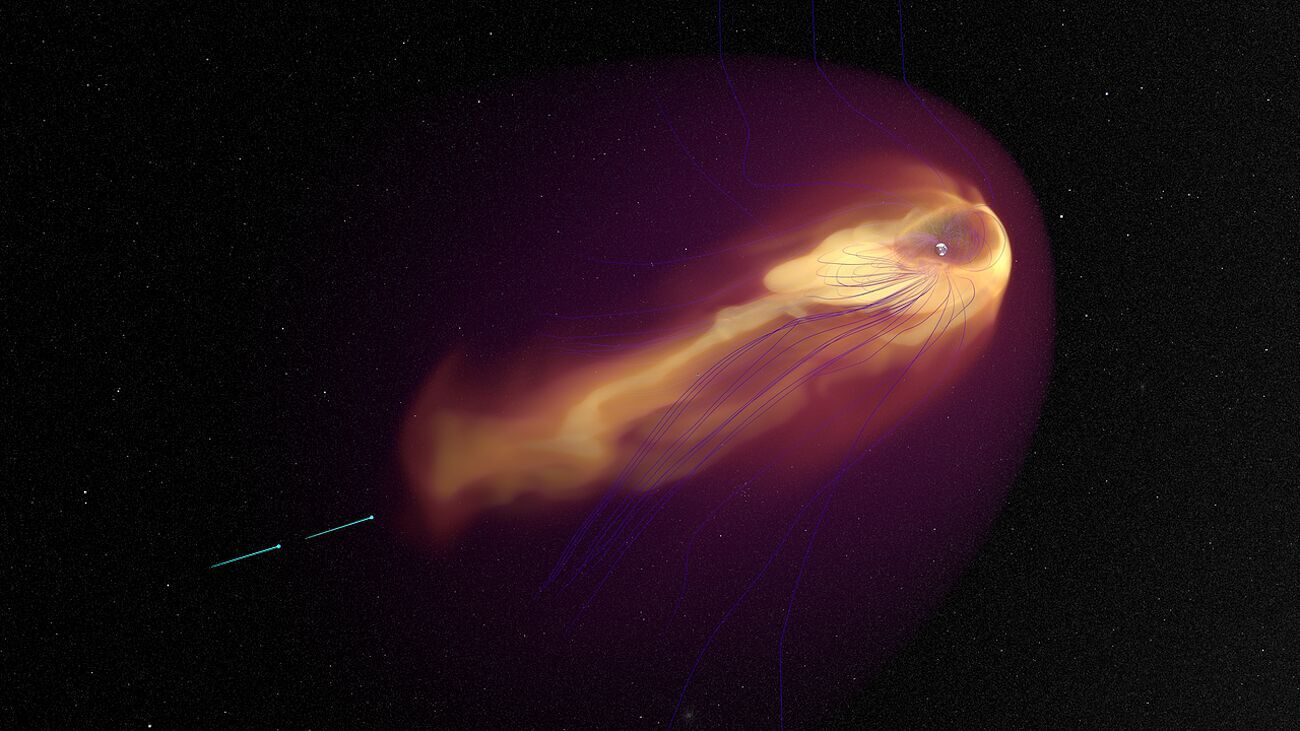
© NASA's Scientific Visualization Studio - ADNET Systems, Inc./AJ Christensen, Kyoto University/Yusuke Ebihara, University of California, Berkeley/Robert Lillis, eMITS/Vanessa Thomas, eMITS/Joy NgA rendering of Earth's magnetotail extending behind it, away from the sun.
Article Sources:
Shang, W., Liu, J., Xu, Z., Yue, C., Guo, R., Xiao, C., Shi, Q., Wimmer-Schweingruber, R., Guo, J., William, D. A., Rankin, R., Tian, A., Zong, Q., Han, C., Park, J., Wang, H., Liu, W., Fu, S., Zhai, L. M., . . . Chen, T. (2026). A galactic cosmic ray cavity in Earth-Moon space. Science Advances. 12(1), eadv1908. www.science.org/doi/10.1126/sciadv.adv1908




Reader Comments
~
Yeah - the Van Allen belt cannot be forgotten or denied I reckon - tis a place where there is much electrical energy remnants - broken into little rocks circling around and wondering - what is the meaning of our existances!
It was an awfully long pause between 'sucessful mission' and a return. A simpleton like me assumed there would be more to learn on the moon, maybe even a second space station past the belt...
Man walked on the moon....the LIE that will never die...Man NEVER walked on the moon! What does NASA (Never A Straight Answer) have to figure out before going to Mars?? In their own words..How to pass through those pesky Van Allen belts of radiation..But wait...Man did it the the 1970's you may ask...And again in their own words..."We LOST the technology"..WTF??? The BIGGEST thing man has ever done and NASA lost the tech??? SORRY but you will have to GIVE ME A BREAK...So much proof it never happened like converging shadows..Oh thats right the moon has 2 suns...No stars..Wait they can be seen from Mars....No dust on landers feet or crater from landing engine..must have rained that day....The sound of a hammer bounding in a stake...Thought sound didnt travel in a vacuum...Flags and tool bags waving in the studio breeze...Now Nasa's proof is pictures of the landing sites from orbit...But if NASA faked it all...what stops them from faking it ALL....Bad case of fox guarding the hen house...Only thing I know is the light at the end of the tunnel is not an illusion....The tunnel IS!!!
Amazing that Kodak film made it through the belt unaffected, they must have protected that tech when it became clear it was a major feat...
Light, shine in the darkness, and the lies are destroyed...
what about those meteors in the solar system circling the sun at a place where a planet may have been
Here is the response: Bottom line is I also don't think anybody has walked on the moon.