
© Prehistory Decoded
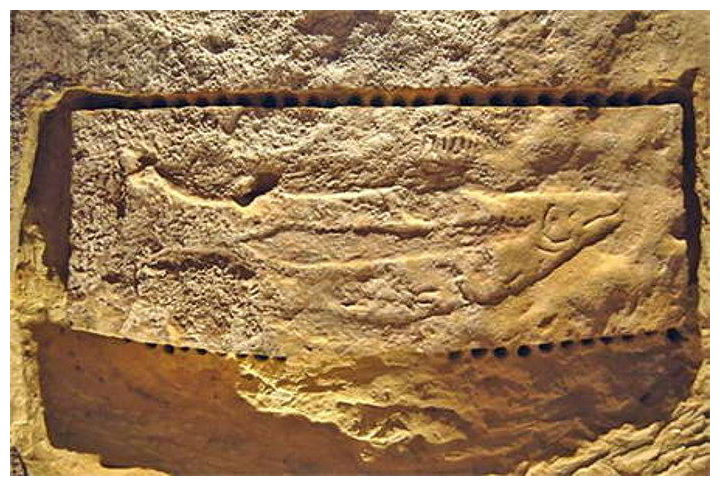
The earliest potential Pisces-fish symbol might be the carved salmon in the L'Abri du Poisson cave, France (BTW, Don's maps is a simply brilliant resource for Palaeolithic art - how he found the time to visit all these sites, I'll never know). Unfortunately, this fish carving can't be radiocarbon dated, so we can't know whether it corresponds to Pisces or not. But given that we have proven that animal symbols in Palaeolithic art do generally represent constellations, and given the undoubted effort and expertise that has gone into this particular one, it appears to be a good candidate.
We also saw fish carved onto some Mesopotamian seal stamps from around 3200 BC, and wondered if they too represented Pisces (see an earlier post on the origin of writing). If they do, they must be older than thought, because Pisces is the winter solstice only until 3600 BC. From around 3600 to 3400 the winter solstice transitions from Pisces to Aquarius, typically represented by the stag or ibex (see an earlier post 'stag vs ibex').
I recently briefly visited the British Museum in London - Wow! The place is full of stuff we have plundered from around the world. A treasure trove of past misdemeanors, with so many animal symbols. It's tricky to work out which cultures actually knew about our ancient zodiac, and which ones didn't. Not all animal representations are zodiacal - some simply represent animals, as you might expect. Nevertheless, the further back in time we go, the more consistently we observe agreement with our ancient zodiac. It seems the advent of writing, which allowed a more accurate representation of dates, spelled the beginning of the end for our zodiacal system.














Comment: See also: