Animals
S


Attention

Adapt 2030 Ice Age Report: Foods disappearing one by one

Locusts in Africa
© YouTube/Adapt 2030 (screen capture)
As global grain, vegetable, fruit and nut yields continue to decline, we will be retrained to eat blemished fruit and taught not to hunt feral pigs because that's only what the authorities can do. A discouragement for self sufficiency and only rely on supermarkets which will be less and less stocked, meaning prices up and declining alternatives for consumers. Big-Ag lobbying to keep food only through their supply chains.


Comment: The coronavirus crisis, in addition to earth changes affecting crop growth, and the losing value of currency which is set to get much worse in Western nations in particular, have made the production, availability, purchasing and distribution of food - a MAJOR global issue the likes of which we haven't seen in generations.

See related articles:


Question

Thousands of seabirds wash up on north-east beaches of Scotland

Black guillemot birds have been washing up on beaches across the north-east
The public are urged to stay vigilant as thousands of birds wash up on beaches across the north-east.

New Arc rescue centre has been receiving a number of calls regarding guillemots washed up on beaches across the north-east, most of which are dead.

Head of the charity, Keith Findlay is asking people walking along beaches to check on the birds. He said: "This is happening at a time near the start of the breeding season and although the birds are not a rare species, this could have a major impact on their population."

It's not certain why exactly so many of the birds have washed on the north-east shores however, Mr Marley said:" The birds that have been coming into us have been quite underweight so it's presumably food-related."

Question

Hundreds of birds found dead on cruise ship open decks

dead birds
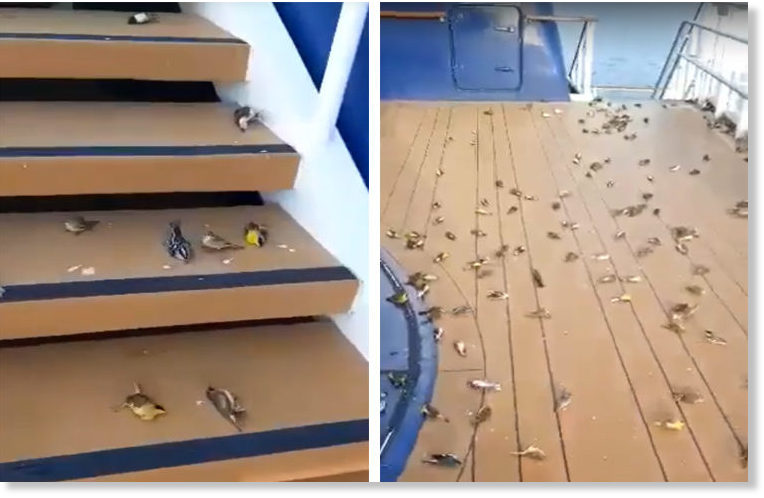
Hundreds of birds were discovered dead on a cruise ship open deck by the crew, yesterday morning. A crew member who wishes to remain anonymous recorded a video of the sight which appears as if the birds had dropped down dead from the sky. There were many birds flying around the ship the night before "It was a beautiful night and we couldn't believe our eyes when we woke up this morning and see so many dead birds all around the ship's open deck" the crew member says.

"We wake up with announcements asking to not go to the open decks. To not touch the birds, and to feed them. I thought that the poor birds we're alive and I didn't went there. I love animals and I didn't want to see them and couldn't help in anything. I still can't stop to cry and nobody give reasonable explanation" says another crew member.


Comment: The explanation usually tossed out for these kind of events - that the birds may have been attempting to avoid an aerial predator - seems superficially plausible at first. However if this was really the case one might reasonably expect to see numerous examples and witness reports of mass fatalities like the above happening in the natural world every single day.

Clearly this is not the case.

The explanation just doesn' t fly.

Something odd is going on.


Info

100 million years ago, the Sahara was the most dangerous place

Kem Kem group animals
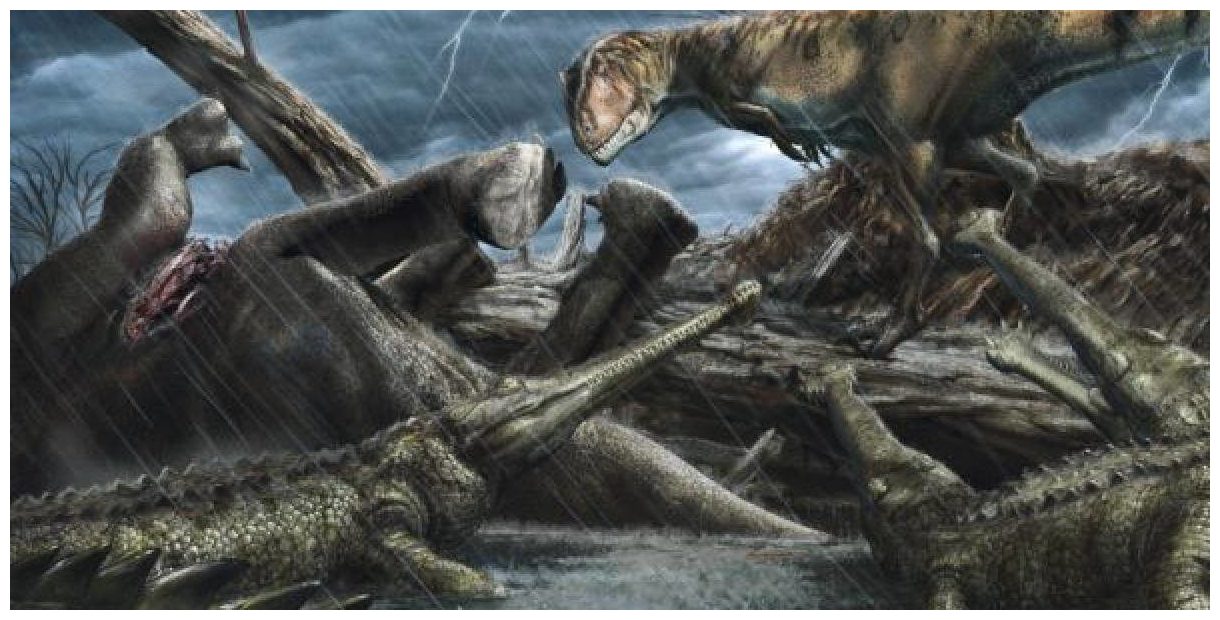
© UNIVERSITY OF PORTSMOUTHArtist's illustration of Kem Kem group animals.
100 million years ago, ferocious predators, including flying reptiles and crocodile-like hunters, made the Sahara the most dangerous place on Earth.

This is according to an international team of scientists, who have published the biggest review in almost 100 years of fossil vertebrates from an area of Cretaceous rock formations in south-eastern Morocco, known as the Kem Kem Group.

The review, published in the journal ZooKeys, "provides a window into Africa's Age of Dinosaurs" according to lead author Dr Nizar Ibrahim, an Assistant Professor of Biology at the University of Detroit Mercy and Visiting Researcher from the University of Portsmouth.
This was arguably the most dangerous place in the history of planet Earth, a place where a human time-traveller would not last very long.

Dr Nizar Ibrahim, Visiting Researcher
About 100 million years ago, the area was home to a vast river system, filled with many different species of aquatic and terrestrial animals. Fossils from the Kem Kem Group include three of the largest predatory dinosaurs ever known, including the sabre-toothed Carcharodontosaurus (over 8m in length with enormous jaws and long, serrated teeth up to eight inches long) and Deltadromeus (around 8m in length, a member of the raptor family with long, unusually slender hind limbs for its size), as well as several predatory flying reptiles (pterosaurs) and crocodile-like hunters. Dr Ibrahim said: "This was arguably the most dangerous place in the history of planet Earth, a place where a human time-traveller would not last very long."

Info

Hidden geometric pattern found at Göbekli Tepe

Gobekli Tepe Carvings
© DICK OSSEMANCryptic carvings at Gobekli Tepe, 'world's oldest temple'.
The enigmatic monoliths built some 11,500 years ago at Göbekli Tepe have been puzzling archaeologists and challenging preconceptions about prehistoric culture since their discovery in the 1990s. Chiefly, how could hunter-gatherers with a supposedly primitive societal structure build such monumental stone circles on this barren hilltop in what is today southeastern Turkey? How could a largely nomadic society at the dawn of agriculture marshal the resources and know-how to create what its discoverers have dubbed the oldest known temple in the world?

If anything, a discovery by Israeli archaeologists suggests the Göbekli Tepe construction project was even more complex than previously thought, and required an amount of planning and resources thought to be impossible for those times. Their study of the three oldest stone enclosures at Göbekli Tepe has revealed a hidden geometric pattern, specifically an equilateral triangle, underlying the entire architectural plan of these structures.

This implies that, in contrast to the prevailing assumption among Göbekli researchers until now, these three circles were planned as a single unit and possibly built at the same time, say archaeologists Gil Haklay and Avi Gopher of Tel Aviv University.

Thus, thousands of years before the invention of writing or the wheel, the builders of Göbekli Tepe evidently had some understanding of geometric principles and could apply them to their construction plans, concludes the study published in January in the Cambridge Archaeological Journal.

Bug

Bugged: Earth's insect population shrinks 27% in 30 years

This undated photo provided by Michael Thomas in April 2020 shows a clouded sulphur butterfly in Cromwell, Conn.
© Mike ThomasThis undated photo provided by Michael Thomas in April 2020 shows a clouded sulphur butterfly in Cromwell, Conn.
The world has lost more than one quarter of its land-dwelling insects in the past 30 years, according to researchers whose big picture study of global bug decline paints a disturbing but more nuanced problem than earlier research.

From bees and other pollinators crucial to the world's food supply to butterflies that beautify places, the bugs are disappearing at a rate of just under 1% a year, with lots of variation from place to place, according to a study in Thursday's journal Science.

That's a tinier population decline than found by some smaller localized studies, which had triggered fears of a so-called insect apocalypse. But it still adds up to something "awfully alarming," said entomologist Roel van Klink of the German Centre for Integrative Biology, the study's lead author.

Attention

Boy is eaten alive by stray PIGS after wandering out of his house to play in India

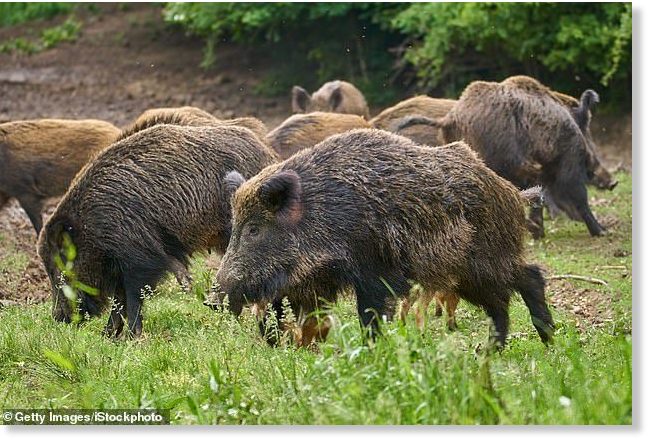
Four-year-old V. Harshavardhan was killed by a herd of wild pigs as he played near his home in Hyderbad, India (stock image)
A four-year-old boy in India died after he was attacked by a herd of pigs which then ate part of his body.

V. Harshavardhan left his home in Saibabad, Hyderbad, at 4pm on Tuesday and went to play at an isolated area near his home.

The herd of wild pigs dragged the boy to a rubbish dump where they killed and then ate him.

Blue Planet

Adapt 2030 Ice Age Report: The phase out of humanity

Earth Day 2020
© YouTube/Adapt 2030 (screen capture)
With Earth Day the signal to a move away from renewables is set in motion, humans are the problem and need to be phased out after being relegated to menial tasks and medieval surfs on Universal Basic Income as the wildlife renews itself returning where human apes once roamed. There will be no return to normal, you are being phased out.


Comment: See also:


Info

Researchers find first traces of amphibians in Antarctica

Palaeontologists at Seymour Island
© FEDERICO DEGRANGE, CENTRO DE INVESTIGACIONES EN CIENCIAS DE LA TIERRA AND JONAS HAGSTRÖM, SWEDISH MUSEUM OF NATURAL HISTORYPalaeontologists at the fossil site on Seymour Island.
The discovery of the earliest known modern amphibians in Antarctica provides further evidence of a warm and temperate climate in the Antarctic Peninsula before its separation from the southern supercontinent Gondwana.

The fossils, which belong to the family of helmeted frogs, are described in a paper in the journal Scientific Reports by researchers from Sweden, Argentina and Switzerland.

They discovered the remains of a hip bone and ornamented skull bone during expeditions to Seymour Island between 2011 and 2013. The specimens are about 40 million years old, from the Eocene period. Both belong to the Calyptocephalellidae family.

No traces of cold-blooded amphibians or reptiles from families still in existence had previously been found in Antarctica.

"Among Recent amphibians, the frogs (Anura) have the widest distribution, covering all continents except Antarctica, where the conditions have been uninhabitable for over tens of millions of years," the researchers write.

Attention

Humpback whale washes up on San Francisco beach

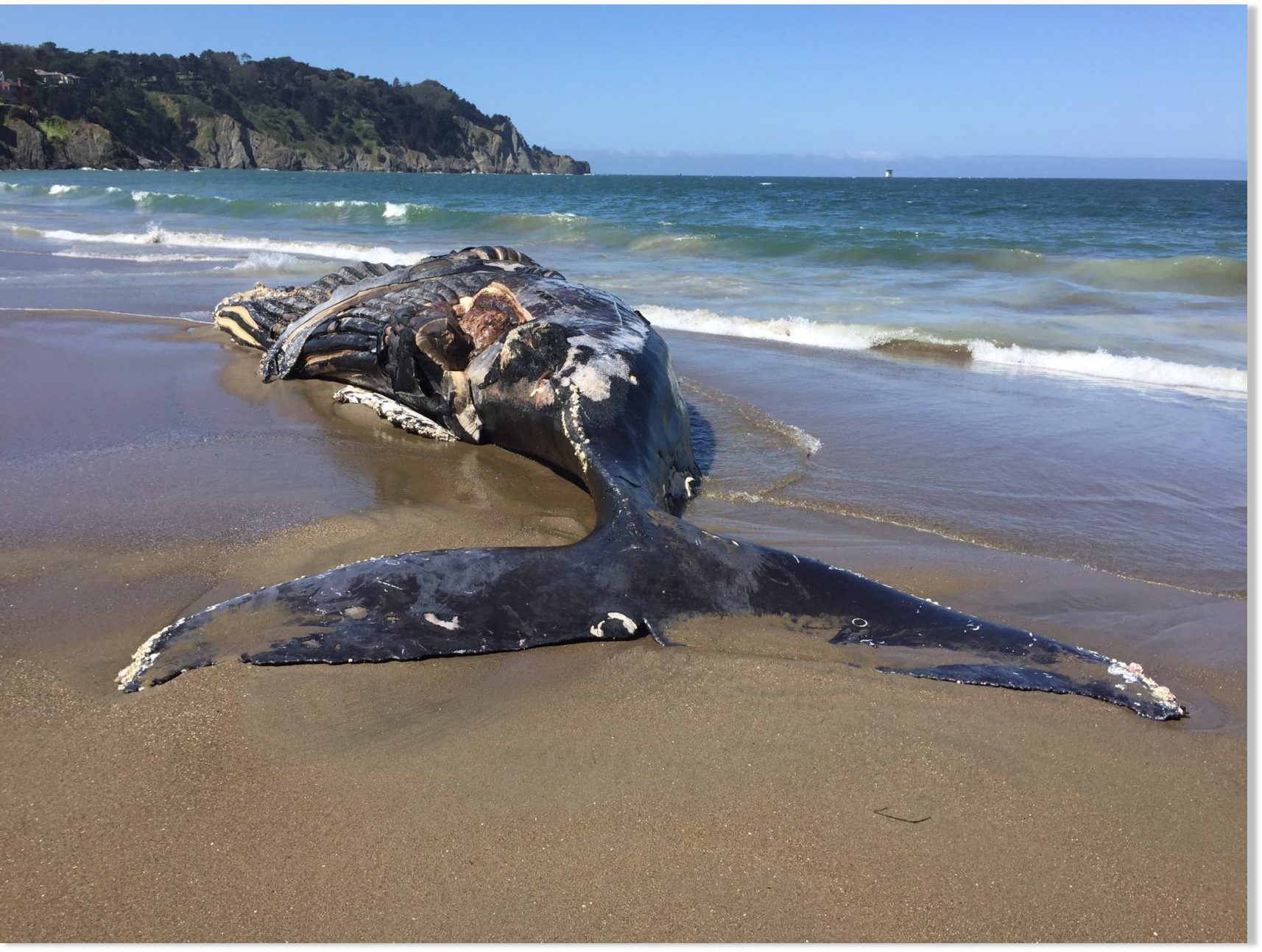
A dead humpback whale washed up at San Francisco’s Baker Beach on Tuesday.
© Dean C. SmithA dead humpback whale washed up at San Francisco’s Baker Beach on Tuesday.
A severely decomposed young humpback whale washed ashore on a San Francisco beach and experts said Tuesday they were trying to determine how it died.

Dr. Pádraig Duignan, Chief Pathologist at The Marine Mammal Center in Sausalito, said the center was alerted early Tuesday to a dead whale on San Francisco's Baker Beach.

A small team of scientists from the center and California Academy of Sciences performed a partial necropsy on the 37-foot-long (11-meter) whale. Details on what killed the whale won't be available until a final necropsy report is completed, he said.