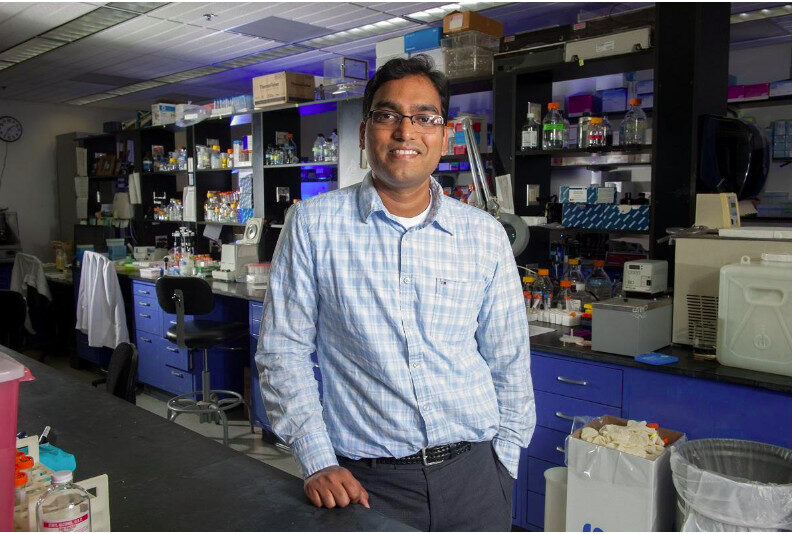
© Edwin RemsbergBhanu Telugu in his lab at UMD.
In a new paper published in
Stem Cell Reports, Bhanu Telugu and co-inventor Chi-Hun Park of the University of Maryland (UMD) Department of Animal and Avian Sciences
show for the first time that newly established stem cells from pigs, when injected into embryos, contributed to the development of only the organ of interest (the embryonic gut and liver), laying the groundwork for stem cell therapeutics and organ transplantation. Telugu's start-up company,
Renovate Biosciences Inc. (RBI), was founded with the goal of leveraging the potential of stem cells to treat terminal diseases that would otherwise require organ transplants, either by avoiding the need for transplants altogether or creating a new pipeline for growing transplantable human organs. With the number of people who suffer from organ failures and the 20 deaths per day in the U.S. alone purely from a lack of available organs for transplant, finding a new way to provide organs and therapeutic options to transplant patients is a critical need. In this paper, Telugu and his team are sharing their first steps towards growing fully transplantable human organs in a pig host.
"This paper is really about using the stem cells from pigs for the first time and showing that they actually can be injected into embryos and only go to the endodermal target organs like the liver, which is very important for delivering safe therapeutic solutions going forward," says Telugu. "This is an important milestone. It's a pipe dream in a way because a lot of things need to work out between here and full organ transplantation, but this paper sets the stage for all our future research. We can't really just go and start working with humans in work like this, so we started with pig-to-pig transfer in this paper, working with the stem cells and putting them back into other pigs to track the process to make sure it is safe for liver production as proof-of-concept."
Telugu and his team pitched this work at UMD Bioscience Day on behalf of his company, RBI, and received the
Inventor Pitch Award and the
UMD Invention of the Year Award in 2018. In order to protect the intellectual property, Telugu worked with the UMD Office of Technology Commercialization (OTC) to secure patents and open the work up for additional fundraising to carry this technology through the preclinical and clinical stages. The Maryland Stem Cell Foundation provided some funding to advance this work, and Telugu is thankful that Maryland funds technologies in the human stem cell space.

















Comment: In the same state of Tamil Nadu a day earlier a man riding a bicycle was trampled to death.