Ozone depletion following the Toba eruption around 74,000 years ago compounded the ensuing volcanic winter and caused a human population bottleneck.
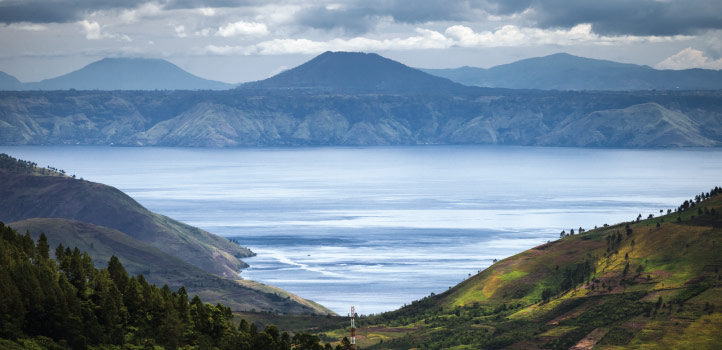
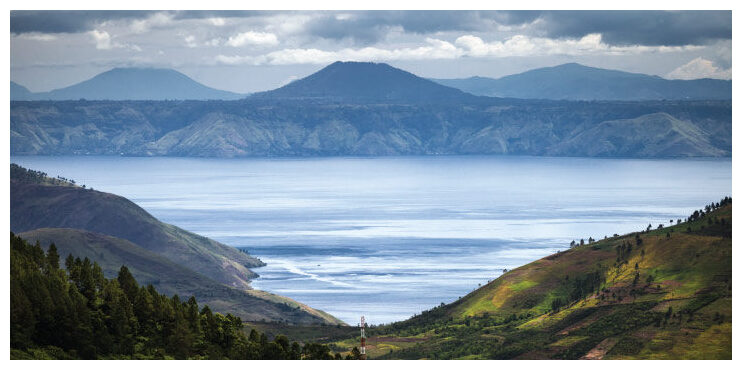
© Karpov Oleg/ShutterstockThe eruption of the Toba volcano 74,000 years ago affected the planet's climate so drastically that it led to a drop in the human population.
A catastrophic drop in atmospheric ozone levels around the tropics is likely to have contributed to a bottleneck in the human population around 60 to 100,000 years ago, an international research team has suggested.
The ozone loss, triggered by the eruption of the Toba supervolcano located in present-day Indonesia, might solve an evolutionary puzzle that scientists have been debating for decades."Toba has long been posited as a cause of the bottleneck, but initial investigations into the climate variables of temperature and precipitation provided no concrete evidence of a devastating effect on humankind," says Sergey Osipov at the Max Planck Institute for Chemistry, who worked on the project with KAUST's Georgiy Stenchikov and colleagues from King Saud University, NASA and the Max Planck Institute for Chemistry.
"We point out that, in the tropics, near-surface ultraviolet (UV) radiation is the driving evolutionary factor. Climate becomes more relevant in the more volatile regions away from the tropics," says Stenchikov.
Large volcanic eruptions emit gases and ash that create a sunlight-attenuating aerosol layer in the stratosphere, causing cooling at the Earth's surface. This "volcanic winter" has multiple knock-on effects, such as cooler oceans, prolonged El Niño events, crop failures and disease.







Comment: A few days ago a significant earthquake swarm hit southern California.