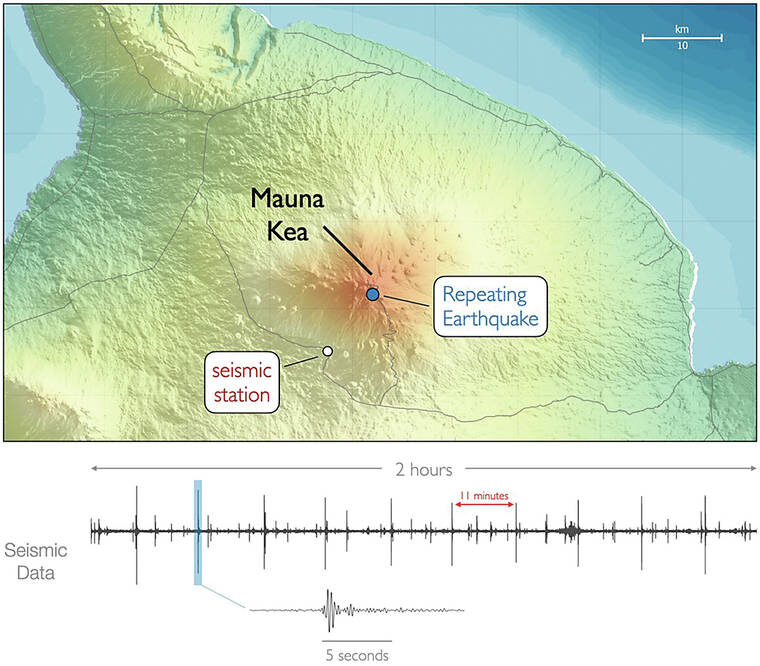
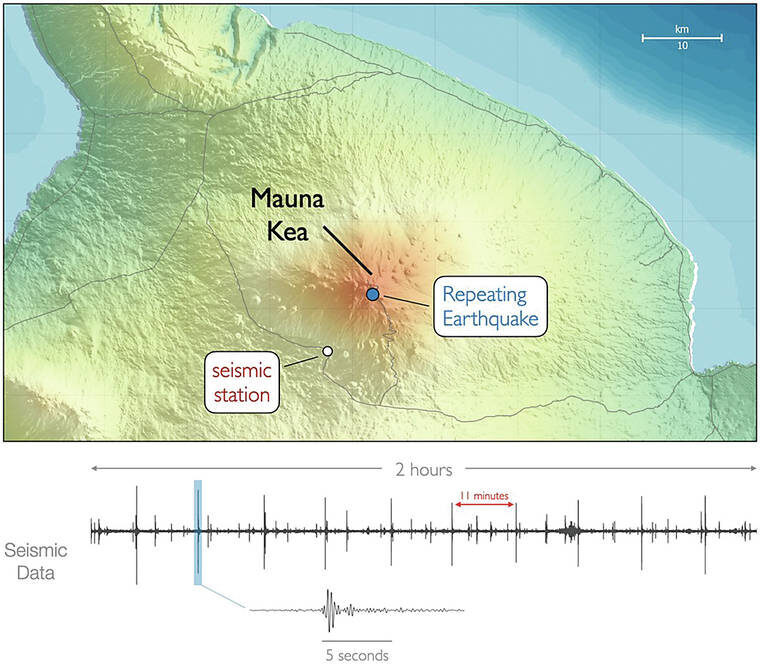
Example of 2 hours of seismic data from the station near Maunakea on April 14. The large spikes are earthquakes under Maunakea repeating every 11 minutes. The bottom waveform zooms in on 15 seconds of an individual event.
Maunakea volcano hasn't erupted in over 4,500 years, but that doesn't mean it's quiet. In fact, for decades it has been hiding one of the most unique seismic signals seen at any volcano.
Some discoveries are just serendipity. Several years ago, U.S. Geological Survey seismologists at the Hawaiian Volcano Observatory and Alaska Volcano Observatory were trying out a new method to track seismicity at Kilauea Volcano. The method scans 24-hour sections of seismometer data looking for signal similarity on many instruments. Out of curiosity, they decided to look at the rest of the Island of Hawaii to see what else they might find.
What they found came as a surprise. A study published in the journal
Science in May, 2020 describes
how they detected deep earthquakes beneath Maunakea that repeat every 7-12 minutes. Noise in the seismic records from wind and nearby cars, together with the small size of the individual earthquakes (magnitude 1.5), had prevented these earthquakes from being detected with the regular earthquake detection system.
The small, repeating earthquakes occur at depths of about 20-25 km (12-15 mi) directly beneath Maunakea's summit and happen every 7-12 minutes with surprising regularity. Furthermore, the repeating events can be detected going back to at least 1999. This was when a particularly quiet seismic station was installed in the saddle between Maunakea and Mauna Loa. It is very likely that the repeating earthquakes were occurring even further back in time.







Comment: See also: