Earthquakes
S


Bizarro Earth

Magnitude 6.5 earthquake strikes northern coast of Chile - 3rd strong quake in 24 hours

Chile Earthquake
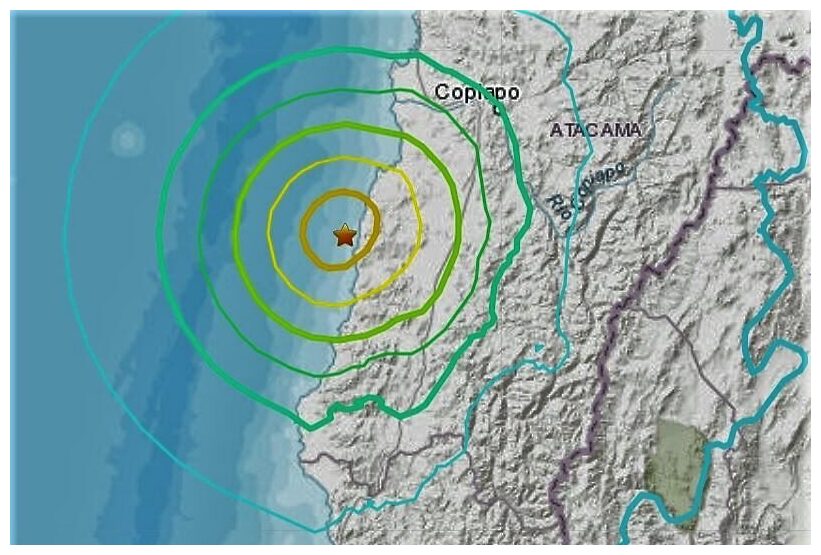
© U.S. Geological SurveyThe quake was followed by more than a dozen aftershocks -- including one with a magnitude of 6.1.

A magnitude 6.5 earthquake struck near the coast of Northern Chile on Tuesday, the GFZ German Research Centre for Geosciences said, with local news media reporting some damage and minor landslides in areas near the epicenter.

Chile's interior ministry said in a statement that mining companies operating in the area had not reported any issues in the 2-1/2 hours since the initial quake. GFZ has reported several aftershocks of magnitudes between 5.5 and 6.2.

Chile is the world's largest copper producer and most of its large operations are in Antofagasta region, more than 300 km (180 miles) north of the quake's epicenter.

Miner Antofagasta Plc told Reuters that its operations at Los Pelambres, the closest large deposit to the epicenter, some 379 km (236 miles) in a straight line, had not been affected.

Patricio Elgueta, a union chief at state miner Codelco's El Salvador mine 200 km (120 miles) north, said operations continued as normal.

Mine facilities and other infrastructure in Chile are built to withstand large quakes.

The interior ministry's National Emergency Office said there had been some localized power outages and landslides blocking roads.

Comment: Also within the same 24 hours: Magnitude 6.8 earthquake strikes off the coast of Chile - shortly followed by a magnitude 6.3


Seismograph

Magnitude 6.8 earthquake strikes off the coast of Chile - shortly followed by a magnitude 6.3

MAP QUAKE
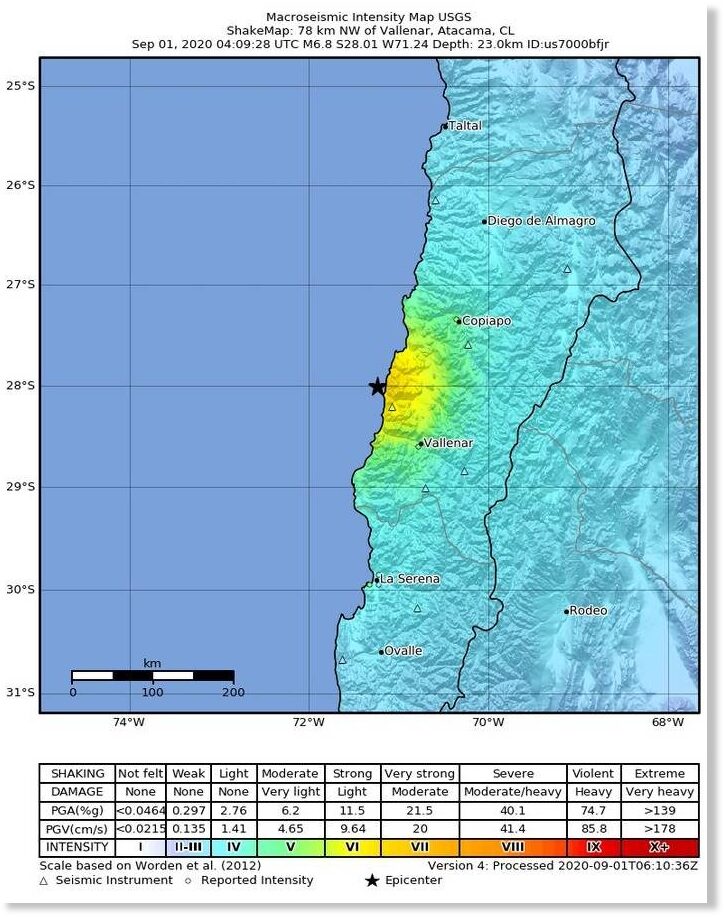
The U.S. Geological Survey says a strong earthquake with a preliminary magnitude of 6.8 has struck off the coast of northern Chile

A strong earthquake with a preliminary magnitude of 6.8 struck off the coast of northern Chile in the first minutes of Tuesday, the U.S. Geological Survey said.

There were no immediate reports of casualties or damage and the Chilean navy said there was no possibility of a tsunami.

The quake occurred at 12:09 a.m. local time at a depth of 35 kilometers (22 miles). It was centered 78 kilometers (48 miles) northeast of the Atacama city of Vallenar. A few minutes later, a second quake occurred with a preliminary magnitude of 6.3.

Seismograph

Shallow 6.2-magnitude earthquake hits Chagos Archipelago region of the Indian Ocean

quake
An earthquake with a magnitude of 6.2 jolted Chagos Archipelago region at 17:24:04 GMT on Monday, the U.S. Geological Survey said.

The epicenter, with a depth of 10 km, was initially determined to be at 4.0692 degrees south latitude and 70.2513 degrees east longitude.

Xinhua

Seismograph

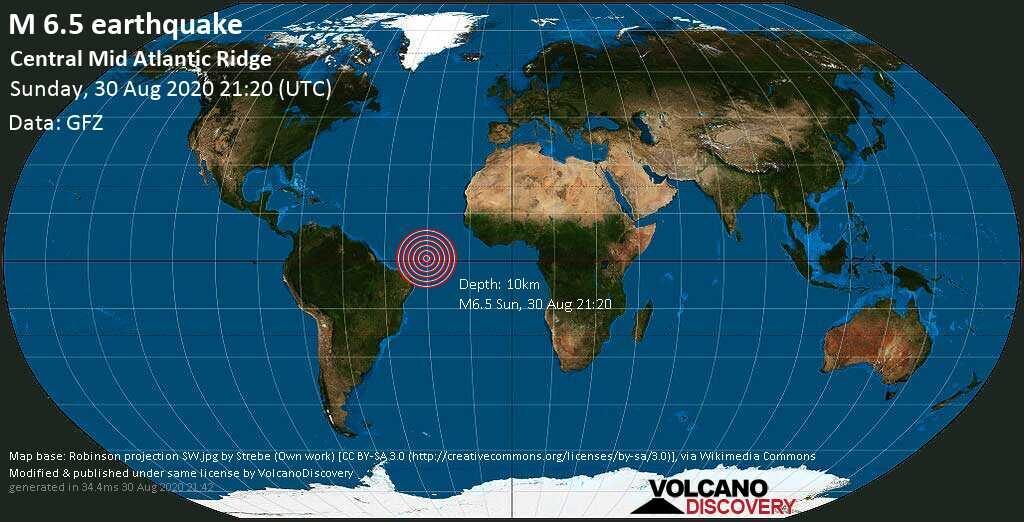
Shallow M6.5 earthquake strikes Central Mid Atlantic Ridge

mid Atlantic ridge quake
Date & time: Sunday, 30 August 2020 21:20 UTC
Magnitude: 6.5
Depth: 10.0 km
Epicenter latitude / longitude: 0.76°N / 29.9°W (international territory)
Primary data source: GFZ
Estimated released energy: 3.5 x 10¹⁴ joules (98.6 gigawatt hours, equivalent to 84802 tons of TNT or 5.3 atomic bombs!)

Seismograph

Do mystery odors in Japan predict an upcoming earthquake?

Image of Tokyo and Yokohama, Japan, after the September 1, 1923 earthquake
© USGS/George A. Lang CollectionImage of Tokyo and Yokohama, Japan, after the September 1, 1923 earthquake.
Kanagawa Prefecture, site of Japan's second largest city, Yokohama, and home to 9.2 million people has recently seen numerous reports of unexplained strange smells permeating the air in a coastal region sitting above the epicenter of the devastating 1923 Great Kanto Earthquake.

And worryingly, at least one prominent seismologist indicates this could be a precursor of another earthquake.

Most recently reported early Friday, the gas-like smell was reported to the local Yokosuka Fire Department multiple times over the course of an hour, although nobody was eventually taken sick because of the smell.

Just a month earlier, on July 17th the same thing happened with calls from the across the Miura peninsula to authorities complaining about the exact same thing, and six weeks prior to that the same again.

Yet no known cause has been detected.

However, Japanese seismologist Manabu Takahashi from Ritsumeikan University now fears that the smells could predate a quake in the area; something he has long studied according to reports from Japan.

The site the smells have been detected at sit near the meeting point of the Nankai, Sagami, and Suruga trough fault lines and too close to comfort to the 1923 quake epicenter that left around 140,000 dead across the wider Kanagawa and Kanto plains.

Seismograph

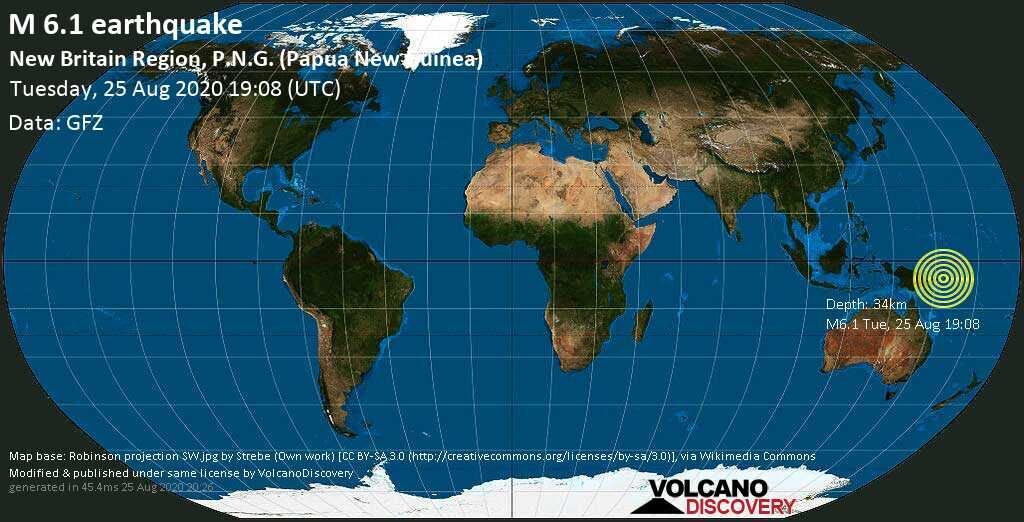
M6.1 earthquake hits New Britain Region, Papua New Guinea

PNG earthquake map

Date & time: Tuesday, 25 August 2020 19:08 UTC
Magnitude: 6.1
Depth: 34.0 km
Epicenter latitude / longitude: 5.49°S / 151.81°E (Papua New Guinea)
Nearest volcano: Bamus (66 km)
Primary data source: GFZ
Estimated released energy: 8.9 x 10¹³ joules (24.8 gigawatt hours, equivalent to 21301 tons of TNT or 1.3 atomic bombs!)

Seismograph

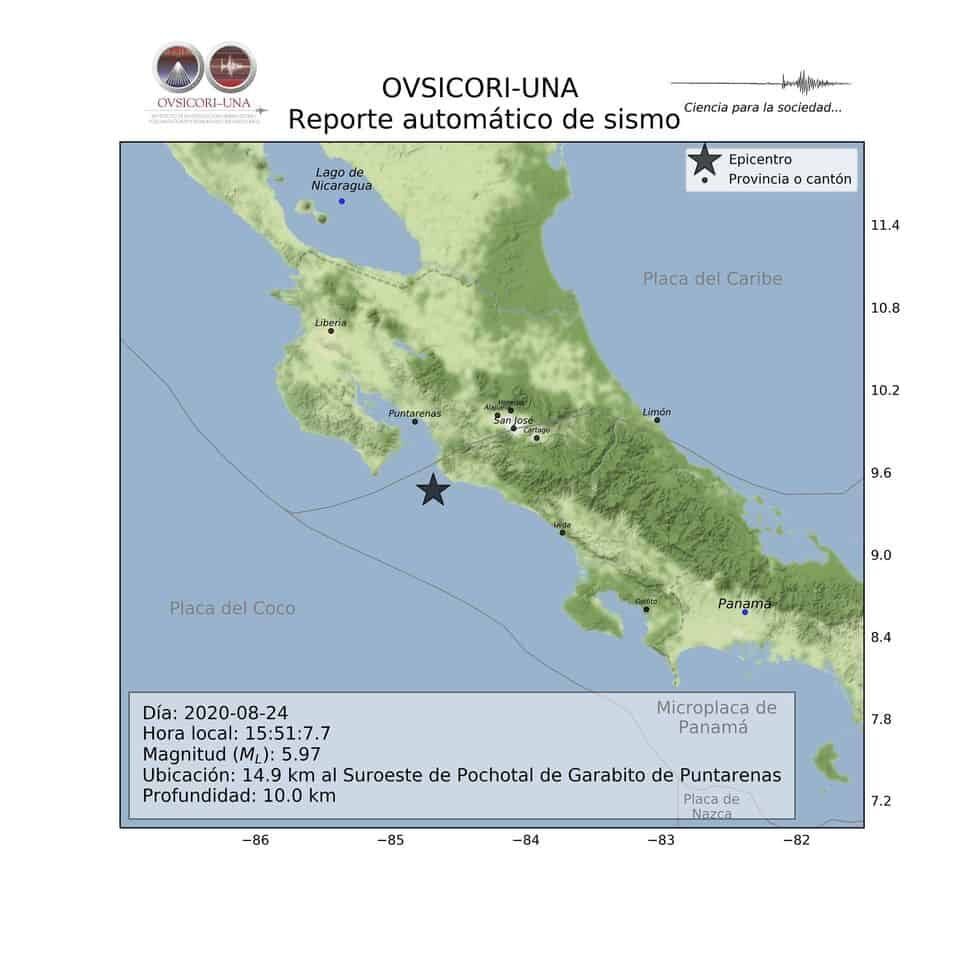
6.2 magnitude earthquake shakes Costa Rica

Costa Rica earthquake map
A moderately strong earthquake shook Costa Rica this Monday, August 24 at 3:50 pm.

According to the National Seismologic Network (RSN)the earthquake had a magnitude of 6.2 and the epicenter was located 12 kilometers southwest of Jaco, Garabito, Puntarenas as a result of the subduction of Cocos plate.

Attention

Fermi 2 nuclear power plant 'stable' after rare earthquake near Detroit Beach, Michigan

A 3.2-magnitude earthquake was reported near Monroe around 6:55 p.m. on Friday, Aug. 21, 2020.
© U.S. Geological SurveyA 3.2-magnitude earthquake was reported near Monroe around 6:55 p.m. on Friday, Aug. 21, 2020.
A minor earthquake near Detroit Beach rattled Downriver areas and was felt in places through the region, but left the nearby Fermi 2 nuclear power plant in a safe condition, officials said.

The 3.2-magnitude earthquake was recorded Friday evening south-southeast of Detroit Beach near Monroe by the U.S. Geological Survey, about two miles south of the nuclear plant.

The earthquake, rare for Michigan, occurred at 6:55 p.m just off the shoreline of Sterling State Park, according to USGS.

Depth was determined to be 9.2 km, or about 5.71 miles. The USGS initially reported the quake as reaching 3.4 magnitude.


Attention

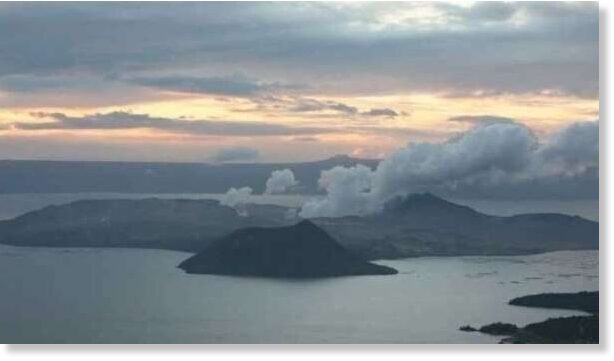
20 quakes recorded in 24 hours at Taal Volcano, Philippines

Taal Volcano
Taal volcano
Twenty volcanic earthquakes were recorded at the Taal Volcano island in Batangas in the past 24 hours, the Philippine Institute of Volcanology and Seismology (Phivolcs) reported yesterday.

State seismologists observed a weak steaming activity that reached five meters high from the vents on the main crater between 8 a.m. on Saturday and 8 a.m. yesterday.

The volcano remains under Alert Level 1, which means it is still in abnormal condition, the agency said.

On Aug. 18, a 20-meter- high steam emission was observed from the vents of the main crater.

Seismograph

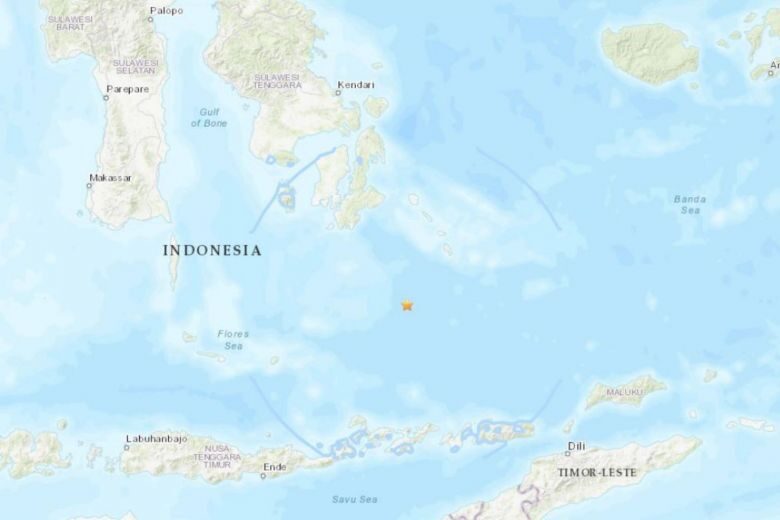
Deep M6.9 earthquake strikes Banda Sea off Indonesia

Banda Sea earthquake
© USGSThe quake was at a depth of 640km, with an estimated magnitude of 6.9.
A 6.9-magnitude quake struck eastern Indonesia on Friday (Aug 21), the US Geological Survey (USGS) reported, but there was no tsunami warning issued and no immediate reports of casualties or major damage.

In Kupang city, far south of the quake's epicentre in the Banda Sea, frightened residents ran outside as buildings and streetlights swayed.

"I was in the shopping centre when the quake hit," said resident Engky Nussi. "Many people ran outside as stuff started falling off the shelves and we were afraid something worse might happen."

The undersea tremor struck at a depth of more than 600km about 220km south of Katabu on the island of Sulawesi, the USGS said.

Deep quakes tend to cause less damage than shallow ones and USGS said there was a low likelihood of casualties and damage.

Comment: Only two days ago on Wed. 19 Aug. twin shallow 6.8 & 6.9 magnitude earthquakes hit Indonesia within 10 minutes of each other.