Earth ChangesS


Arrow Up

May be decades before contaminated groundwater sites are cleaned up

Contaminated Ground Water
© Photos.com
A new report from the National Research Council revealed that at least 126,000 sites across the U.S. have contaminated groundwater that requires remediation.

Approximately 10 percent of those sites are considered "complex," which means that restoration efforts will likely be unsuccessful for 50 to 100 years due to technical limitations. The estimated cleanup cost ranges from $110 billion to $127 billion, however, the report states that both the number of sites and the cost are likely underestimated.

Over the last 30 years, several national and state groundwater cleanup programs have been developed with the aim to mitigate the human health and ecological risks posed by underground contamination. Included in these programs are the cleanup at Superfund sites; facilities that treat, store, and dispose of hazardous wastes; leaking underground storage tanks; and military installations. In order to clean up past industrial operations, the Department of Defense has already spent an approximate $30 billion in hazardous waste remediation. Although DOD sites only represent 3.4 percent of the total sites, many of these sites present the greatest technical challenges to restoration and come with a very high price tag. This realization prompted the DOD to create the report detailing the future of groundwater restoration efforts and the challenges faced.

"The complete removal of contaminants from groundwater at possibly thousands of complex sites in the U.S. is unlikely, and no technology innovations appear in the near time horizon that could overcome the challenges of restoring contaminated groundwater to drinking water standards," said Michael Kavanaugh, chair of the NRC committee and a principal with Geosyntec Consultants, Inc. "At many of these complex sites, a point of diminishing returns will often occur as contaminants in groundwater remain stalled at levels above drinking water standards despite continued active remedial efforts. We are recommending a formal evaluation be made at the appropriate time in the life cycle of a site to decide whether to transition the sites to active or passive long-term management."

Blackbox

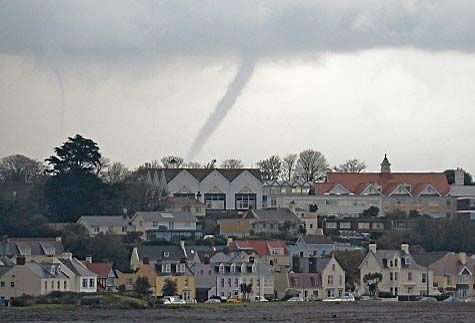
Twister or tornado? Rotating funnel spout seen in Guernsey

Image
Andy Le Page took this picture, looking out from Salerie Corner to St Sampson’s School and Delancey, of the funnel spout that appeared west of the island.
Some islanders frantically searched for their cameras after a funnel cloud was seen to the west of Guernsey yesterday.

Guernsey Airport senior meteorological officer Martin Crozier said the sighting had been recorded and reported to air traffic control at 8.20am.

'What we mean by funnel cloud, is a rotating cloud that descends from the normal cloud but doesn't necessarily touch the surface,' he said.

'If it touches the sea we call it a waterspout and if it touches land, it's a tornado and can do a lot of damage, but that's quite unusual.'

Funnel clouds are reported in or near Guernsey on average between three and six time each year.

Bizarro Earth

Earthquakes on East Coast travel farther and cause more damage due to geologic structure and rock properties

Image
© engadget
Data from the 2011 earthquake centered in Virginia shows East Coast tremors can travel much farther and cause damage over larger areas than previously thought, the U.S. Geological Survey said Tuesday.

The agency estimated about one-third of the U.S. population could have felt the magnitude 5.8 tremor centered about 50 miles northwest of Richmond, which would mean more people were affected than any earthquake in U.S. history. Scientists also found the quake that caused more than $200 million in damage triggered landslides at distances four times farther and over an area 20 times larger than research from previous quakes has shown.

"Scientists are confirming with empirical data what more than 50 million people in the eastern U.S. experienced firsthand: this was one powerful earthquake," USGS Director Marcia McNutt said in a news release about the findings presented at the Geological Society of America conference in Charlotte, N.C.

Ambulance

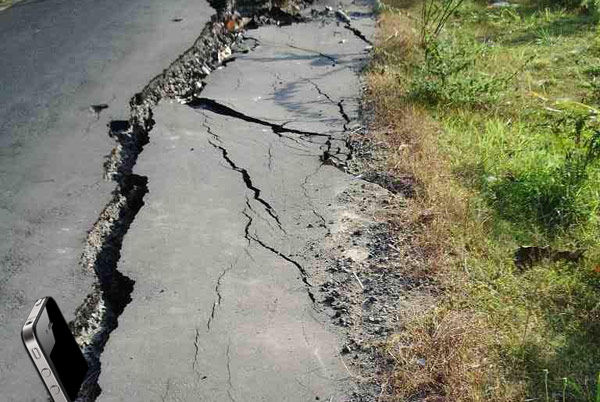
At least 52 dead in 7.4 Guatemala quake


At least 52 people have been killed and hundreds remain missing after a powerful earthquake struck off the Pacific coast of Guatemala, where a tsunami warning has now been issued.

About 125,000 people were without power as a result of the quake.

The 7.4-magnitude earthquake centered about 160km southwest of Guatemala City. It is the strongest to hit the country since a deadly 1976 quake that killed 23,000.

Bizarro Earth

Over 500 pigeons drop dead in Bihar village, India

Patna: More than five hundred pigeons have dropped dead at a village in Bihar's Bhagalpur district over the last four days, causing residents, some of them pigeon-keepers, to fear that something was amiss.

District officials are still to visit the site and conduct an inquiry. "We were shocked, and we cannot understand why it happened," Subodh Kumar Singh, a keeper of pigeons who lost 250 birds in two days, said. Another pigeon keeper, Mohan Singh, said, "We need some manner of inquiry into this. Why did such a large number of pigeons drop dead in a matter of days?" Other pigeon keepers like Subhit Singh, Radhe Singh and Bhumeshwar Singh said that the government ought to investigate the deaths.

While some veterinarians suspected a bird flu or poisoning, others speculated that the deaths could have been caused because of radiation from mobile phone towers. They added that that only an investigation could get to the root of the mystery. Pigeons are valued as pets here, and there is a thriving market for them.

Snowflake Cold

Winter storm Brutus threatens snow, severe weather for US West, Midwest

Image
© Weather.com
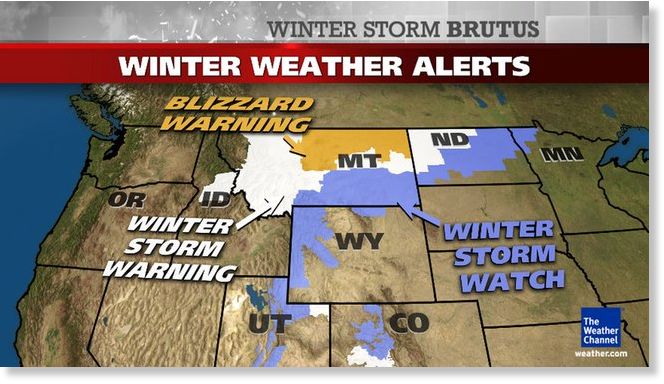
Even before Winter Storm Athena can finish pulling away from the Northeast, we have another significant winter storm system to deal with in the western half of the country: Winter Storm Brutus. This time, not only will there be a wind-snow combo on the cold side of the system, but there will be a warm sector with severe weather potential - eventually.

But first things first.

Wintry Side: Snow, Wind, Blizzard?

With strong low pressure developing over the northern Rockies and a strong high pressure zone to the north over western Canada, the stage is set for a wind-driven snow.

That snow will develop over Montana and central Idaho on Thursday. There will also be snow farther west over the Oregon Cascades and the northern Sierra Nevada in California.

Bizarro Earth

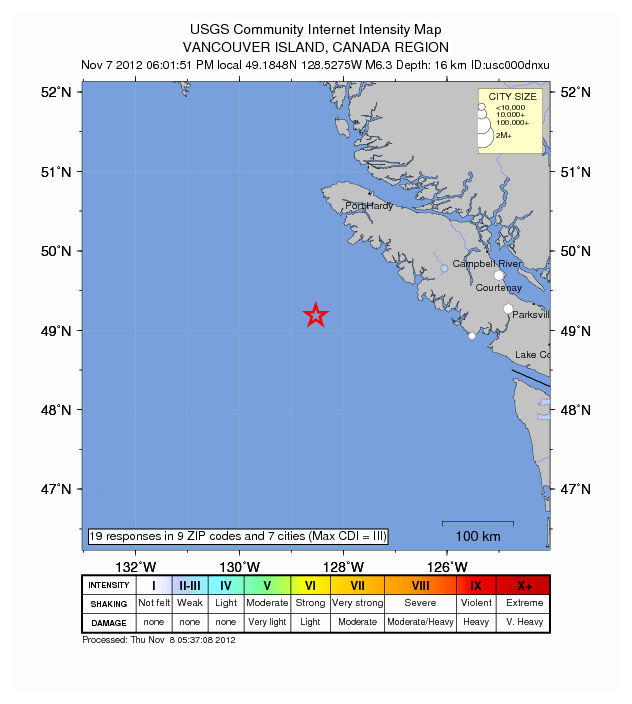
USGS: Earthquake Magnitude 6.3 - SSW of Port Hardy, Canada

Canada Quake_081112
© USGS
Event Time
2012-11-08 02:01:51 UTC
2012-11-07 17:01:51 UTC-09:00 at epicenter

Location
49.185°N 128.528°W depth=16.6km (10.3mi)

Nearby Cities
186km (116mi) SSW of Port Hardy, Canada
254km (158mi) WSW of Campbell River, Canada
262km (163mi) W of Courtenay, Canada
271km (168mi) W of Port Alberni, Canada
387km (240mi) WNW of Victoria, Canada

Technical Details

Snowflake Cold

Cold snap devastates New Zealand vineyards

Image
© NZPA / John Cowpland
Some Central Otago vineyards have lost as much as 50% of their crop after devastating frosts hit the region over the weekend.

Central Otago Winegrowers Association president James Dicey said some vineyards suffered significant losses, with reports of temperatures plummeting to as low as -5.5 degrees Celsius in some areas, rendering frost-fighting techniques next to useless.

"The damage . . . appears to be worst on the road between Wanaka and Cromwell," Dicey said. "I'm on a vineyard at the moment and the damage is extensive, it looks like 50% is gone."

The full extent of the damage would not be known until next month, he said, as there was a chance some vines could recover.

"It's not fantastic news but it's too early to get too depressed about it yet," he said.

Cloud Lightning

New storm bears down on Sandy-battered New York and New Jersey

Image
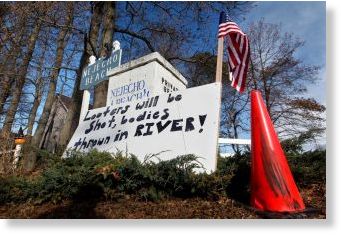
© Mel Evans / APA sign warning against looting is posted in the Nejecho Beach neighborhood of Brick, N.J. Tuesday, Nov. 6, 2012, after the area suffered serious damage from last week's storm surge from Superstorm Sandy. Brick is ordering mandatory evacuations in advance of an approaching nor'easter. Residents in the low-lying waterfront sections of Brick Township have been told to leave their homes by 6 p.m. Tuesday. Those areas are prone to flooding and storm surges.
A nor'easter blustered into New York and New Jersey on Wednesday, threatening to swamp homes all over again, plunge neighborhoods back into darkness and inflict more misery on tens of thousands of people still reeling from Superstorm Sandy.

Under ordinary circumstances, a storm of this sort wouldn't be a big deal, but large swaths of the landscape were still an open wound, with many of Sandy's victims still mucking out their homes and cars and shivering in the deepening cold.

Thousands of people in low-lying neighborhoods staggered by the superstorm just over a week ago were warned to clear out, with authorities saying rain, wet snow and 60 mph gusts in the evening could bring more flooding, topple trees wrenched loose by Sandy, and erase some of the hard-won progress made in restoring electricity to millions of customers.

"I am waiting for the locusts and pestilence next," New Jersey Gov. Chris Christie said. "We may take a setback in the next 24 hours."

In New Jersey, public works crews worked to build up dunes along the shore to protect the stripped and battered coast, and new evacuations were ordered in a number of communities already emptied by Sandy. New shelters opened.

In New York, police went to low-lying neighborhoods with loudspeakers, encouraging residents to leave. But Mayor Michael Bloomberg didn't order new evacuations, and many people stayed behind, some because they feared looting, others because they figured whatever happens couldn't be any worse than what they have gone through already.

Snowflake

Record-breaking blizzard freezes Beijing before Congress

Beijing snow
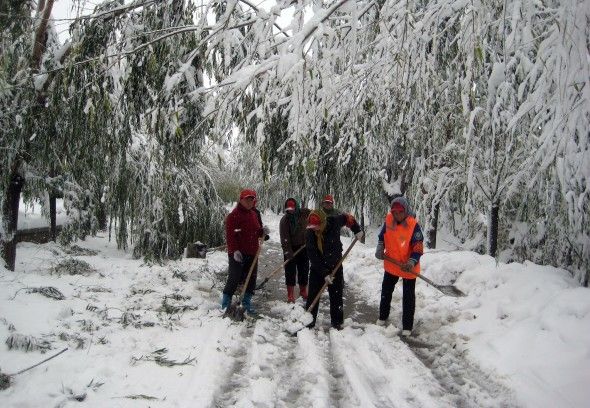
© (STR/AFP/Getty Images)Workers clear a snow-covered street after a heavy snow-fall in the outskirts of Beijing on Nov. 4, 2012.
Netizens and scholar point to traditional culture, and posit causal link

A blizzard swept through northeastern China on Nov. 4, shutting down transportation in Beijing just before the opening of the 18th Party Congress. The unexpectedly early snow storm was commented on heavily, with Internet users drawing a connection between the inclement weather and the Chinese Communist Party's upcoming political meeting.

Breaks Records

In the early morning on Nov. 4, Beijing's Weather Bureau issued their most severe weather warning, a red alert, for the western and northern parts of the city and a second most severe warning, an orange alert, for the entire city, reported the state-run China Daily.