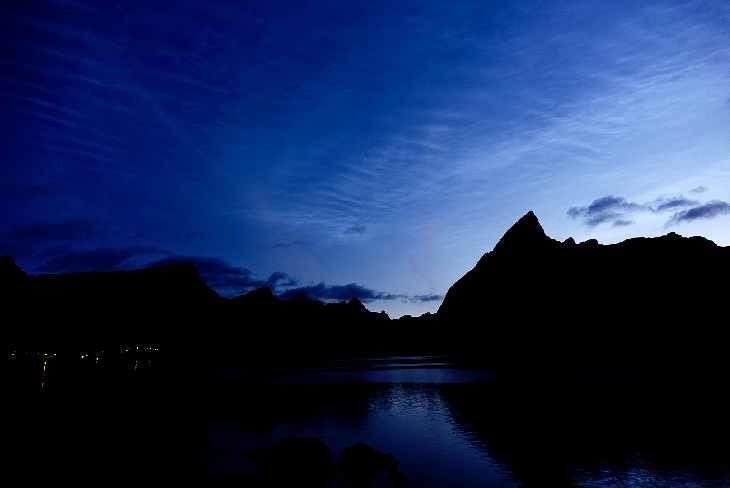
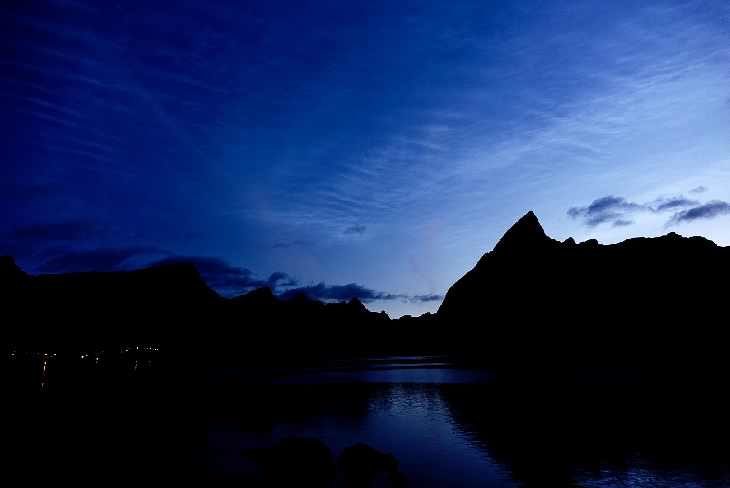
© Paul KnightleyFILE: NLCs on August 14, 2018 @ Hamnoy, Norway.
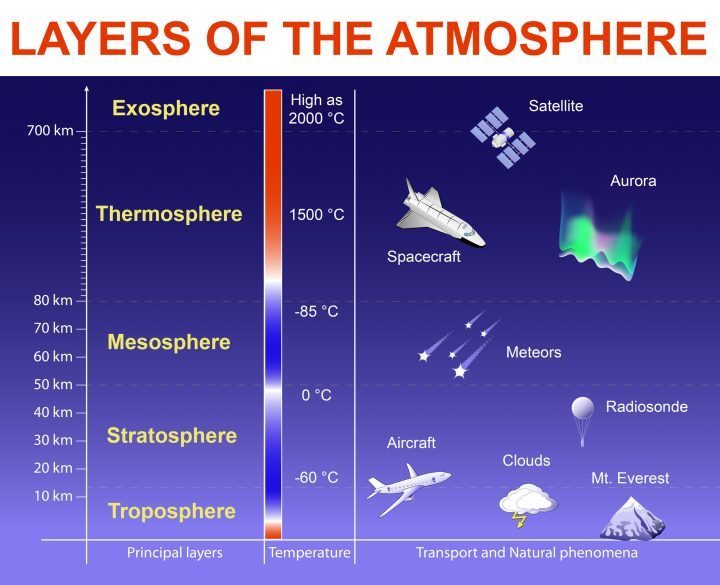
This summer, something strange has been happening in the mesosphere. The mesosphere is a layer of the atmosphere so high that it almost touches space. In the rarefied air 83 km above Earth's surface, summertime wisps of water vapor wrap themselves around specks of meteor smoke. The resulting swarms of ice crystals form noctilucent clouds (NLCs), which can be seen glowing in the night sky at high latitudes.
And, no, that's not the strange thing.
Northern sky watchers have grown accustomed to seeing these clouds in recent years. They form in May, intensify in June, and ultimately fade in July and August. This year, however, something different happened.
Instead of fading in late July, the clouds exploded with unusual luminosity. Kairo Kiitsak observed this outburst on July 26th from Simuna, Estonia:
"It was a mind-blowing display," says Kiitsak. "The clouds were visible for much of the night, rippling brightly for at least 3 hours."
Other observers saw similar displays in July and then, in August, the clouds persisted.
During the first half of August 2018, reports of NLCs to Spaceweather.com have tripled compared to the same period in 2017. The clouds refuse to go away.
Researchers at the University of Colorado may have figured out why. "There has been an unexpected surge of water vapor in the mesosphere," says Lynn Harvey of Colorado's Laboratory for Atmospheric and Space Physics (LASP). This plot, which Harvey prepared using data from NASA's satellite-based Microwave Limb Sounder (
MLS) instrument, shows that the days of late July and August 2018 have been the wettest in the mesosphere for the past 11 years:











Comment: