Earth ChangesS


Fire

Video shows fire tornado in British Columbia, Canada

BC fire tornado
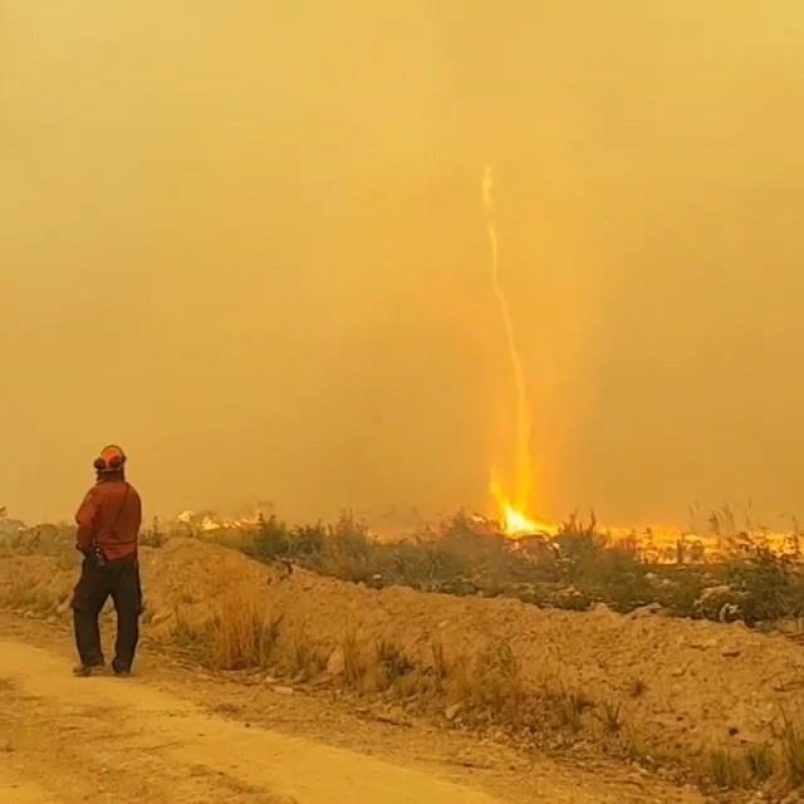
© THE CANADIAN PRESS/HO-Instagram-Mary SchidlowskyBC Wildfire Service crews encounter a "fire whirl" while fighting a wildfire near Vanderhoof, B.C. on Aug. 19.
For some B.C. residents it may seem like the wildfire season is over for this year, but fire crews are still battling blazes across the province.

Video captured and posted to social media shows firefighters dealing with a huge blaze near Vanderhoof on Aug. 19, including a fire whirl or fire tornado.

The firefighters were battling the Chutanli Lake wildfire, currently estimated at 20,813 hectares. It is now 95 per cent contained.

The video, posted on Instagram, was shot by a wildland firefighter, who is part of the Mackenzie Unit Crew.

"Fire tornado destroyed our line," she writes. "It threw burning logs across our guard for 45 minutes and pulled our hose 100-plus [feet] in the air before melting it. That's definitely a first."

In the video, a firefighter can be seen grabbing their hose, which is being pulled high into the air by the fire. A second firefighter rushes in to help.


Comment: Also in British Columbia, Canada this week, according to reports and footage sent to Environment Canada, there is a possibility that an extremely rare tornado formed near Hayward Lake in Lower Mainland, B.C. on September 16. If confirmed, this will be the 5th tornado in British Columbia over the past 15 years.

An increasing number of waterspouts, 'firenados' and dust-devils also made their appearance around the world this August. Once a rare phenomenon, waterspouts are increasingly common these days in some areas. At the same time, vortexes of water, fire and dust are appearing in very unusual places.
SOTT Earth Changes Summary - August 2018: Extreme Weather, Planetary Upheaval, Meteor Fireballs


Windsock

Storm Ali: Two dead after 100mph winds lash UK and Ireland - UPDATE

Waves hit the seafront in Porthcawl, Wales

Travel disruption, power cuts and damage to buildings are expected as forecasters predict a very windy spell of weather


The Met Office has warned of a danger to life as Storm Ali brings winds up to 80mph to parts of the UK today.

Forecasters are predicting a very windy spell of weather, with travel disruption, power cuts and damage to buildings expected.

Severe amber weather warnings have been issued for the North of England, Scotland and Northern Ireland, which are in place until 5pm on Wednesday.

"Flying debris is likely and could lead to injuries or danger to life," a Met Office spokesman said.

Commuters have been told to expect longer journey times and cancellations, with road, rail and air travel likely to be affected.

The strong winds may blow tiles from roofs and cause damage to properties from falling trees, the Met Office said.

There is also a risk of power cuts, which could affect mobile phone coverage, it added.

A less severe yellow warning for wind has been issued for the whole of Scotland, northern England, north Wales and Northern Ireland until 10pm.

Comment:

UPDATE: The Independent on 20th Sept. reports:
Woman thrown from cliff in caravan and man killed by falling tree as raging winds batter country

Two people have been killed after Storm Ali swept across the UK and Ireland, bringing torrential rain and winds of more than 100mph.

A woman died after a caravan was blown off a cliff on Ireland's west coast as she slept inside.

A workman was also killed by a falling tree in a country park. The man in his 20s, was a contractor for Northern Ireland Water.

His colleague, a man in his 40s, was also injured after the tree was torn from ground in Slieve Gullion Park in County Armagh.

The Health and Safety Executive has launched an investigation.

The body of the woman in her 50s was found during a search of a beach on Ireland's west coast.

Police said the caravan was lifted by strong winds and blown down a 15ft cliff at Claddaghduff village, near Clifden in County Galway. Pictures showed the caravan smashed to pieces on the rocks below.

The fatalities came as raging winds battered much of the UK, leaving tens of thousands of homes without power and causing widespread travel disruption.

Authorities in Dumfries and Galloway, southwest Scotland, declared a "major incident" and warned of a "serious risk to life".

Schoolchildren were stopped from walking home after several people were injured by flying debris. Teachers stayed late to supervise pupils after school buses were suspended due to hazardous roads.

Storm Ali
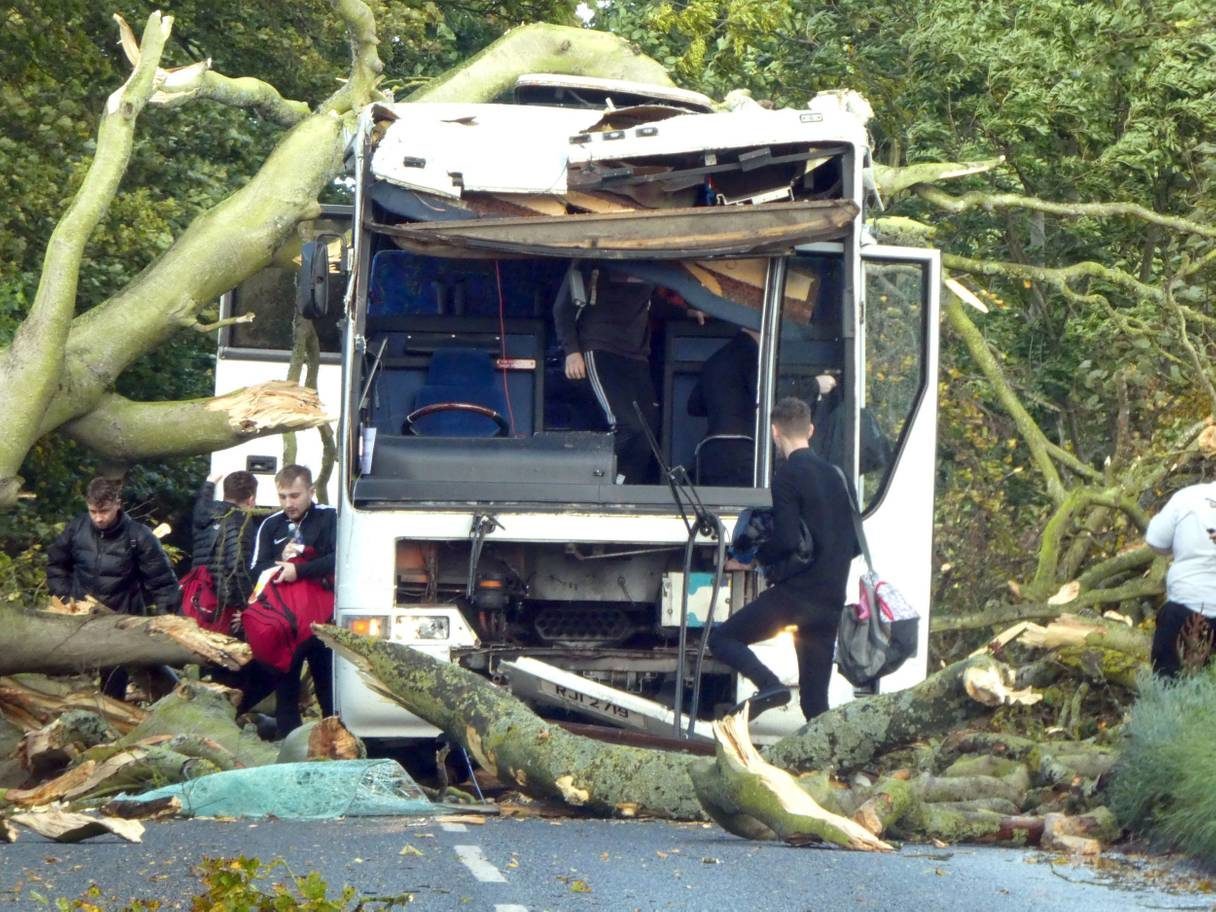
© PAPictured is a bus that was carrying students of Dundee University that was hit by a falling tree in Fife during storm Ali.
More than 70,000 homes were left without power across Scotland, while 250,000 properties in Ireland suffered electricity outages as lines toppled.

Rail, roads, flights and ferry services were all severely affected by the storm in Scotland and Ireland.

Gusts of 102.2mph hit Dundee's Tay Road Bridge, forcing its complete closure to traffic. Restrictions were also put in place on the Forth Road Bridge, Clackmannanshire Bridge and Queensferry Crossing.

Elsewhere, tug boats were called to a cruise ship which slipped its berth in Greenock. Strong winds caused the Nautica vessel - which had 478 passengers and 26 crew - leave the dock after its mooring lines parted. There were no reports of injuries.

In Crewe, Cheshire, a woman was seriously injured after a tree fell on her car, trapping her inside.

Rescue teams winched a man out of a ravine after he was thrown out of a digger during high winds in Rogart, the Highlands.

North Yorkshire Police said it had dealt with an incident on the roads every three minutes on Wednesday afternoon. The 81 call-outs between noon and 4pm include roads being blocked by fallen trees and storm-related car crashes.

A Met Office amber warning was in place across Scotland, Northern Ireland, north England and northwest Wales throughout the day.

The alert warned that flying debris was likely and could lead to injuries or danger to life. It was downgraded to a yellow warning on Wednesday night as Storm Ali edged away from the UK.

Ali was the first named storm of the season. The name was drawn from a list compiled by the Met Office and Met Eireann using public submissions.


Seismograph

Rare earthquake hits West Jutland, Denmark

Mors, Denmark
© Finn Byrum/Ritzau ScanpixFile photo: Mors from the air.
An earthquake measuring 3.4 on the Richter scale was felt in parts of West Jutland on Sunday.

The quake was registered at 10:57am local time. Its epicentre was just outside the town of Hobro, the Geological Survey of Denmark and Greenland (GEUS) confirmed.


Comment: There seems to be an error in the reporting. While it is true there is a town called Hobro, there is also one called Holstebro located 70 km to the south-west of Hobro. According to the geologists, the small earth quake occured near Holstebro.


"On a global scale, this is a small earthquake, and many of this magnitude occur every day. But for Denmark, this is one of the larger earthquakes. We don't often see earthquakes of this size here," GEUS seismologist and senior researcher Trine Dahl-Jensen said.

An earthquake measuring 3.4 Richter magnitude can cause "noticeable" shaking of indoor objects but very rarely causes damage, according to the scale.

Sunday's tremor is the strongest in Denmark since 2012, when an earthquake reaching 4.3 Richter magnitude was recorded.

GEUS confirmed a quake had occurred after people living in the area reported noticing the tremor on Sunday.

"We noticed briefly that the whole building where we are located was shaking. It's actually a solid building," Central and West Jutland Police duty officer Carsten Henriksen told Ritzau.

Tornado1

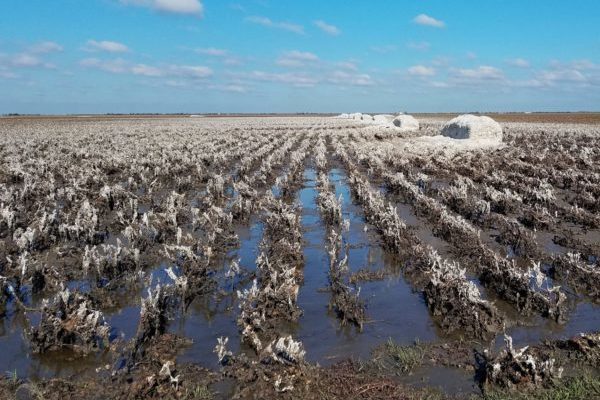
Huge crop losses expected as Hurricane Florence battered North Carolina just before harvest

Cotton damage crop
© Josh McGinty, Texas A&M AgriLife ExtensionCotton damaged by Hurricane Harvey, 2017.
With rainfall totals in parts of North Carolina reaching as much as 36 inches since Thursday due to Hurricane Florence, a big chunk of rural North Carolina was largely marooned Monday with more than 1,000 roads closed in the state.

Still, North Carolina Farm Bureau President Larry Wooten noted the sun was shining in Raleigh, North Carolina, on Monday afternoon and he expected recovery would begin soon.

"We're seeing some blue skies, and that makes everybody's spirits a little better and that old Flo (Florence) has gone on north somewhere," Wooten said. "We don't wish it on anybody, but we're just glad it's off the coast of North Carolina."

The North Carolina Farm Bureau is also a major insurer in the state, and people with personal property and business damages were trying to call offices to file claims. But phone lines were down and travel remains nearly impossible in parts of the state because of flooded roads and bridges.

Comment: Crop and cattle losses are on the rise everywhere, whether it be due to extensive drought, massive hail, epic flooding, unexpected frosts, and even epidemics, see: Erratic seasons and extreme weather devastating crops around the world


Ice Cube

Scientists observe ice thickening above 'inactive' volcano in Antarctica

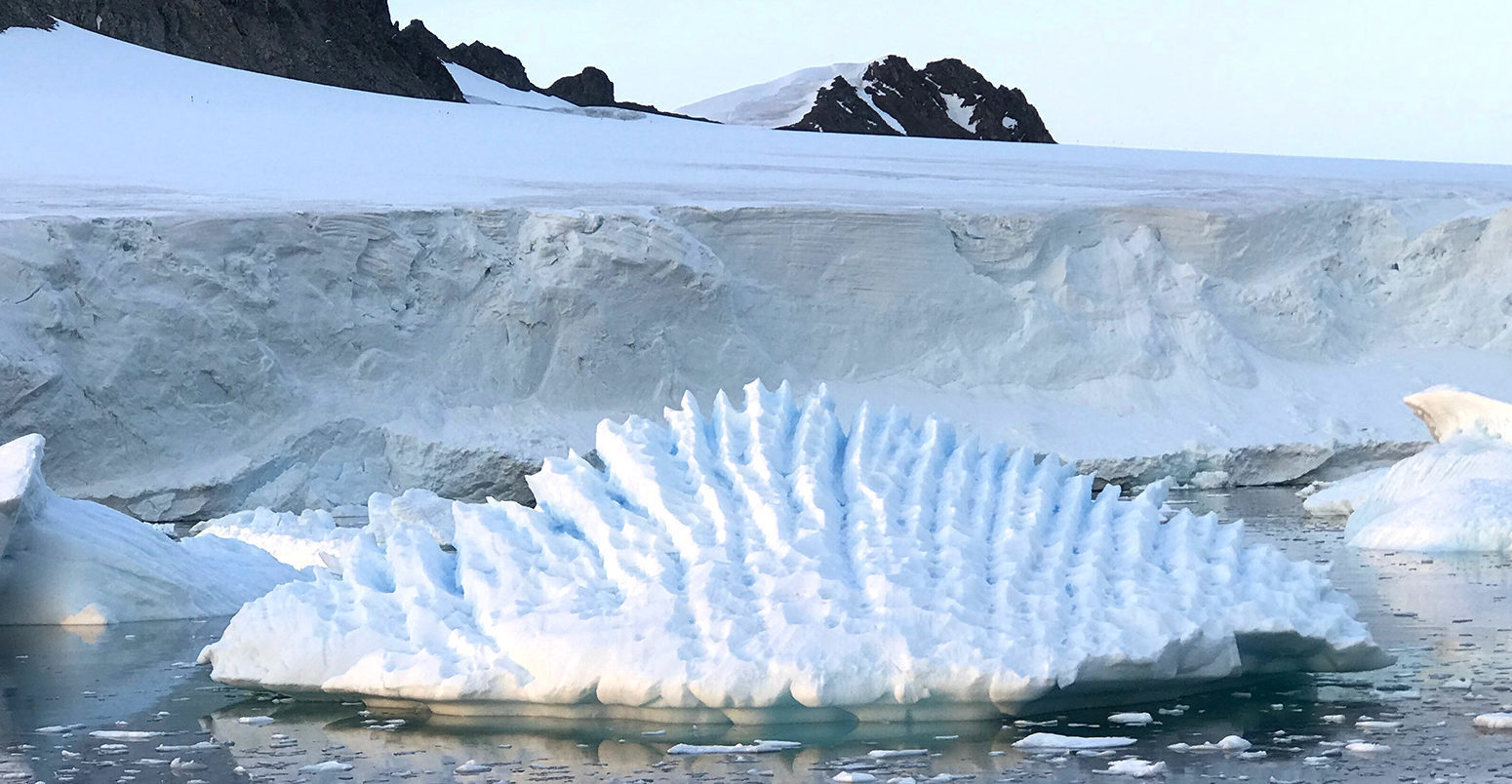
Unusual iceberg
© Andrew Shepherd, UniversityUnusual iceberg at Rothera Research Station, Antarctic Peninsula.
A region of West Antarctica is behaving differently from most of the rest of the continent: A large patch of ice there is thickening, unlike other parts of West Antarctica that are losing ice. Whether this thickening trend will continue affects the overall amount that melting or collapsing glaciers could raise the level of the world's oceans.

The track hidden in the middle of the ice sheet suggests that the current thickening is just a short-term feature that may not affect the glacier over the long term, the new study indicates. It also suggests that similar clues to the past may be hiding deep inside the ice sheet itself.

SHUTTING IT DOWN

"What's exciting about this study is that we show how the structure of the ice sheet acts as a powerful record of what has happened in the past," says first author Nicholas Holschuh, a postdoctoral researcher in Earth and space sciences at the University of Washington.

The data come from the ice above Mount Resnik, a 1.6-kilometer (mile-high) inactive volcano that currently sits under 300 meters (0.19 miles) of ice. The volcano lies just upstream of the thickening Kamb Ice Stream, part of a dynamic coastal region of ice that drains into Antarctica's Ross Sea.

Comment: The likely scenario is that the undersea volcano is waking up from it's dormancy, see: NASA study finds volcanic magma plume under Antarctica may explain ice sheet instability

See also:


Tornado2

100 presumed dead after Typhoon Mangkhut triggers landslide in Philippines

Philippines Typhoon Mangkhut
Almost 100 people are presumed dead after a landslide caused by Typhoon Mangkhut enveloped a small mining town in the Philippines, burying homes and a chapel where dozens of people had taken shelter.

By Monday night 36 bodies had been recovered in the remote town of Itogon, with 12 pulled from the ruins of the chapel. The area's death toll was expected to rise with more than 50 people missing.

Mangkhut, a category five typhoon, swept through the Philippine region of Luzon on Saturday, wreaking destruction on homes and crops and causing massive flooding.

At the height of the storm, dozens of people in Itogon - mostly miners and their families - took refuge in a chapel housed in a former bunkhouse in the belief they would be protected. However, part of a mountain collapsed on top of the building.

Comment: Sky News reports more on the carnage wrought by Mangkhut:
At least 40 people, mostly gold miners, are missing after part of a mountain slope collapsed on houses in Itogon town in Benguet province.

Sky's Asia correspondent Tom Cheshire, who is the only UK broadcaster at the rescue site, said one worker had voiced fears that none of those missing would be found alive.

At least 66 people are confirmed to have died in the Philippines since Mangkhut made landfall on Saturday with the equivalent strength of a category five Atlantic hurricane.

Another four deaths have been reported in China as winds of up to 125mph and storm surges as high as 10ft hit Guangdong province.

More than 2.4 million were evacuated as the typhoon moved on to southern China and densely populated Hong Kong, smashing windows and forcing the cancellation of 889 flights. [...]

Mangkhut has now weakened to a tropical storm but rain and strong winds are expected to continue in southern China until Tuesday.

About 87,000 people have been evacuated from high-risk areas of the Philippines, where they were advised not to return home until the danger had passed.

Hong Kong's home affairs department said it had opened 48 temporary shelters and was currently housing more than 1,200 people displaced by the storm.

Meanwhile, Hong Kong's hospital authority reported that 213 people had sought medical treatment as a result of the typhoon.
Also see:


Microscope 2

Mysterious microbes turning the world's ice pink

polar pink ice
© Liane G. Benning, GFZHidden microbes turn the ice pink around the world.
Algae are currently turning parts of the Greenland ice sheet pinkish-red and contribute more than a little to the melting of one of the biggest frozen bodies of water in the world. The discolored snow isn't just an Arctic phenomenon. It's actually a global occurrence.

In order for them to form visible blooms and increase the melting of the snow and ice, they just need the right conditions, which at a minimum involve basic nutrients and melting. Right now, the availability of liquid water from snow and ice becomes higher, favoring the growth of snow and ice algae.

This is an increasing problem in the Arctic, Alpine, and Himalayan glaciers. Blooms of red snow and brown ice are turning up in Antarctica, too.

Comment: What is changing in our environment to cause this sudden increase in algae blooms? Also check out SOTTs monthly documentary: SOTT Earth Changes Summary - August 2018: Extreme Weather, Planetary Upheaval, Meteor Fireballs


Info

Adapt 2030 Ice Age Report: Robert Felix - Onset of crop losses, cosmic rays and cold climate (2 of 3)

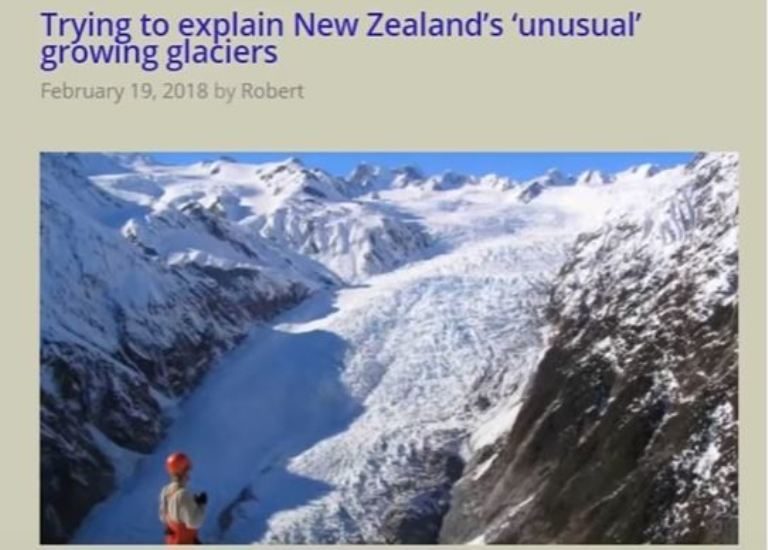
NZ growing glaciers
© YouTube/Adapt 2030 (screen capture)
David DuByne from ADAPT 2030 and Robert Felix of Iceagenow.info and the author of Not by Fire but by Ice and Magnetic Reversals & Evolutionary leaps discuss:
  • Cosmic Rays increases
  • Cosmic rays triggering volcanoes
  • Magnetic reversals
  • Increased volcanism and underwater volcanoes effecting the climate
  • 3 million underwater volcanoes heating the oceans
  • Declining sea levels
  • Global crop yield declines
  • Which countries will lose crop production
  • Not by Fire but by Ice
  • Crater Glacier in Mt St Helens grows
  • Antarctic glaciers grow
  • The climate of Chicago moved to Atlanta during the last glaciation
  • You are on your own to grow food as governments are not acknowledging the problem

Comment: Adapt 2030 Ice Age Report: Robert Felix - Onset of crop losses, cosmic rays and cold climate (1 of 3)

For more information check out SOTT's latest monthly summary: SOTT Earth Changes Summary - August 2018: Extreme Weather, Planetary Upheaval, Meteor Fireballs

To understand how and why these extreme weather events are occurring read Earth Changes and the Human Cosmic Connection by Pierre Lescaudron and Laura Knight-Jadczyk.


Cloud Precipitation

Florence death toll rises to 31 as flooding continues

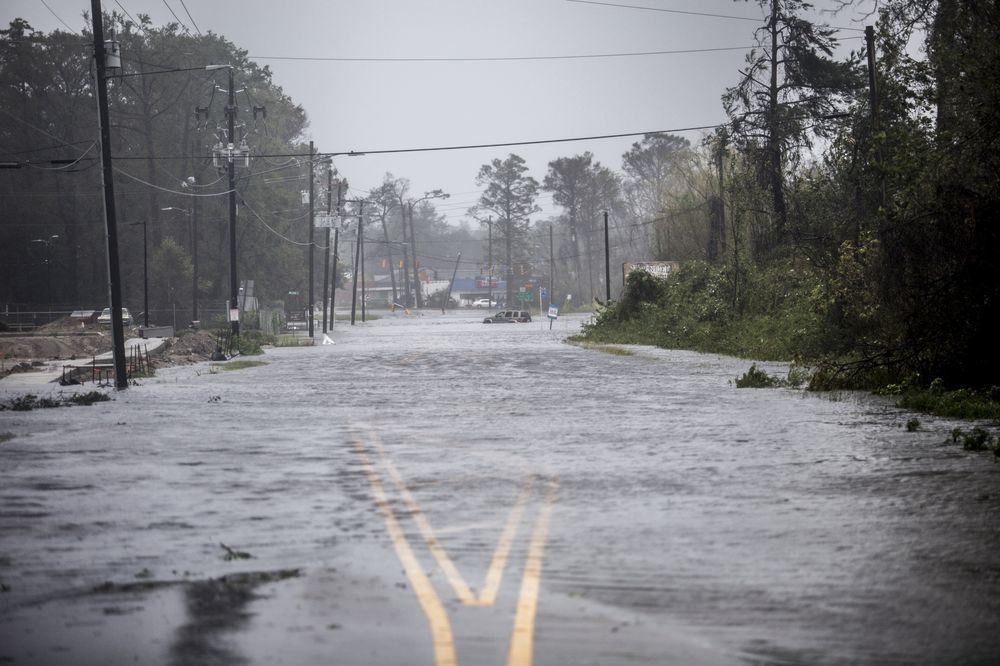
A street sits submerged in flood water n Wilmington, North Carolina
© Alex Wroblewski/BloombergA street sits submerged in flood water n Wilmington, North Carolina.
As flooding continues to inundate North Carolina, the death toll from Florence has risen to at least 31, with 24 deaths confirmed in North Carolina.

The state's governor, Roy Cooper, said on Monday that the "epic storm" was still an immediate danger as rivers reach major flood levels.

The coastal city of Wilmington became an island amid heavy floods following the storm.

Officials have warned evacuated residents to stay away.

At a news conference on Monday, Gov Cooper said "catastrophic flooding and tornados are still claiming lives and property" across the state.

"For many parts of North Carolina the danger is still immediate," he said. "Some areas have not seen the worst flooding yet. This is a monumental disaster for our state."

An initial estimate from Moody's Analytics puts the cost of Florence between $17bn (£13bn) and $22bn, making the storm one of the 10 costliest hurricanes in US history, according to NPR.

Most of the monetary damage is due to property loss, and the company said these figures could rise as inland flooding continues.


Comment: "State of Emergency" called for North Carolina's Brunswick Nuclear Plant


Tornado1

China evacuates millions after Typhoon Mangkhut leaves Hong Kong in tatters

commercial building in Hong Kong damaged by Typhoon Mangkhut
© Lam Yik Fei/Getty ImagesWindows of a commercial building in Hong Kong damaged by Typhoon Mangkhut.
More than three million people have been moved to safety in southern China as Typhoon Mangkhut moved northward and continued to wreak havoc across the region.

Mangkhut made landfall in Guangdong, China's most populous province, late afternoon Sunday, killing four people before heading west into neighboring Guangxi province around midnight.

The decision to evacuate towns and cities in southern China came as Hong Kong was left reeling by ferocious winds of up to 173 kilometers per hour (107 miles per hour) and gusts of up to 223 kph (138 mph).

The storm tore off roofs and scaffolding from skyscrapers, shattered windows, shook high-rise buildings and caused serious flooding in low-lying areas as waves of more than three meters (9.8 feet) lashed the coast.

Across the Pearl River Delta in the gambling hub of Macau, hundreds of households were left without power amid extensive flooding, which reached head-height in places close to the shoreline.


Comment: Watch as Super-typhoon Mangkhut wreaks havoc in Philippines, Hong Kong and southern China