Secret HistoryS


Bad Guys

Epstein madam Ghislaine Maxwell's host of family skeletons

ghislane maxwell family portrait
© James Andanson/GettyThe Maxwell family
Ghislaine Maxwell, 57, comes from a family by turns brilliant and accomplished, deceptive and doomed. Her backstory is full of sex and science, money and magical illusions. And today she is the world's most wanted woman — at least by the media and Jeffrey Epstein's victims.

She is the youngest child of the notorious and disgraced British media mogul Robert Maxwell, rumored after his mysterious death in 1991 to have been an Israeli spy. She was the alleged paramour-turned-pimp for Jeffrey Epstein, the billionaire pedophile who reportedly committed suicide in his cell on August 10.

Dig

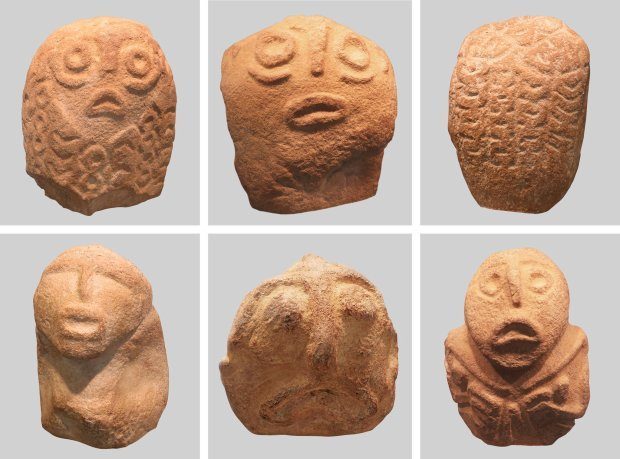
8,000 year old haunting stone faces from "city" on the Danube river baffle archeologists

danbue figurines
© Mickey Mystique/Wikimedia CommonsThe strange statues have been declared 'fish-like'
Mysterious sculptures with "haunting faces" that date back 8,000 years have left archaeologists baffled.

The strange human figurines found in Serbia have bizarre fish-like features - but there's no telling exactly who made them, or why.

Carved by ancient Europeans on the banks of the Danube river, the sculptures represent a little-known period of history.

They were sculpted over a period of around 200 years at a long-lost Serbian settlement known as Lepenski Vir.

Comment: See also:


Info

Humans migrated to Mongolia much earlier than previously believed says new study

Tolbor Valley
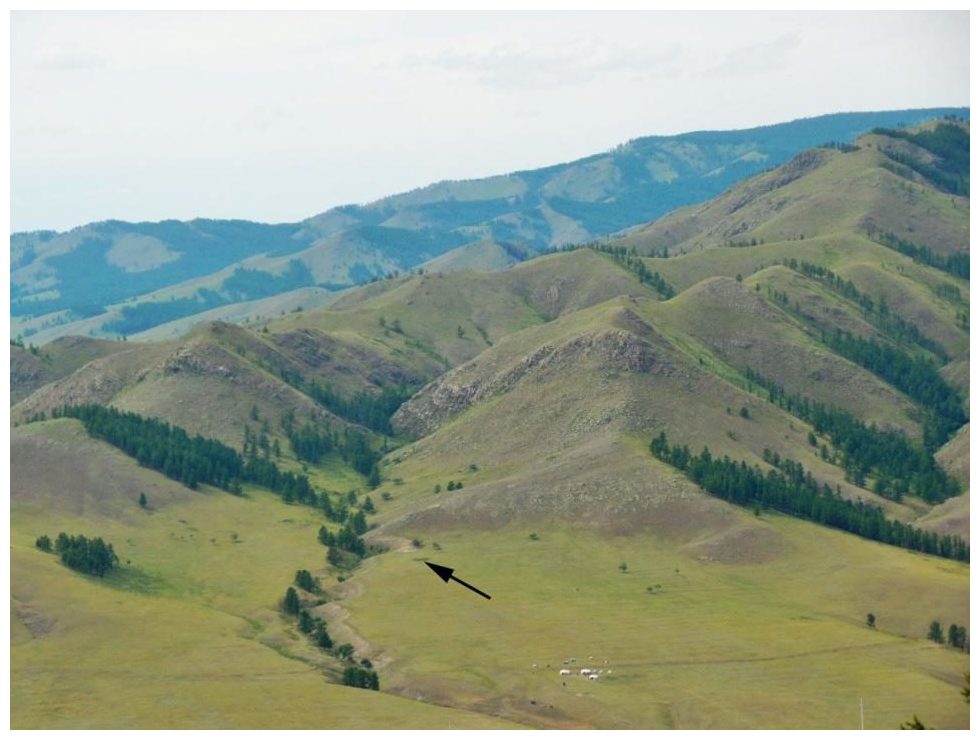
© University of California, DavisAncient tools were found in a site in the western flank of the Tolbor Valley.
Stone tools uncovered in Mongolia by an international team of archaeologists indicate that modern humans traveled across the Eurasian steppe about 45,000 years ago, according to a new University of California, Davis, study. The date is about 10,000 years earlier than archaeologists previously believed.

The site also points to a new location for where modern humans may have first encountered their mysterious cousins, the now extinct Denisovans, said Nicolas Zwyns, an associate professor of anthropology and lead author of the study.

Zwyns led excavations from 2011 to 2016 at the Tolbor-16 site along the Tolbor River in the Northern Hangai Mountains between Siberia and northern Mongolia.

The excavations yielded thousands of stone artifacts, with 826 stone artifacts associated with the oldest human occupation at the site. With long and regular blades, the tools resemble those found at other sites in Siberia and Northwest China — indicating a large-scale dispersal of humans across the region, Zwyns said.

Heart - Black

Pioneering UN leader Dag Hammarskjold was assassinated, new data suggests

bivši glavni tajnik UN-a Dag Hammarskjöld
© UNBivši glavni tajnik UN-a Dag Hammarskjöld
Updated: Aug 16, 2019, Original: Aug 16, 2019 - UN Leader Dag Hammarskjold Died in Mysterious Circumstances in 1961. What Really Happened? New evidence supports a theory that the pioneering U.N. secretary general was assassinated.

Shortly after midnight on September 18, 1961, a chartered DC-6 airplane carrying United Nations Secretary-General Dag Hammarskjold on a peacekeeping mission to the newly independent African nation of the Congo crashed in a forest near Ndola, in the British protectorate of Northern Rhodesia (now Zambia).

Hammarskjold and 14 other people aboard, including U.N. staffers and the plane's crew, were killed; a single survivor died of his injuries six days later. Though inquiries by colonial authorities in Africa indicated the crash had been the result of pilot error, rumors of foul play surfaced immediately — and they have not stopped swirling since.

Today, Hammarskjold's name is emblazoned on several buildings at U.N. headquarters in New York, while his death remains the biggest enigma in the organization's eventful history. In 2017, the UN commissioned a new investigation of the crash, while the 2019 documentary Cold Case Hammarskjöld explores the long-running theory that Belgian or South African mercenaries may have shot down Hammarskjold's plane to stop his diplomatic activities in the Congo, possibly even with the backing of U.S. and British intelligence.


Comment: See also: And check out SOTT radio's:


Sherlock

Bronze Age Britons were riddled with parasites but had the finest of fabrics

bronze age settlement
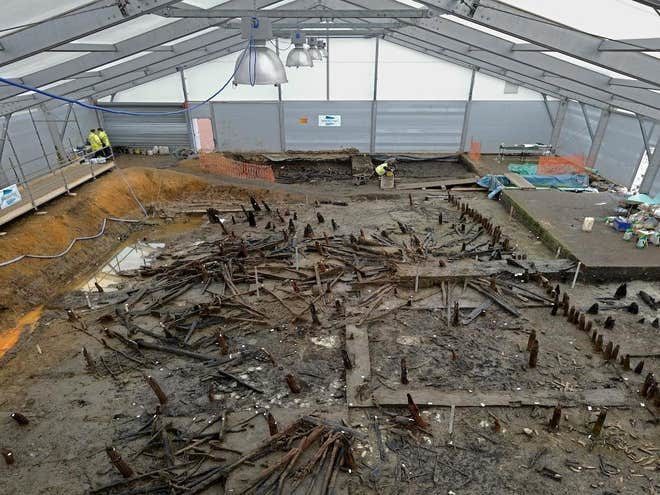
© (D Webb, Cambridge Archaeological Unit)People living in houses perched on freshwater marshes were infected by intestinal worms caught from foraging for food in lakes. Artifacts from the houses such as food, clothes and jewellery were preserved in the mud
Bronze Age Britons were infected with a number of parasites including giant kidney worms that could reach up to one metre in length, analysis of 3,000-year-old faeces has revealed.

Prehistoric people living in a settlement perched on freshwater marshes in eastern England were infected by intestinal worms caught from foraging for food in lakes and waterways, according to researchers from the University of Cambridge.

The 900BC Bronze Age settlement at Must Farm - located near what is now the fenland city of Peterborough - was made of wooden houses built on stilts above the water. A wooden causeway connected islands on the marsh and inhabitants used dugout canoes to travel along the channels.

Three-thousand years ago, a catastrophic fire burnt the village down, but artefacts from the houses such as food, clothes and jewellery were preserved in the mud.

Comment: These houses reflect a similar living arrangement to the Crannogs discovered in Scotland: Crannogs: Neolithic artificial islands in Scotland stump archeologists

It's curious that, while these people were seemingly ignorant - or unable to deal with - sanitation and parasites, they also had fabrics that were of the finest quality. The following article provides more details and clues on just what life was like at Must Farm: "Catastrophic" fire destroyed incredible British Bronze Age settlement a year after it was built

See also:


Info

Lascaux Shaft Scene and cometary impacts

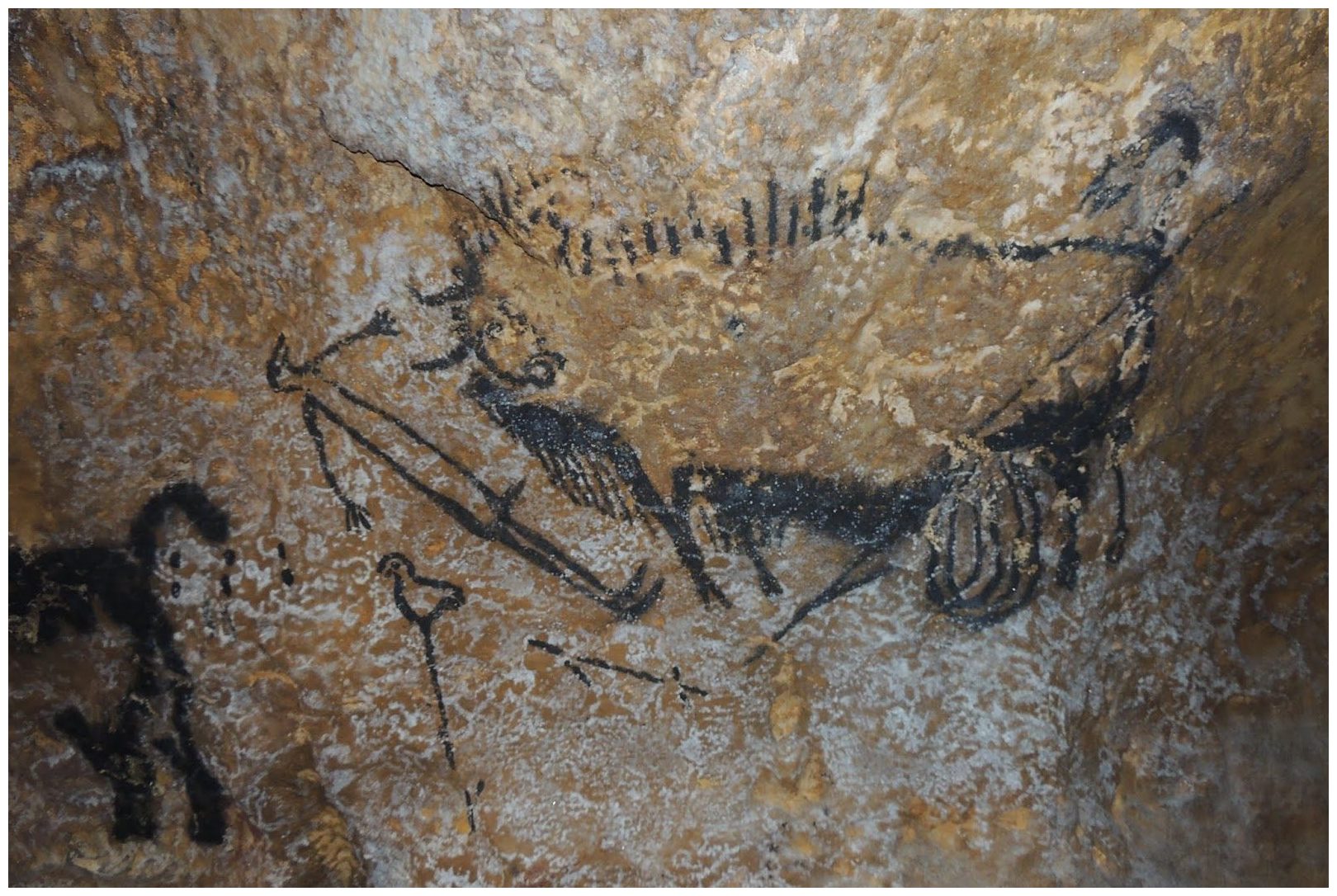
The Lascaux shaft scene is perhaps the most iconic of all European Palaeolithic cave artworks (see below). It shows a bison and human, apparently both dying and normally interpreted as a hunting scene. But we now know, beyond any reasonable doubt, the animal symbols represent constellations, and the Shaft Scene in particular very likely represents a date using precession of the equinoxes.
Lascaux Shaft Scene
© Copy of the Lascaux Shaft Scene, courtesy of Alistair Coombs
Using the zodiacal method and our ancient zodiac, the date 'written' in the scene is between 15,300 and 15,000 BC (see Prehistory Decoded). The similarity of this scene to Pillar 43 at Gobekli Tepe suggests it documents another asteroid or comet strike, this time from the direction of Capricornus (represented by the aurochs). It so happens that the Taurid meteor stream would rave radiated from this direction at this time, suggesting this artwork memorialises another strike from the Taurid system. Given the presence of a giant comet in the inner solar system at this time, such frequent impacts are entirely expected.

Very interestingly, this time span also corresponds to a sudden temperature fluctuation in the North Atlantic region (see Prehistory Decoded), documented by a Greenland ice core, and to a major cultural transition: the Magdalenian to Azillian.

Pirates

Before there was Epstein: Kingpins of the Caribbean

Map carribbean smugglers spies operation 40
© Corey's Diggs
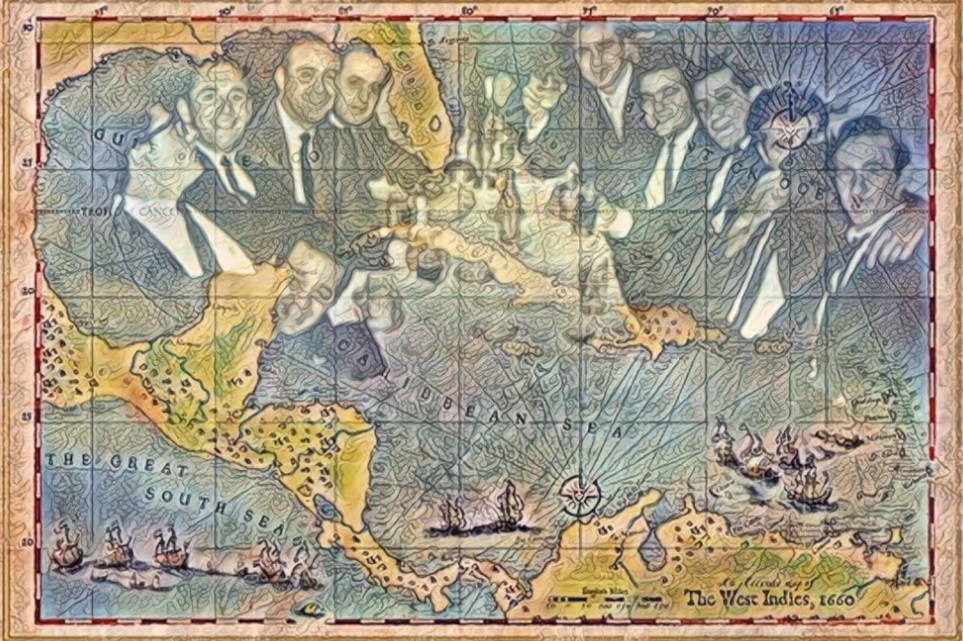
Epstein is not the first kingpin of the Caribbean. In fact, there were many before him. This is the hidden history of CIA black ops in the Caribbean - from No Name Key to Norman's Cay to Disney's Castaway Cay and beyond.

Operation 40, a CIA sponsored hit squad in the 1960s, was a "mixed group of Cuban exiles, Italian wise guys, and square-jawed military intelligence types." Created under Eisenhower in March 1960, controlled under VP Nixon, and funded by George HW Bush, this secretive team has been implicated in the assassination of JFK, CIA drug trafficking, Watergate and even the 9/11 cover up. Taken in a Mexico City nightclub in 1963, this is the only known picture of the original members of Operation 40.
Operation 40 CIA caribbean smuggling spies
This photograph was taken in a nightclub in Mexico City on 22nd January, 1963. It has been argued by Daniel Hopsicker that the men in the photograph are all members of Operation 40. Hopsicker suggests that the man closest to the camera on the left is Felix Rodriguez, next to him is Porter Goss and Barry Seal. Hopsicker adds that Frank Sturgis is attempting to hide his face with his coat. It has been claimed that in the picture are Albertao 'Loco' Blanco (3rd right) and Jorgo Robreno (4th right).

Comment: A wealth of scoundrels who's legacy the world is still burdened.


Sherlock

Half of Neanderthals got 'surfer's ear'

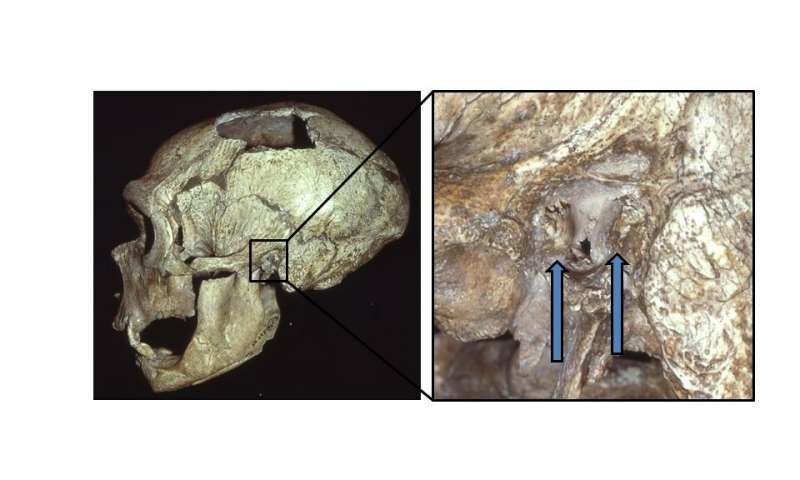
The La Chapelle-aux-Saints Neandertal
© Erik TrinkausThe La Chapelle-aux-Saints Neandertal skull, with the external auditory exostoses ("swimmer's ear" growths) in the left canal indicated.
What do surfers, kayakers and Neanderthals have in common?

New research published Wednesday revealed that abnormal bony growths in the ear canal, also called "surfer's ear" and often seen in people who take part in water sports in colder climates, occurred frequently in our ancient cousins who died out around 40,000 years ago.

But unless Neanderthals were righteous dudes searching for the perfect wave, the findings may mean they fished far more frequently than the archaeological record suggests, the scientists behind the study published in journal PLOS One said.

Comment: There's no mention of aquatic mammal or fish bones in situ, but there is evidence of land mammal consumption, so it's curious that the archeological data doesn't support the theory that the over half of the population of Neanderthal's were fisherman. Could it instead have been caused by other factors that are known to produce the bony growth known as 'surfer's ear', such as brief exposures to unusually cold waters? Or prolonged periods of bad weather, such as biting winds and cold rain? After all, to fish, one needn't spend time under water or in particularly rough conditions, and there is evidence of society's who consume primarily aquatic diets that did not suffer from surfers ear. Clearly to make any conclusions more data from a number of different fields may be required.

For more, see:


Dig

'Ghosts' of 2 unknown extinct human species found in modern DNA

denisovans
© João Teixeira
When modern humans started emerging from Africa and spreading throughout Eurasia, they found many places already occupied by older hominins such as Neanderthals and Denisovans. As humans do, we got rather friendly with our new neighbours: evidence of that hanky panky lives on in our DNA today.

But we're also starting to find glimpses of something strange in our neighbourhoods - traces of ancient, unknown hominins that we've never seen before.

"Each of us carry within ourselves the genetic traces of these past mixing events," said biologist João Teixeira of the University of Adelaide.

"These archaic groups were widespread and genetically diverse, and they survive in each of us. Their story is an integral part of how we came to be."

After closely analysing the existing literature, Teixeira and his colleague biologist Alan Cooper have identified two such 'ghost' ancestors in modern DNA. The first, identified in Eurasian DNA with the help of artificial intelligence, was widely reported earlier this year.

The second, however, was reported last year, a detail that flew under the radar in a larger paper: a mysterious, and inconclusive, genetic signature exclusively found in the population of Flores, Indonesia. It appears to be as divergent from modern human DNA as Neanderthal or Denisovan DNA is.

Bizarro Earth

The genocide pit at Sacred Ridge, Colorado

Sacred Ridge
© via Science NewsGenocide at Sacred Ridge: Excavations at an ancient Pueblo site uncovered crushed skulls (one shown) and other bones from at least 35 victims.
"Mutilated and processed" is not a phrase that you ever hope to read in any context whatsoever. But it fits good to Sacred Ridge in Colorado, an ancient Native American settlement consisting of 22 pit houses.

One day, as archeologists were cataloging the usual pots and tools and petrified turds and such, they stumbled straight into a problem: scientists didn't have enough room on their checklist for the huge amount of two-headed axes spattered in human blood that they were finding.

And the pit homes were absolutely filthy with "mutilated and processed" human bodies.

So what happened here?

Attackers with a deadly plan climbed a knoll to a Pueblo village called Sacred Ridge around 1,200 years ago. What happened next was anything but sacred.

Comment: The area is home to numerous of unusual and unexplained discoveries: