Puppet MastersS


Heart - Black

Israel owns up to 'losing' remains of Palestinians killed during Second Intifada

Unmarked cemetery
© Ma'an News AgencyUnmarked graves of slain Palestinians in Bethlehem.
The Israeli government has admitted to losing the remains of seven Palestinians who were killed while "committing attacks" against Israelis during the Second Intifada, Israeli news daily Haaretz reported on Monday. [T]he admission came from the Israeli state prosecutor's office in response to petitions to Israel's Supreme Court filed by the slain Palestinians' families, demanding the return of the bodies.

During a Supreme Court session last month, it was revealed that the number of Palestinians whose burial places are unknown is far higher than the seven that Israel has admitted to losing. Haaretz quoted Israeli prosecutors as saying that as of 2015, out of 123 petitions submitted by Palestinian families, only two bodies had been located.

"A number of Israeli legal and military officials say they believe the state has no information about the whereabouts of many of the bodies. In a few cases, the remains had been in Israel's possession since the 1990s," Haaretz said, adding that Israel has yet to decide which government agency will be tasked with handling the matter.


Comment: In other words, no, you are screwed, we don't give a flip.


Haaretz quoted a Ministry of Justice official as saying that the burials of dozens of missing Palestinian bodies could have been carried out by "a few companies working for the National Insurance Institute" or the Israeli police. The official pointed out that one of the companies involved in the burial of Palestinians during the Second Intifada went out of business a few years ago, and the documents relating to the identities of the interred were destroyed.

"For many years in the 1990s, the atmosphere was different. Less importance was attributed to questions of who we put in the ground and how could we identify them in the future," Haaretz quoted another Justice Ministry source as saying.

The Director of the Center for the Defense of the Individual Dalia Kirshstein criticized the Israeli government, saying that "every smashed Jewish gravestone around the world raises a hue and cry in Israel, but when it comes to dozens of bodies of Palestinians that disappeared, there's complete silence."

Comment: Bodies lost. Bodies as bargaining chips. Funerals as cause for incitement. DESPICABLE!


Blue Planet

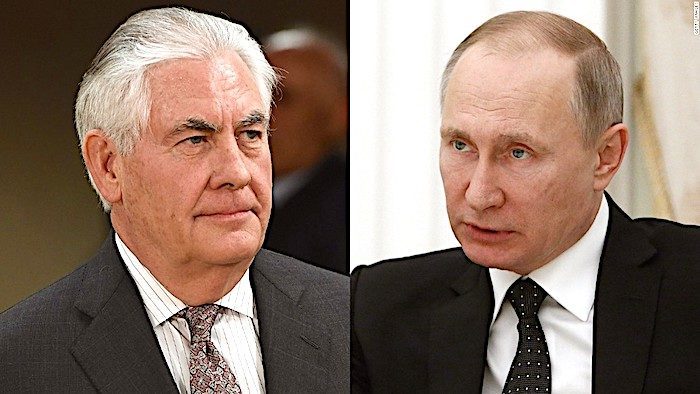
Putin and Tillerson finally meet in Moscow

TillersonPutin
© CNN.comSecretary of State Rex Tillerson • President of Russia Vladimir Putin
Despite speculations to the contrary, US Secretary of State Rex Tillerson has met Russian President Vladimir Putin in Moscow. Some observers claimed this wouldn't happen due to the tension between the two nations. "Russian President Vladimir Putin is meeting US Secretary of State Tillerson and Russian Foreign Minister Lavrov at the Kremlin," presidential spokesman Dmitry Peskov said on Wednesday evening.

Peskov did not elaborate on what the three discussed. Earlier in the day, Tillerson held a meeting with Sergey Lavrov.

The top US diplomat is visiting Moscow amid a conflict over the alleged use of chemical weapons in Syria. The US blamed the incident, which happened almost two weeks ago, on Damascus, and retaliated with a barrage of cruise missiles targeting a Syrian airbase.

Russia called it a possible false flag operation and said the US attack was an act of international aggression. It also said more provocative incidents involving toxic agents may follow in Syria, now that the Trump administration has demonstrated it can be baited into the reaction that the enemies of Damascus want from it. Moscow believes a proper investigation, including at the scene of the reported attack, is necessary to establish the truth.

Telephone

Lavrov confirms US-Russia military hotline in Syria still suspended

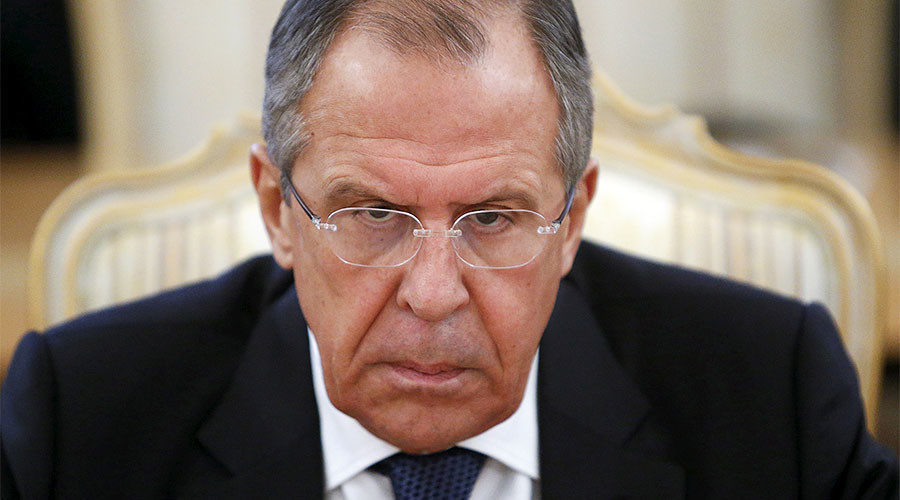
Russia's Foreign Minister Sergei Lavrov
© Sergei Karpukhin / ReutersRussia's Foreign Minister Sergei Lavrov
Contrary to media claims Russian Foreign Minister Lavrov did not say during his press conference with US Secretary of State Tillerson that the hotline between the US and Russian militaries in Syria is no longer suspended. On the contrary he confirmed it remains suspended pending US assurances that the US military will henceforth only attack Al-Qaeda and ISIS.

Since US Secretary of State Rex Tillerson's meeting with President Putin yesterday, and since the joint press conference between Tillerson and Russian Foreign Minister Lavrov which followed shortly after, there have been numerous media reports which say that President Putin heeded Tillerson's request to reinstate the hotline between the US and Russian militaries in Syria, and that as a result this hotline is back in operation.

This is quite simply wrong. It arises from a poor translation of certain comments Foreign Minister Lavrov made at the joint news conference.

Comment:


Info

Assad says Idlib chemical attack 100% fabricated, Syria destroyed all chemical weapons

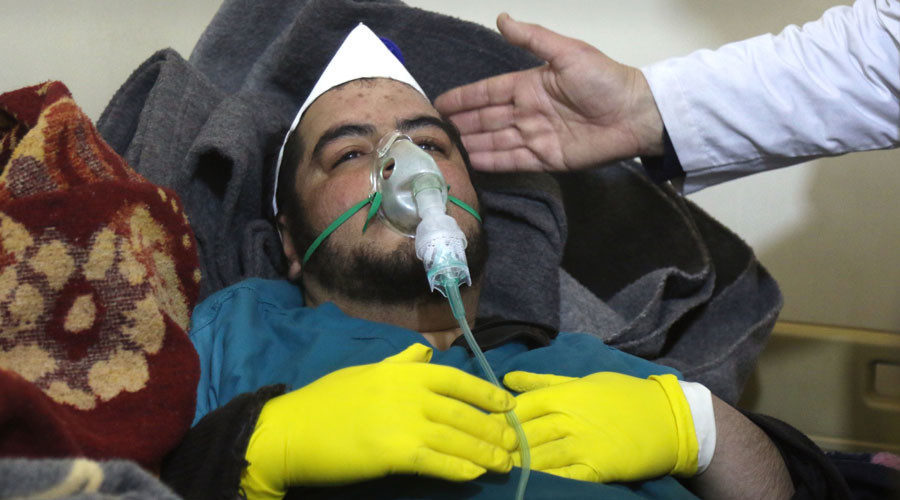
A Syrian man receives hospital treatment in Maaret al-Noman
© Mohamed al-Bakour / AFPA Syrian man receives hospital treatment in Maaret al-Noman, after a suspected toxic gas attack in Khan Shaykhun, on April 4, 2017
The chemical incident in Idlib province blamed on Damascus was a "100 percent fabrication" as the Syrian military has already dismantled chemical weapons stockpiles, President Bashar Assad told AFP.

"Definitely, 100 percent for us, it's fabrication... Our impression is that the West, mainly the United States, is hand-in-glove with the terrorists," President Assad told the French news agency in his first interview since the retaliatory US missile strike on a Syrian airbase in Shayrat.

"They fabricated the whole story in order to have a pretext for the attack," he said.

According to Assad, the Syrian military dismantled all of its chemical weapons arsenal in 2013.


"There was no order to make any attack... We gave up our arsenal a few years ago. Even if we have them, we wouldn't use them," he added.

Comment: See also: Western media quiet as Russia exposes lies at Security Council


Attention

'We are sending an armada': Trump ready to eliminate N. Korean 'menace' with or without China

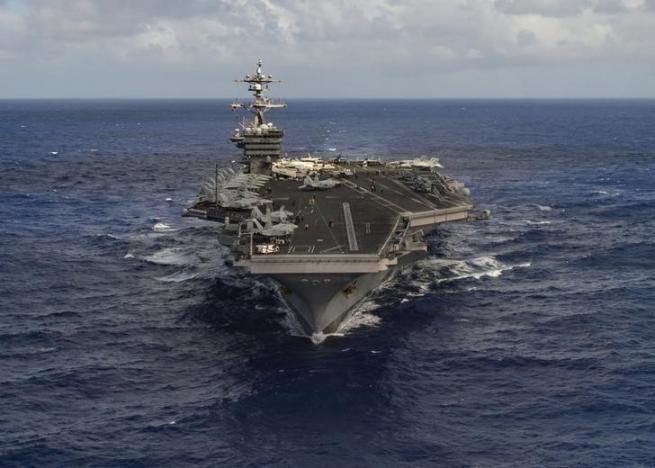
USS Carl Vinson (CVN 70)
© US Navy Photo by Mass Communication Specialist 3rd Class Tom Tonthat/Handout via ReutersThe aircraft carrier USS Carl Vinson (CVN 70) transits the Pacific Ocean January 30, 2017.
The US is looking forward to working with China to solve the North Korean nuclear threat. But while Washington is mustering its forces in the Korean peninsula, Beijing insists on finding a peaceful solution to Pyongyang's "denuclearization."

Less than a week after US President Donald Trump met with his Chinese counterpart Xi Jinping, the two leaders once again engaged on Wednesday, where among other things they discussed the North Korean threat.

"President Xi wants to do the right thing. We had a very good bonding, I think we had a very good chemistry together, I think he wants to help us with North Korea," Trump said after the meeting with NATO's chief in Washington

"We talked trade, we talked a lot of things, and I said the way you're going to make a good trade deal is to help us with North Korea, otherwise we're just going to go it alone, that'll be all right too, but going it alone means going with lots of other nations," Trump added.

Comment: More from Newsbud:
China: Beware of Donny Big Hands!


This week on China Watch with Peter Lee: Blood and Embarrassment at Mar a Lago, as President Donald Trump met with Chinese President Xi Jinping, plus the Last Days of the Dalai Lama and much more!


Bad Guys

Tillerson/Lavrov presser: Tillerson approves US hacking against Russian war targets, CBS reporter insults Lavrov with demand to answer question in English

tillerson lavrov pres conference April 2017
© RBC/ Youtube
US Government officials and the official US media have wound up their meetings in Moscow with Foreign Minister Sergei Lavrov and President Vladimir Putin with one unexpected admission, one unprecedented demand, and a non-disclosure by the Kremlin which has never happened before.

Following morning and midday meetings at the Foreign Ministry and the Kremlin, US Secretary of State Rex Tillerson told a press conference he approves the US use of cyber-warfare weapons, but makes a distinction between military and civilian targets. The US Government, he made clear, authorizes hacking against enemies but objects to enemies retaliating in kind. Listen to the full 54-minute conference here. For the State Department's English translation, read this.

At minute 35:50 Kommersant reporter Yelena Chernenko asked Tillerson if he had talked at his meetings about US allegations of Russian interference in the US presidential election campaign. She also asked Tillerson: "could you tell us about how the presence of Russian cybernauts differs from the question of American cybernauts in virtual space?"

Comment: Just when the Russians couldn't think the West couldn't be any more boorish. Way to go CBS.


Question

Trump tweets that US & Russia 'will work out fine', promises 'lasting peace'

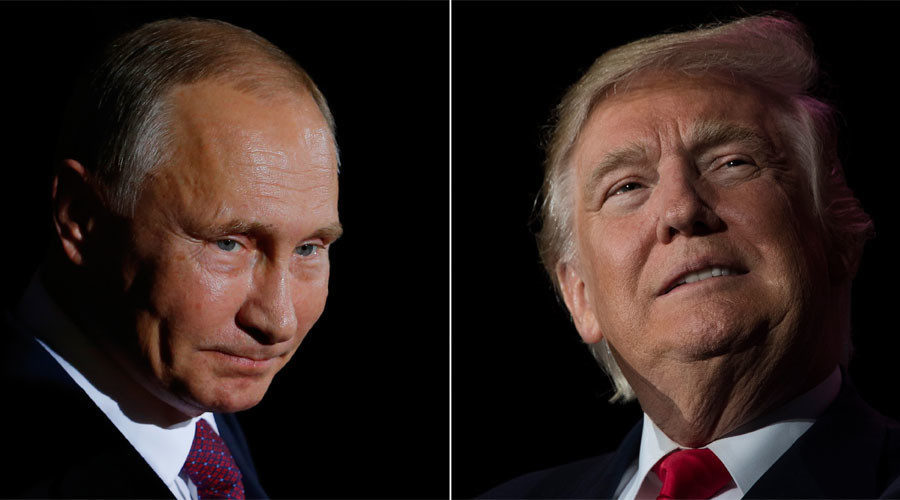
Putin Trump
© Jim Watson / Odd Andersen / Agence France-Press
Despite tensions between the global superpowers, US President Donald Trump has promised that "things will work out fine" between the USA and Russia.

On Wednesday, the president said US relations with Russia may be at "an all-time low." Trump's comments came following a meeting between US Secretary of State Rex Tillerson and Russian President Vladimir Putin.

"There is a low level of trust between our countries," Tillerson said to the media after the two-hour long meeting where the men discussed US-Russia relations in the wake of last week's US airstrike on a Syrian airbase.

Comment: Trump may think matters can be worked out, but the neocons surrounding him have other plans. Which they are busy doing.


Target

Stephen Bannon's White House struggle: From 'shadow president' to Trump's marked man?

Stephen K. Bannon
© Jabin Botsford/The Washington PostWhite House chief strategist Stephen K. Bannon, second from left, listens to President Trump’s news conference Wednesday.

Comment: Though the following updates on Stephen Bannon's status and position comes to us from the malignantly biased Washington Post and New York Times, it is interesting none the less to note how one of Trump's leading voices of relative reason may now be increasingly sidelined.


When Stephen K. Bannon reported for work Wednesday, he did not act like a man who had just been publicly humiliated by his boss.

The White House chief strategist cycled in and out of the Oval Office for meetings with President Trump and took a seat in the front row of the East Room for the afternoon visit of NATO's secretary general, flanked by some of the very advisers with whom he has been feuding.

But for Bannon, the day's routine obscured the reality that he is a marked man — diminished by weeks of battles with the bloc of centrists led by Trump's daughter and son-in-law and cut down by the president himself, who belittled Bannon in an interview with the New York Post.

The president's comments were described by White House officials as a dressing-down and warning shot, though one Bannon friend, reflecting on them Wednesday, likened Bannon to a terminally ill family member who had been moved into hospice care.

Comment: And from that other bastion of truth, the New York Times, we get this:
One person with firsthand knowledge of internal White House dynamics, who asked not to be identified given how tense the situation had become, insisted that no immediate changes were likely. Mr. Trump is notoriously fickle in his decision-making process, and he dislikes confrontation. But by openly criticizing Mr. Bannon, he has created an environment that makes it hard for the swaggering and self-assured chief strategist to remain in place without appearing undermined.

Allies of Mr. Trump say that he has become increasingly impatient with the infighting — and the overwhelming attention it is receiving. In a lengthy conversation with Mr. Bannon this week, the president repeated his admonition that the chief strategist and his adversaries needed to "knock off" their back-and-forth sniping.

[...]

Mr. Bannon appears to now recognize the danger and has kept a low profile inside the White House while Mr. Kushner has been away with his family. He has told friends and associates, using his trademark military vernacular, that he understands he cannot throw bombs every day and needs to pick his battles carefully.

Mr. Bannon told several associates over the weekend that he believed that things had cooled off with Mr. Kushner. But the president's comments suggest the truce is uneasy and may not last.

Mr. Bannon's allies have already begun discussing a post-White House future for him. On Friday, his main political patron, Rebekah Mercer, the daughter of Robert Mercer, a major Trump donor, holed up in her office at Cambridge Analytica in New York, discussing possibilities for Mr. Bannon should he leave, according to two people briefed on the meeting. Mr. Bannon served on the data-mining firm's board until last summer.

[...]

The split between the hard-nosed Mr. Bannon and the far more reserved and soft-spoken Mr. Kushner reflects much more than a personality clash between two senior aides. For starters, Mr. Kushner is not the only one who has told the president he has misgivings about Mr. Bannon's style. The president's chief economic adviser, Gary Cohn, the former president of Goldman Sachs and a longtime Democrat, has also aligned himself against Mr. Bannon, whose strongest ally in the White House is Reince Priebus, the chief of staff and former Republican Party chairman.

Mr. Kushner; Mr. Cohn; Ivanka Trump, the president's daughter; and Dina Powell, a former Goldman Sachs executive who is now a deputy national security adviser, have come to represent to many on the right a slow and dangerous creep of liberalism into the administration.


Attention

Intel & military sources who warned about Iraq WMD lies now say Assad did NOT launch chemical weapon attack

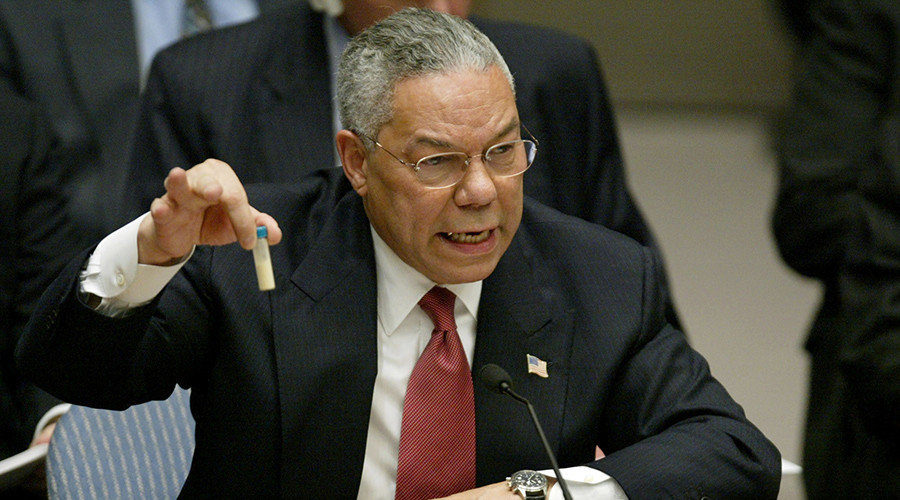
Colin Powell holds up a vial
© Ray Stubblebine / ReutersU.S. Secretary of State Colin Powell presents a dummy vial of anthrax on Feb. 5, 2003, during a speech to the UN Security Council outlining the American case that Iraq possessed forbidden stockpiles of WMD.
Former U.N weapons inspector Scott Ritter warned before the start of the Iraq war that claims that Saddam Hussein possessed weapons of mass destruction were false.

Sunday, Ritter wrote that current claims that the leader of Syria launched a chemical weapons attack was false:
Some sort of chemical event took place in Khan Sheikhoun; what is very much in question is who is responsible for the release of the chemicals that caused the deaths of so many civilians.

No one disputes the fact that a Syrian air force SU-22 fighter-bomber conducted a bombing mission against a target in Khan Sheikhoun on the morning of April 4, 2017. The anti-regime activists in Khan Sheikhoun, however, have painted a narrative that has the Syrian air force dropping chemical bombs on a sleeping civilian population.

A critical piece of information that has largely escaped the reporting in the mainstream media is that Khan Sheikhoun is ground zero for the Islamic jihadists who have been at the center of the anti-Assad movement in Syria since 2011. Up until February 2017, Khan Sheikhoun was occupied by a pro-ISIS group known as Liwa al-Aqsa that was engaged in an oftentimes-violent struggle with its competitor organization, Al Nusra Front (which later morphed into Tahrir al-Sham, but under any name functioning as Al Qaeda's arm in Syria) for resources and political influence among the local population.

MIB

White House pushes new conspiracy theory alleging Russia plotted attacks during Montenegro elections

Montenegro NATO protests
© Savo Prelevic / AFP
The day of Secretary of State Rex Tillerson's high-profile Moscow visit, trying to resolve ever-worsening bilateral relations, the White House is continuing to come up with new allegations against Russia, insisting today that they had "credible reports" Russia plotted attacks against Montenegro during their October elections.

The narrative on Russia trying to interfere in Montenegro's elections is not new, and like most such allegations is based around the idea that opposition positions conflicting with the Western establishment must necessarily be the result of Russian plots. In Montenegro, the divisive election issue was Montenegro joining NATO, which voters were split roughly down the middle on.