Puppet MastersS


Quenelle - Golden

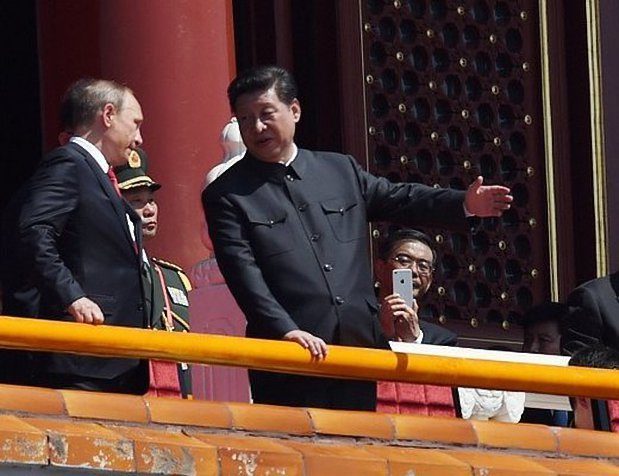
Vladimir Putin will meet Chinese President Xi at One Belt - One Road international cooperation forum

Vladimir Putin and Chinese President Xi
© Unknown
Chinese envoy meets Russian President Putin in Moscow; reaffirms alliance with Russia, confirms series of bilateral Xi-Putin summits being prepared.

Just days after Chinese President Xi Jinping met US President Donald Trump in Florida, Zhang Gaoli, the First Vice-Chairman of China's State Council (ie. China's deputy prime minister) has arrived in Moscow where he has had a meeting with Russian President Putin.

This visit had been set up well in advance, and is not connected to the recent events in Syria. It is intended to prepare for President Putin's long announced trip to China next month, where he will meet with Chinese President Xi Jinping, as part of a major Russian-Chinese summit. Importantly however Zhang Gaoli confirmed President Xi Jinping is planning a follow-up trip to Russia in July.

Sherlock

Russia can't confirm reports on loss of life over US-led bombing in Deir ez-Zor, US denies everything

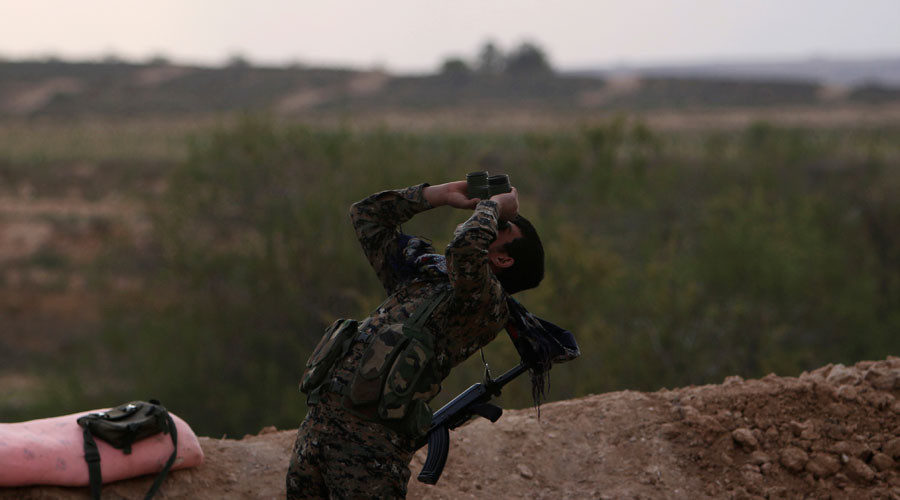
SDF fighter
© Rodi Said / ReutersFILE PHOTO: A Syrian Democratic Forces (SDF) fighter uses his binoculars to look at a drone they said belonged to Islamic State fighters on the bank of the Euphrates river, west of Raqqa city, Syria April 8, 2017.
The Russian Defense Ministry has no information that could confirm reports about a US-led coalition airstrike in the Syrian Deir ez-Zor province leading to civilian deaths, the ministry's spokesman, Major General Igor Konashenkov, said.

"The Russian Defense Ministry does not have any information confirming the reports about loss of life and material damage resulting from a bombing carried out by the US-led coalition warplanes in the area of the city of Deir ez-Zor," Konashenkov told journalists at a press briefing.

He went on to say that the Russian military has sent surveillance drones to the area of the alleged airstrike to assess the situation and monitor developments on the ground.

Comment: See: US coalition air strikes hit ISIS chemical weapons depot in Deir ez-Zor - 'hundreds killed'


Chess

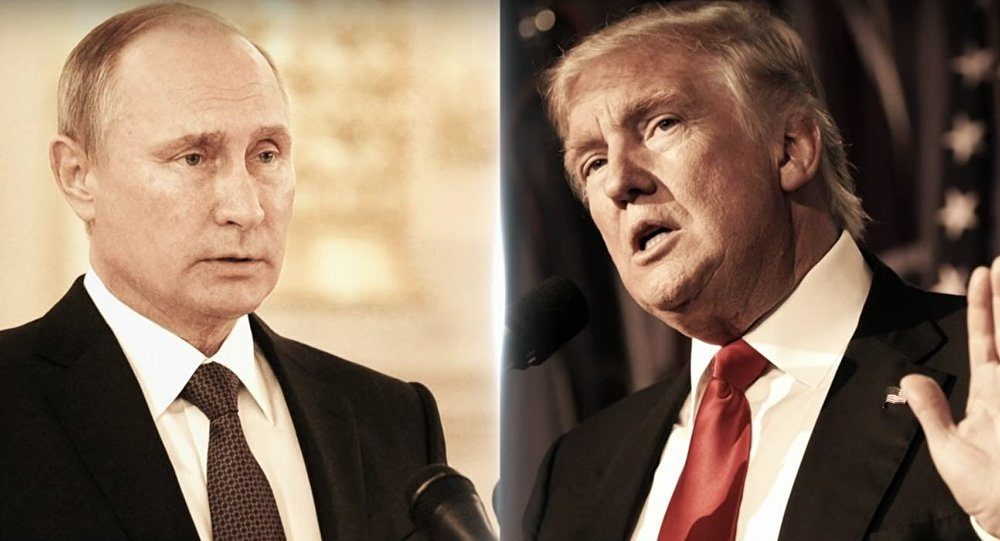
Scott Adams: U.S. and Russian relations at a low?

Putin und Trump
Everyone is saying the relationship between the United States and Russia is really, really bad right now. President Trump says it is bad. Russia agrees. All the pundits agree too.

So it must be true, right?

In the 2nd dimension - where things are just the way they look - it does seem that the U.S. and Russia are in a bad place with each other. The United States attacked Russia's little buddy, Assad, for allegedly using chemical weapons. But Russia says Assad didn't use chemical weapons. Now Russia is mad at the United States.

Maybe the situation is exactly what I just described.

But just for fun, let's hop up to the 3rd dimension (of persuasion) and see what the view looks like.

Jet4

US military receives the message: Russia ready to shoot down US aircraft and missiles in Syria

russian special ops syria
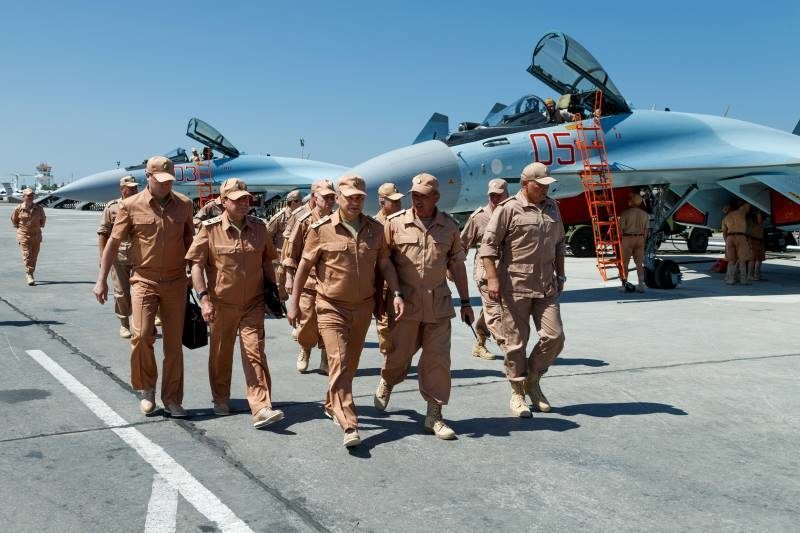
© Vadim Savitsky / Agence France-PresseA handout picture taken on June 18, 2016 shows Russian Defence Minister Sergei Shoigu (C) visiting Russia's air base in Hmeimim in the Syrian coastal province of Latakia
Russia has repeatedly warned it will shoot down US aircraft and missiles in Syria if its troops are threatened. The US has always heeded these warnings.

There has been some discussion, especial on social media, as to whether or not Russia might shoot down US aircraft or missiles attacking Syria, and of the circumstances in which that might happen.

There have even been some suggestions that there are no circumstances where the Russians would ever shoot down US aircraft or missiles in Syria, and that the whole Russian military position in Syria is limited to fighting Jihadi terrorists and with respect to the US is essentially a bluff.

This is certainly wrong and is contradicted by the Russians' own statements and by the actions they have taken. Since this is a vitally important point, I have decided to discuss it in some detail.

Bad Guys

'Make Al-Qaeda great again': Why and how US intelligence creates terrorist networks to strengthen America's strategic domination

Al-Qaeda soldier

Valery Korovin is a member of Russia's Civic Chamber and the high-profile intellectual Izborsky Club
.

***
Why and how American intelligence services create terrorist networks

Today many people are convinced that the CIA and United States are the founding fathers of the terrorism that has engulfed the world. This conviction is well founded. Evidence abounds as to ties between American intelligence and terrorists. Indeed, it is precisely the US that has nurtured most of those groups that are blowing up the contemporary world, and this was done, as it turns out, in American interests for the sake of achieving concrete goals, whether it be for the acquisition of resources or inciting chaos on an opponent's territory, but overall in order to maintain its hegemony. An increasing number of facts suggest that none other than the US is the main breeder of terrorism, the main customer and creator of terrorist networks.

American intelligence agencies have more than once been caught aiding terror. They've even participated in organizing several terrorist strikes akin to to the Al-Qaeda attacks on September 11th, 2001 in order to, for example, justify full-scale intervention in Middle Eastern affairs. As many circumstances have proven, maybe not the CIA itself as an institution, but certain forces within the CIA and American intelligence as a whole were involved in the preparation of this terror attack, as well as numerous other terrorist sorties around the world. The fact that things do not add up in the official report on the investigation into the events of 9/11 has since the very beginning not bothered anyone in the US. What's more, dozens of independent investigations have confirmed that it was not Bin Laden, but hundreds of well-prepared and specially trained people who organized this large-scale operation. Nothing else can be assumed given that a fly can't fly without the knowledge of intelligence services. And all of this is done in order to provoke the beginning of the active phase of the US' invasion of Eurasia's South, an operation which a bit later came to be formulated as the Greater Middle East project.

Chess

Lavrov invites Iranian and Syrian FMs to Moscow

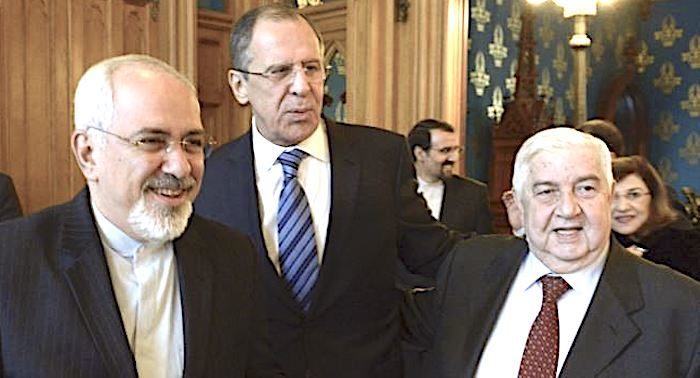
Lavrov, Muallem, Zarif
© AFPRussian Foreign Minister Sergei Lavrov (center) is hosting Iranian Foreign Minister Mohammad Javad Zarif (left) and Syrian Foreign Minister Walid al-Muallem (right) in Moscow.
Russian Foreign Minister Lavrov convenes conference with Iranian and Syrian foreign ministers in Moscow to hammer out joint position.

Following a series of telephone conversations between the Foreign Ministers of Russia, Iran and Syria, the Russians have agreed to host in Moscow on Friday 14th April 2017 a meeting of the three countries' foreign ministers. Russian Foreign Minister Lavrov is also due to hold bilateral talks with Syrian Foreign Minister Muallem the day before this tripartite meeting takes place.

Holding a foreign ministers' conference in Moscow on Friday means that the Russians will be able to brief the Iranians and the Syrians in private about the discussions they are currently having with US Secretary of State Tillerson in Moscow, and agree [on] a joint diplomatic and political strategy with the Iranians and the Syrians in response to the US actions.

Here is how Maria Zakharova, the Russian Foreign Ministry's spokesman, explained the purpose of the meeting:
On April 14, a trilateral meeting of foreign ministers of Russia, Syria and Iran will take place in Moscow. [The ministers[ will discuss measures needed to coordinate trilateral steps, so as not to let the situation aggravate and the efforts for a political settlement in Syria be derailed amid the US' armed aggression against Damascus.
The reason this meeting is being held face-to-face rather than by way of a video or telephone conference - which would be easier and faster to arrange - is because the Russians, the Iranians and the Syrians do not want the CIA and the NSA listening in to their discussions. Holding the meeting in person in Moscow in a room secured against electronic eavesdropping ensures this.

Comment: Dynamics. The US is too big to be ignored, but most definitely not in this inner circle. The Iranians and Syrians will unlikely be as forbearing of the US as Russia has been - given red lines, deliberate aggression, international law violations and such.


Jet4

UPDATE: US sharply cuts air operations in Syria out of fear of Russian missiles

S300 missile delivery system
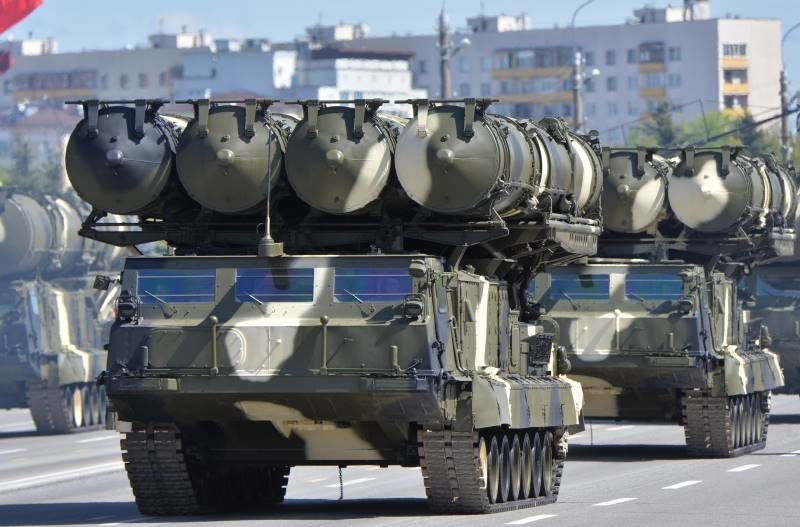
© RIA Novosti/GettyRussia's S300 missile delivery system
US sharply reduces air operations in Syria because of presence of Russian missiles after Moscow closes hotline.

The media is barely reporting the fact but the immediate effect of the US missiles strike on Syria's Sharyat air base has been to reduce US air force flights over Syria as the US worries about Moscow's reaction.

That this is so is confirmed by the New York Times which - presumably because its anti-Trump campaign overrides all other issues - has actually been doing some proper reporting about the Syrian conflict following the US missile strike.

Comment: UPDATE:

The Duran further reports:
The Pentagon has now confirmed that US air operations in Syria have indeed been sharply cut back. This is what Colonel John Dorrian, spokesman for Operation Inherent Resolve, told the Pentagon press corps on Wednesday 12th April 2017
We have made adjustments to our operations to account for the potential tensions that resulted from the strikes that were conducted because of the Syrian regime's chemical attack. But make no mistake, we do plan on continuing our operations and we do continue to look for ways to accelerate them. It's just appropriate to make sure that you're taking appropriate measures to account for that. We don't want to be reckless and we don't want to have some type of incident that would cause a miscalculation, or some type of unintended incident. The intent is to get back as quickly as possible to our normal operations and as fast a pace as we can manage.
This comes alongside Pentagon confirmation that over the past week the US led anti-ISIS coalition has carried out only 123 air strikes around Raqqa, ISIS's "capital" in eastern Syria, as opposed to the more than 7,800 strikes which were conducted over the course of March.

One of US Secretary of State Tillerson's primary objectives in Moscow was to get the hotline reopened. That this is so was confirmed by Russian Foreign Minister Lavrov during his joint news conference with Tillerson following Tillerson's meeting with Russian President Putin. Lavrov confirmed that Tillerson sought Putin's agreement to re-instate the hotline. Contrary to some media reports, it is clear from Lavrov's comments that the hotline remains suspended, and that Putin imposed conditions on its reinstatement
We also very thoroughly discussed the situation with regard to our air forces with the U.S.-led coalition and the Russian forces, and we talked about the de-confliction memorandum during the operations in Syria. You know that this was halted, but President Putin confirmed our determination to put it on track again, confirming that the main aim, of course, is between these forces of the coalition and the Russian forces is to combat Jabhat al-Nusrah and other terrorist organizations and ISIL, of course.
(bold italics added)

In other words Putin told Tillerson that Russia would reinstate the hotline only after it received categorical assurances from the US that US forces would henceforth concentrate their fire on the Jihadi terrorists - Jabhat Al-Nusra (ie. Al-Qaeda) and ISIS - and not on the Syrian military. Until that happens the hotline remains closed and US air operations in Syria remain hobbled. What this means in turn is that it is the Russians who have leverage over the US, and not the other way round, a fact which partly explains why all the talk of US ultimatums to Russia has amounted to precisely nothing.

The sharp reduction in US air operations in Syria as a result of the Russian decision to suspend the hotline is a matter of indisputable fact confirmed by the public record, including the Pentagon's own statements and the reporting of The New York Times. It has also been confirmed by the Belgian authorities, who have suspended operations by the Belgian air force supporting the US in Syria entirely.

It is a deeply regrettable fact that this is not being widely reported - a fact which is fostering an incomplete and distorted view of the crisis - but to pretend that it has not happened or that it is not happening is delusional and an exercise in denial.

Whether the US anticipated the Russians would respond in this way before it launched its missile strike is another matter, but it is the situation it is having to deal with now.

Meanwhile, that it is the Russians who hold the advantage is confirmed by the fact that though the US has been forced to scale down sharply its air operations in Syria since the missile strike, air operations by the Russian and Syrian air forces in Syria continue unabated.

Before leaving this subject I will touch briefly on claims that the reason most of the 59 Tomahawk cruise missiles the US launched against Sharyat air base missed their target was because the Russians jammed their guidance systems.

This suggestion was discussed at length by The Saker in this article, in which he says the following
Explanation B: The Russians could not legally shoot down the US missiles. Furthermore, it is incorrect to assume that these cruise missiles flew a direct course from the Mediterranean to their target (thereby almost overflying the Russian radar positions). Tomahawk were specifically built to be able to fly tangential courses around some radar types and they also have a very low RCS (radar visibility), especially in the frontal sector. Some of these missiles were probably flying low enough not to be seen by Russian radars, unless the Russians had an AWACS in the air (I don't know if they did). However, since the Russians were warned about the attack they had plenty of time to prepare their electronic warfare stations to "fry" and otherwise disable at least part of the cruise missiles. I do believe that this is the correct explanation. I do not know whether the Russian were technically unable to destroy and confuse the 23 missiles which reached the base or whether a political decision was taken to let less than half of the cruise missiles through in order to disguise the Russian role in the destruction of 36 missiles. What I am sure of is that 36 advanced cruise missile do not "just disappear". There are two reasons why the Russians would have decided to use their EW systems and not their missiles: first, it provides them "plausible deninability" (at least for the general public, there is no doubt that US signal intelligence units did detect the Russian electronic interference (unless it happened at very low power and very high frequency and far away inland), and because by using EW systems it allowed them to keep their air defense missiles for the protection of their own forces. Can the Russian really do this?

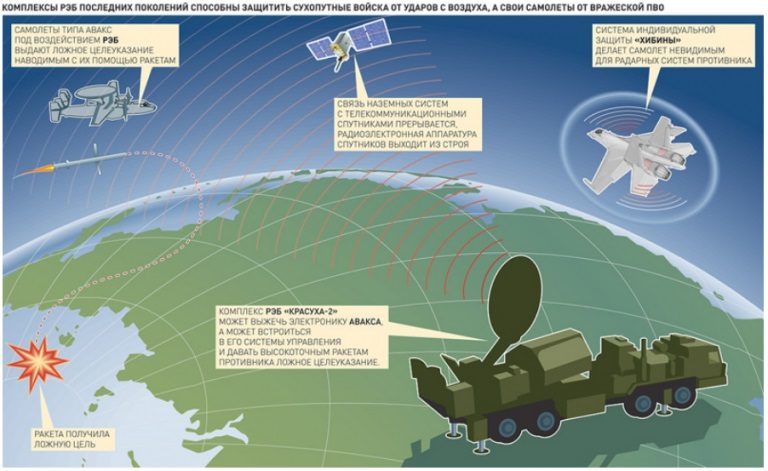
Take a look at this image, taken from a Russian website, which appears to have been made by the company Kret which produces some of the key Russian electronic warfare systems. Do you notice that on the left hand side, right under the AWACs aircraft you can clearly see a Tomahawk type missile turning around and eventually exploding at sea?
Russian electronic warfare systems graphic
How this is done is open to conjecture. All that we are told is that the missile is given a "false target" but for our purposes this really does not matter. What matters is that the Russians have basically leaked the information that they are capable of turning cruise missiles around. There are other possibilities such as an directed energy beams which basically fries or, at least, confuses the terrain following and or inertial navigation systems. Some have suggested a "kill switch" which would shut down the entire missile. Maybe. Again, this really doesn't matter for our purposes. What matters is that the Russian have the means to spoof, redirect or destroy US cruise missiles. It sure appears to be that for the first time these systems were used in anger.
This may indeed be what happened, and I would not personally be at all surprised if it was. It is for example well-established that the Russians have deployed the Krasukha-4 jamming system to Syria, and it may be that the failure of so many of the Tomahawk cruise missiles was the work of this system.

However there is no official confirmation of any of this from the Russians, and in the absence of such confirmation this story is not a fact but is rather extremely well-informed speculation, which as is clear from his article is all the Saker claims it is.

In the meantime, until some confirmation for this theory comes from the Russians, I cannot accept this story as confirmed, and I cannot treat reports drawing on anonymous Syrian sources supposedly confirming it as authoritative and necessarily true.


Target

Beijing warns striking North Korea 'riskier than striking Syria'

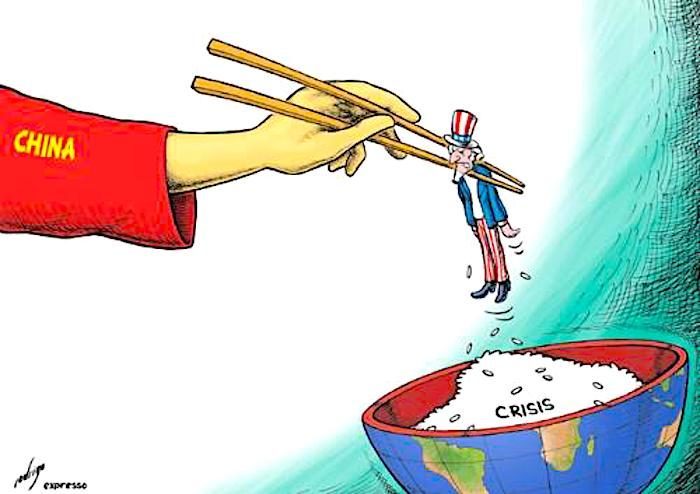
chopsticks unclesam
© toonpool.com
China has warned the US against using military force against North Korea, after a surprise redeployment of an aircraft carrier group. Washington's regional allies said they expect it to consult with them before any action.

Tension is mounting in the region as US President Donald Trump said he would solve the "North Korean problem" with or without China's help. The warning came amid the diversion of the aircraft carrier group 'USS Carl Vinson' to the Korean Peninsula and a week after Trump ordered the US Navy to fire a barrage of 59 Tomahawk missiles at a Syrian airbase as punishment for an alleged chemical attack in Idlib province.

Responding to US belligerence, Beijing called against using force against Pyongyang. "Military force cannot resolve the issue," Chinese Foreign Minister Wang Yi told reporters in Beijing. "Amid challenge there is opportunity. Amid tensions we will also find a kind of opportunity to return to talks."

An editorial in the influential newspaper Global Times, which is published by the Chinese Communist Party' People's Daily, said the situation on the Korean Peninsula could not be compared to that of Syria. "Taking military actions against North Korea is much more risky than launching a missile strike on Syria. Pyongyang is able to deal a heavy blow to South Korea. Regardless of Pyongyang's nuclear capability, a radiological dispersal device, or a 'dirty bomb,' if thrown on the South, will cause nuclear pollution, which will be unbearable to this US ally," the newspaper warned.

The paper said Washington needs to accept the reality that it "has no power to put global affairs in order at the moment" and work with other leading world powers on the Korean situation through the UN Security Council, a body that the US has shunned by the unilateral attack against Syria.

Comment: 'Slow and steady wins the race'...someone said. In other words, proceed with consensus, clear advantage and only when necessary. The US has shown it could use a bit of tutelage. It is lucky both China and Russia are offering, but don't expect it to last.


Pirates

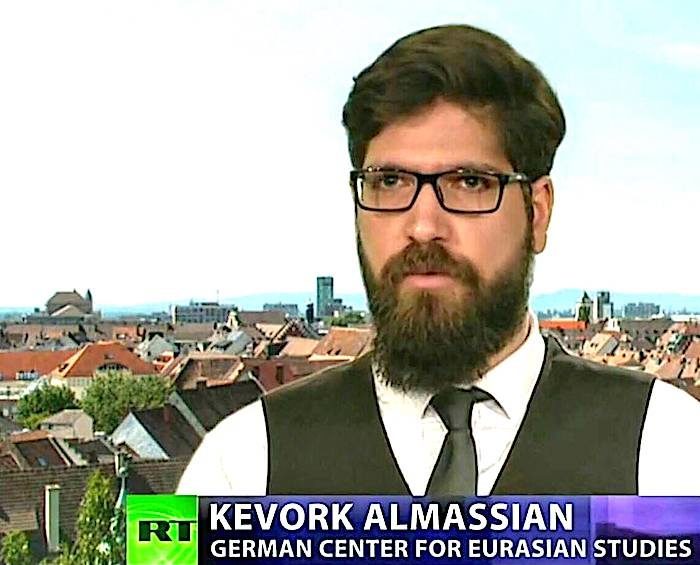
Expert Kevork Almassian: 'Hundreds of radicals are already in Europe'

Almassian
© German Center for Eurasian StudiesStop support • Eradicate the root • Stop the wars
Moderate rebels are considered 'good guys' as long as they are targeting the enemies of the US, but once they get out of control they come to Europe and the US to commit atrocities, says political analyst and Middle East expert Kevork Almassian.

US Senator John McCain warned that the capture of two major ISIS strongholds, Mosul in Iraq and Raqqa in Syria, could lead to "many people seeking violence" coming to Europe and the US as refugees.

RT asked Almassian what could be done to prevent a new flow of refugees with potential terrorists among them. He agrees with McCain that the US-backed forces are not very close to occupying Raqqa and Mosul. However, he said, the question of control of the "flow of terrorists toward Turkey and Europe" should be addressed to Ankara."[Turkey] is geographically close to both Syria and Iraq. It was the government of Turkey that was allowing the movement of these terrorists from Turkey, and from Syria to Turkey back again," Almassian said.

According to the expert, there are "hundreds of radicals" in Europe, and many of them have been granted European citizenship and are therefore "already Europeans." Previously, many of them were fighting in Syria and Iraq, he said. "There are sleeper cells in Europe and maybe in the US. ISIS is trying to organize its cells in Europe by conducting terrorist attacks. Up till this moment, the attacks are being conducted by lone wolves, but in the future, they will try to organize their ranks. So what [Western] government[s] should do is coordinate and cooperate with the governments of Syria and Iraq," he said.

Comment: Spot on advice. Will it be taken? Or will the radicals come 'home' to roost?


Snakes in Suits

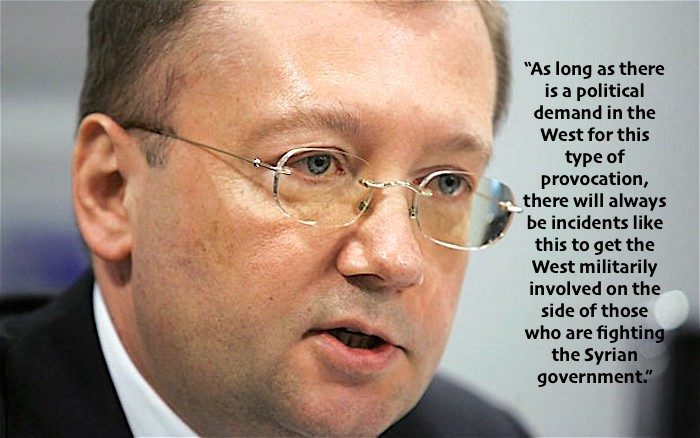
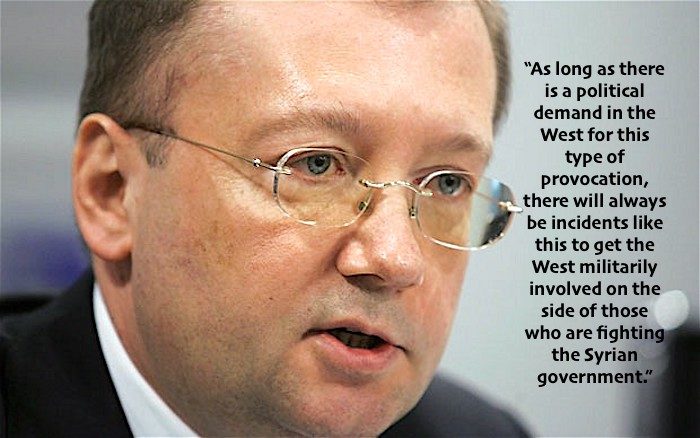
Ambassador Yakovenko: Syrian army most effective force fighting ISIS

Alexander Yakovenko
© ReutersAmbassador Alexander Yakovenko
Our Western colleagues regularly claim Russia pursues in Syria goals other than fighting terrorists. Increasingly, it becomes fashionable in the West to blame Russia for everything, based on rumors, speculation, and fake information.

The same thing here. They prefer to ignore the fact the Syrian army is the most effective force on the ground in fighting ISIS, Jabhat al-Nusra, and their likes. And that is precisely the reason why the Russian Air Force is supporting government troops and coordinating joint efforts. It has always been our position of principle from the very start, open and transparent. If Russia were not interested in tackling jihadists, why would President Vladimir Putin have put forward a plan to establish a common front against terrorists in Syria and elsewhere? While our Western partners cling to their own anti-ISIS coalition, the Russian military has been securing local ceasefires throughout Syria and providing humanitarian assistance to the Syrians on a daily basis.

Unfortunately, openness and consistency are lacking on the part of the West. It was reported in the US media that former US Secretary of State John Kerry, talking to some Syrian opposition figures, hadn't denied the US had been counting on the terrorists to engineer a regime change in Syria. Probably, hoping to domesticate them afterward with the help of their regional allies. It's enough to listen to Peter Ford, former British Ambassador in Damascus, to understand that there is no moderate secular opposition alternative to the present Syrian government.