OF THE
TIMES
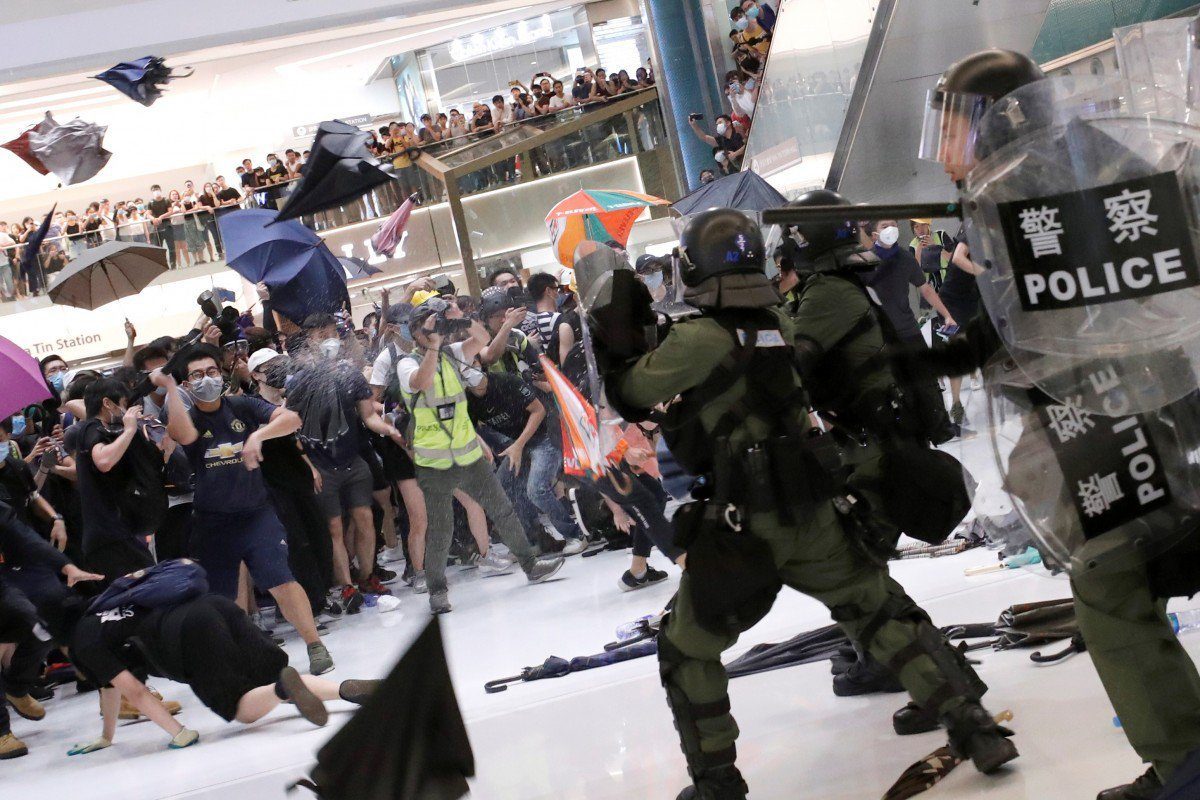
"The behavior of some radical protesters challenges the central government's authority, touching on the bottom line principle of 'one country, two systems,'" Colonel Wu said during a news conference in Beijing where he laid out the government's new strategy. "That absolutely cannot be tolerated."
Note before starting: when writing 'CIA', or more correctly, the CIA-complex, I include all the West's spy agencies, among them MI6 (UK), DGSE (France), BND (Germany), ASIS (Australia), etc.; their Ministries of Foreign Affairs, embassies; thousands of front NGOs, which are financed by the above and by billionaire global capitalists, such as George Soros and Pierre Omidyar. We can also include NATO and its military contractors, the West's government-managed 'free press', as well as transnational corporations, which are full of CIA non-official covers (NOCs), not to mention global and local organized crime cartels, who do a lot of their black ops. It's all one big Frankenstein family, raping and plundering the world's human and natural resources, while making the 99% - you and me - poorer and poorer.On July 1st, 1997 Britain finally renounced its 110-year colonial control over Hong Kong (HK). Margaret Thatcher and Deng Xiaoping had hammered out the Basic Law, which set the course for China's reintegrated Special Administrative Region (HKSAR). The concept was a novel one, One Country, Two Systems, which was to last for 50 years, until 2047. It stipulates that Hong Kong is an inseparable part of China, over which the Mainland has the ultimate right to make all necessary administrative and policy decisions, but the SAR would have a high degree of independence in its legislature and judiciary. On that day, the PLA took over all of Britain's military properties on the territory's islands and on the mainland of HK, in Kowloon and New Territories. There are 1-2 divisions of PLA troops there (about 9,000), including small naval and air force detachments. They stay put, raising and lowering the Chinese flag every day and doing military drills to stay sharp. I've never seen a PLA soldier on Hong Kong's streets, so they must change into their civvies when they leave their bases.
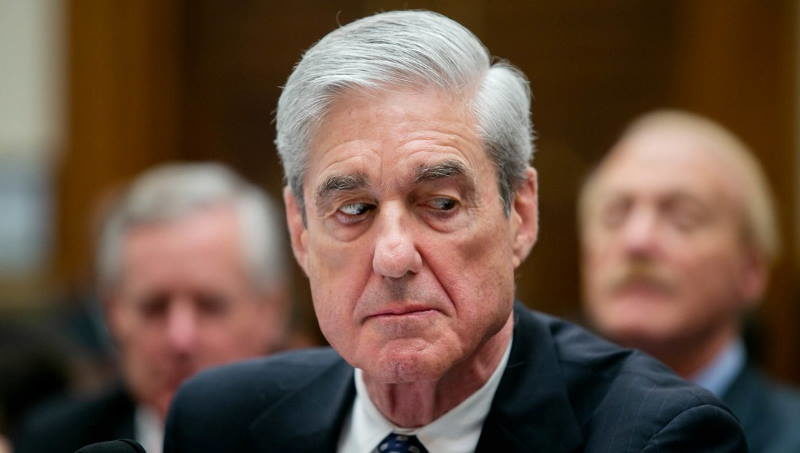
Former special counsel Robert Mueller refused to answer questions Wednesday regarding the so-called Steele dossier, the opposition research document Hillary Clinton's presidential campaign commissioned in 2016, which contained allegations about Donald Trump's ties to Russia.Rep. Gaetz had something to say about Mueller's non-answer:
In a tense exchange with Rep. Greg Steube, R-Fla., Mueller disputed the assertion by Republicans on the committee that the dossier, compiled by former British spy Christopher Steele, was the basis for an FBI investigation that would eventually be incorporated into the special counsel's probe.
"You had two years to investigate," Steube said. "Not once did you deem it worth to investigate how an 'unverified' document that was paid for by a political opponent was used to obtain a warrant to spy on the opposition of a political campaign. Did you do any investigation into that — "
"I do not accept your characterization of what occurred," Mueller replied.
Trump has long asserted that the dossier was the basis for what he has described as a "witch hunt" against him.
Questioning Mueller at a House Judiciary Committee hearing on Wednesday, Lesko (R-Arizona) ridiculed the notion that President Donald Trump impeded the former special counsel's investigation.Mueller denied he asked for the top job at the FBI, which Trump immediately contradicted:
"Were you ever fired Mr Mueller?" she asked, to which Mueller replied "No."
"Were you allowed to complete your investigation unencumbered?" she continued. Mueller replied "Yes."
From there, Lesko chose a peculiar angle of attack to cast doubt on the second half of Mueller's 440-page report. Outlining 10 potential cases of obstruction by the president, the report's second half quotes mainstream media exposes more than 150 times to piece together an image of a president scrambling to prevent Mueller from doing his job.
"Rather than purely relying on the evidence provided by witnesses and documents, I think you relied a lot on media," she said. "I'd like to know how many times you cited the Washington Post in your report."
"Volume two is mostly regurgitated press stories," she said. "Honestly, there's almost nothing in volume two that I couldn't already hear or know simply by having a $50 cable news subscription."
Lesko was mocked by Democrats and the anti-Trump crowd for her line of questioning.
"My understanding of it was [I was] not applying for the job, I was asked to give my input on what it would take to do the job," Mueller, who had been FBI head for 12 years up to 2013, told the House Judiciary Committee.Democrats pressured Mueller on why he did not recommend charges for the president. RT give an analysis of the reasoning:
This contradicts Trump's claim that he had turned down Mueller's request to hold the post again. The US president first tweeted it in May, and recently reiterated during a press conference with Pakistani Prime Minister Imran Khan that Mueller "wanted the job of FBI director and he didn't get it."
[...]
Democrats, on the other hand, pressed Mueller to admit that the decision not to charge Trump was driven primarily by adherence to the so-called OLC Opinion, and not by Trump's innocence.
The Department of Justice's Office of Legal Counsel (OLC) first determined in 1973 that a sitting president cannot be indicted for a crime, as then-President Richard Nixon faced impeachment for his involvement in the Watergate scandal. In short, it stated that a president would need to be removed from office before charges could be brought.
"The spectacle of an indicted president still trying to serve as Chief Executive boggles the imagination," the office wrote.
The office reiterated its position in a 2000 memo, stating that the 1973 opinion was still "the best interpretation of the constitution." Though not enshrined in US law, the OLC opinion represents long-standing Justice Department policy, and is seen as binding for federal officials.
At several points during Wednesday's hearing, Mueller told Democrats that his team was aware "from the outset" that Trump would ultimately not be charged with a crime while in office, triggering accusations of "fishing" from Republicans. Mueller did say that Trump could be potentially charged once out of office, a scenario that some Democrats would no doubt be eager to see play out.
Though Mueller told lawmakers on Wednesday that the OLC opinion was the only obstacle to indictment, the former prosecutor has made contradictory claims before. In a joint statement with Attorney General William Barr in May, Mueller said that the decision not to prosecute Trump was also motivated by other legal factors. Republicans have already pounced on Mueller for his apparent misstatements.
Comment: Rogue Israel's latest attack on Syria launched from Lebanese airspace, killed civilians