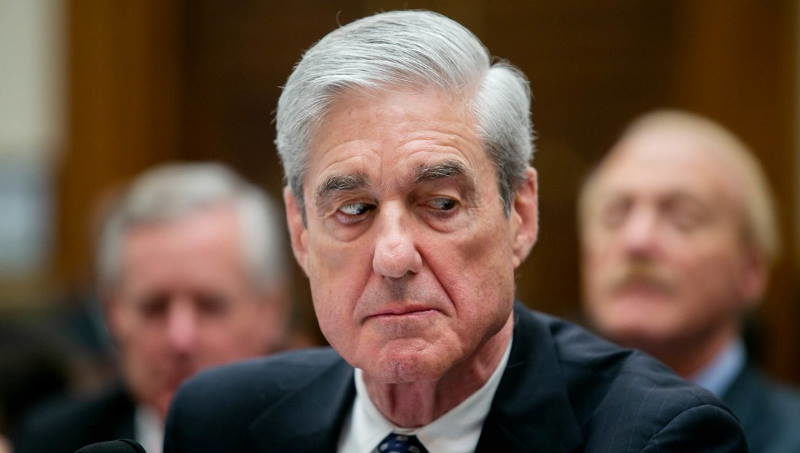
Robert Mueller testifies before Congress on his report
It took just minutes for Robert Mueller's
testimony before the House Judiciary Committee to turn into a painful exercise when it became clear the 74 year-old special counsel had difficulty handling the questions posed to him about his long, complex investigation into the Trump-Russia affair.
Mueller was slow to react to questions. He frequently asked for questions to be repeated. He sometimes appeared confused. He did not appear to be conversant with some issues in the investigation. He did not, or could not, put together detailed answers even to those questions he agreed to address.Reporters who have covered Mueller for years saw differences from his appearances in the past. "I haven't seen a performance quite like this from Mueller," the
New York Times' Noah Weiland said in an online discussion. "In 12 years as FBI director, he gave plenty of clipped responses. But more often than not he was more rhetorically agile than anyone on the committees that were questioning him. And there was rarely a time when he even paused for a second after a question was asked. There was little searching in his eyes for answers. He rarely looked at notes."
That was the Mueller of years ago. On Wednesday, Mueller seemed incapable of engaging fully with the questions that were presented to him.
"This is delicate to say, but Mueller, whom I deeply respect, has not publicly testified before Congress in at least six years. And he does not appear as sharp as he was then."
Mueller's performance raised questions that reached far beyond one appearance before one committee. It called into doubt the degree to which Mueller was in charge of the entire special counsel investigation.
"You wonder how much of this was affecting the investigation," one Republican member of the House said as he watched Mueller's testimony. "It sheds a lot of light on what happened the last two years. He wasn't in charge."
If Mueller was not fully in charge, that would direct attention to the staff he assembled for the investigation — staff that President Trump has often derided as "17 angry Democrats." Some of Mueller's aides were Democratic donors, and a key aide, Andrew Weissmann, famously attended Hillary Clinton's 2016 election night event that was planned as a victory party.
It seems likely that Republicans will direct new attention to them in light of Mueller's appearance.No one noticed Mueller's performance that more than the centerpiece of the investigation, the president himself. "This has been a disaster for the Democrats and a disaster for the reputation of Robert Mueller," the president tweeted — not his own words, but those of Fox News anchor Chris Wallace during a break in the testimony.
During that commentary, Wallace said Mueller "has seemed very uncertain with his brief. He doesn't seem to know things that are in the report ... I think it does raise questions about the degree to which he actually was in charge and control of this [investigation].
Comment: Other highlights, (or low-lights) depending on your point of view:
Former special counsel Robert Mueller refused to answer questions Wednesday regarding the so-called Steele dossier, the opposition research document Hillary Clinton's presidential campaign commissioned in 2016, which contained allegations about Donald Trump's ties to Russia.
In a tense exchange with Rep. Greg Steube, R-Fla., Mueller disputed the assertion by Republicans on the committee that the dossier, compiled by former British spy Christopher Steele, was the basis for an FBI investigation that would eventually be incorporated into the special counsel's probe.
"You had two years to investigate," Steube said. "Not once did you deem it worth to investigate how an 'unverified' document that was paid for by a political opponent was used to obtain a warrant to spy on the opposition of a political campaign. Did you do any investigation into that — "
"I do not accept your characterization of what occurred," Mueller replied.
Trump has long asserted that the dossier was the basis for what he has described as a "witch hunt" against him.
Rep. Gaetz had something to say about Mueller's non-answer:
Republican committee member Debbie Lesko pointed out the report's inordinate
reliance on media stories
Questioning Mueller at a House Judiciary Committee hearing on Wednesday, Lesko (R-Arizona) ridiculed the notion that President Donald Trump impeded the former special counsel's investigation.
"Were you ever fired Mr Mueller?" she asked, to which Mueller replied "No."
"Were you allowed to complete your investigation unencumbered?" she continued. Mueller replied "Yes."
From there, Lesko chose a peculiar angle of attack to cast doubt on the second half of Mueller's 440-page report. Outlining 10 potential cases of obstruction by the president, the report's second half quotes mainstream media exposes more than 150 times to piece together an image of a president scrambling to prevent Mueller from doing his job.
"Rather than purely relying on the evidence provided by witnesses and documents, I think you relied a lot on media," she said. "I'd like to know how many times you cited the Washington Post in your report."
"Volume two is mostly regurgitated press stories," she said. "Honestly, there's almost nothing in volume two that I couldn't already hear or know simply by having a $50 cable news subscription."
Lesko was mocked by Democrats and the anti-Trump crowd for her line of questioning.
Mueller
denied he asked for the top job at the FBI, which Trump immediately contradicted:
"My understanding of it was [I was] not applying for the job, I was asked to give my input on what it would take to do the job," Mueller, who had been FBI head for 12 years up to 2013, told the House Judiciary Committee.
This contradicts Trump's claim that he had turned down Mueller's request to hold the post again. The US president first tweeted it in May, and recently reiterated during a press conference with Pakistani Prime Minister Imran Khan that Mueller "wanted the job of FBI director and he didn't get it."
Democrats pressured Mueller on why he did not recommend charges for the president. RT give an
analysis of the reasoning:
[...]
Democrats, on the other hand, pressed Mueller to admit that the decision not to charge Trump was driven primarily by adherence to the so-called OLC Opinion, and not by Trump's innocence.
The Department of Justice's Office of Legal Counsel (OLC) first determined in 1973 that a sitting president cannot be indicted for a crime, as then-President Richard Nixon faced impeachment for his involvement in the Watergate scandal. In short, it stated that a president would need to be removed from office before charges could be brought.
"The spectacle of an indicted president still trying to serve as Chief Executive boggles the imagination," the office wrote.
The office reiterated its position in a 2000 memo, stating that the 1973 opinion was still "the best interpretation of the constitution." Though not enshrined in US law, the OLC opinion represents long-standing Justice Department policy, and is seen as binding for federal officials.
At several points during Wednesday's hearing, Mueller told Democrats that his team was aware "from the outset" that Trump would ultimately not be charged with a crime while in office, triggering accusations of "fishing" from Republicans. Mueller did say that Trump could be potentially charged once out of office, a scenario that some Democrats would no doubt be eager to see play out.
Though Mueller told lawmakers on Wednesday that the OLC opinion was the only obstacle to indictment, the former prosecutor has made contradictory claims before. In a joint statement with Attorney General William Barr in May, Mueller said that the decision not to prosecute Trump was also motivated by other legal factors. Republicans have already pounced on Mueller for his apparent misstatements.


Comment: Other highlights, (or low-lights) depending on your point of view: Rep. Gaetz had something to say about Mueller's non-answer:
Republican committee member Debbie Lesko pointed out the report's inordinate reliance on media stories Mueller denied he asked for the top job at the FBI, which Trump immediately contradicted: Democrats pressured Mueller on why he did not recommend charges for the president. RT give an analysis of the reasoning: