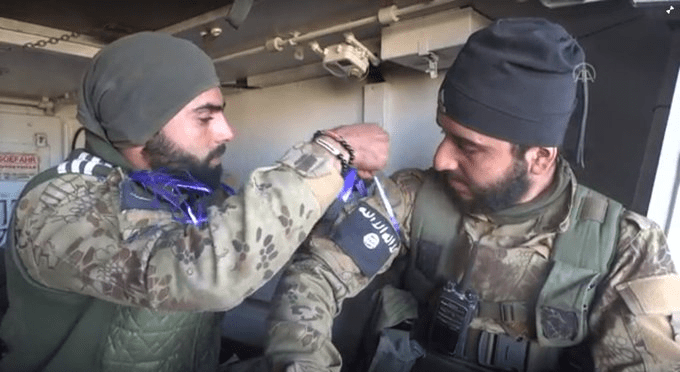
Turkish backed jihadists and foreign fighters preparing an attack against the Syrian Army position around Idlib.
A significant development took place in Syria on Friday.
A Russian attack on a Turkish convoy in Idlib in north-west Syria killed 36 Turkish soldiers and officers. In retaliation, Turkey launched an unprecedented armed drone attack that lasted several hours and
resulted in the killing and wounding of over 150 Syrian officers and soldiers and their allies of Hezbollah and the Fatimiy'oun. The Turkish drones destroyed dozens of tanks and rocket launchers deployed by the Syrian Army along the front line.
Russia ceased air support for Syria, and its allies demanded from Russia an explanation for the lack of coordination of its unilateral stoppage of air support, allowing the Turkish drones to kill so many Syrian Army and allied forces. What happened, why, and what will be the consequences?
In October 2018, Turkey and Russia signed an agreement in Astana to establish a de-confliction zone along the Damascus-Aleppo (M5) and Aleppo-Latakia (M4) highways. It was agreed that all belligerents would withdraw and render the roads accessible to civilian traffic. Moreover, it was decided to end the presence of all jihadists, including the Tajik, Turkistan, Uighur and all other foreign fighters present in Idlib alongside Hayat Tahrir al-Sham (former ISIS, former al-Qaeda in Syria), Hurras al-Din (al-Qaeda in Syria), and Ahrar al-Sham with their foreign fighters and all "non-moderate" rebels.
Last year, Hayat Tahrir al-Sham took full control of Idlib and its rural area under the watchful eyes of Turkey.Over a year later, the Turkish commitment to end the presence of jihadists and to open the M5 and M4 had not been respected. The Syrian Army and its allies, along with Russia, agreed to impose the Astana agreement by force. In a few weeks, the jihadists' defence line crumbled under heavy Russian bombing. According to field commanders, the jihadists left fewer than 100 men in every village, who withdrew under the heavy bombing and preferred to leave rather than be surrounded by the Syrian Army and their fast advance.
Turkey, according to the military commanders in Syria, saw the withdrawal of jihadists and decided to move thousands of troops into Syria to lead a counter-attack against the Syrian Army and its allies.
This action made it impossible for Russia to distinguish between jihadists and the Turkish Army. Moreover, Turkey refrained from informing Russia - as it had agreed to according to the deconfliction agreement between Russia and Turkey - about the position of its regular forces. This was when Russia bombed a convoy killing 36 Turkish officers along with 17 jihadists who were present together with the Turkish Army.







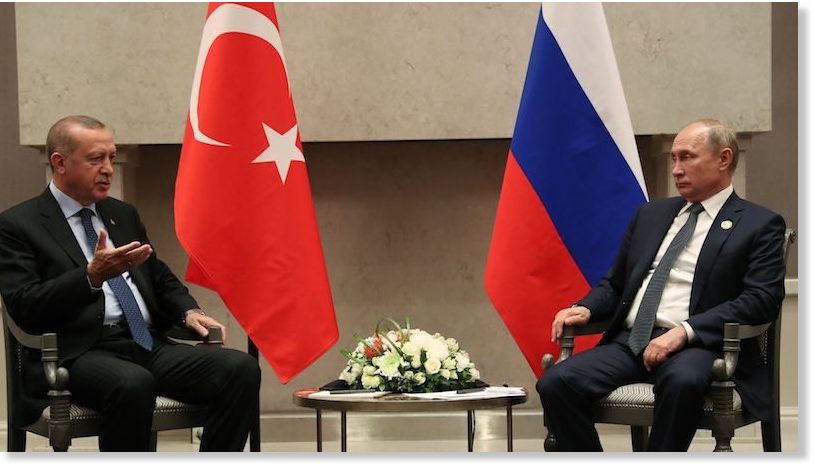



Comment: Erdogan is looking more and more unhinged each day. At the same time he is floating ceasefire offers, he is making threats: Still the Turkish president has retained a bit of a grip on reality, with a switch to making nice with the Kremlin, despite his previous statements in which he ordered Russia (!) to stay out of Turkey's way in Syria. The proffered olive branch: In the meantime, Erdogan has played the migrant card once again, opening its northern borders to Europe: Fierce clashes, tear gas at border as Greece vows to 'turn back' flow of migrants from Turkey
Russia has stayed the course in trying to bring some order to the area: Why is Erdogan so focused on Idlib? One factor resurfacing is that if Turkey loses Idlib, jurisdiction over the neighboring province of Hatay, once under Syrian governance but handed to Turkey by France in 1939, may come back into the picture: