Science & TechnologyS


Sun

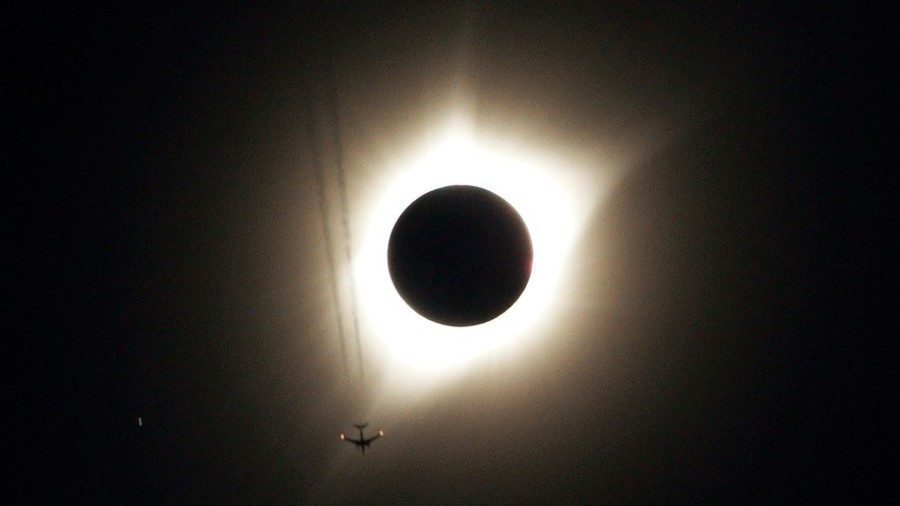
Scientists plan to fight global warming by dimming the sun

zamračenje sunca
© Reuters / Rick Wilking
Scientists have come up with a new and ingenious way of fighting global warming: use chemicals to blot out the sun. Whether we'll then have to fight (and do everything else) in the shade, the research doesn't quite spell out.

Since the world can't seem to agree on reducing CO2 emissions, why not tackle the problem from the other end, scientists from Harvard and Yale have surmised. The researchers recently published a study which says that spraying large amounts of sulfate particles into the Earth's lower stratosphere in order to literally dim out the sun could cut the effects of global climate change in half, and it might even be cheap!

With all the excitement over the "hypothetical" and "highly uncertain and ambitious" plan, there are no guarantees that it will not actually make things worse in a catastrophic sort of way. There is a suspicious lack of information about what 'dimming the sun' could possibly do to those of us who rely on it for basic things - like growing food, or not freezing to death.

Comment: Or how about the critique that it is simply insane. If these researchers had been paying any attention, the sun is entering a grand solar minimum phase and along with it the start of another ice age. In other words, they're too late - the sun will be 'dimmed' all on its own. Of course, that still won't stop them from saying the ice age is because of global warming. See also:


Beaker

Scientists accidentally stumble onto technique for melting gold at room temperature

gold nugget
© rcfotostock/Stock.adobe.com
Scientists were dumbfounded after finding it is possible to melt gold at room temperature using an electron microscope.

For thousands of years, famous scientists and alchemists attempted to find a way to turn common metals into gold. While this proved to be a thankless pursuit, a new discovery announced by a team from Chalmers University in Sweden has managed to find an altogether different and mysterious property of gold itself.

After placing a small piece of gold in an electron microscope, researcher Ludvig de Knoop ramped up the magnification to the maximum and increased the electric field step by step to see what would happen to the gold's atoms. To his amazement, he noticed that the surface layers of gold had actually melted at room temperature.

Bulb

Canadian report reluctantly admits that 'green' energy is a disastrous flop

wind farm
© David McNew/AFP/Getty ImagesThe report confirms what should have been obvious from the start: the more “variable” wind and solar are introduced into any electricity system, the more they make it both more expensive and less reliable.
Amid hundreds of graphs, charts and tables in the latest World Energy Outlook (WEO) released last week by the International Energy Agency, there is one fundamental piece of information that you have to work out for yourself: the percentage of total global primary energy demand provided by wind and solar. The answer is 1.1 per cent. The policy mountains have laboured and brought forth not just a mouse, but - as the report reluctantly acknowledges - an enormously disruptive mouse.

The International Energy Agency (IEA) has in recent years become an increasingly schizophrenic organization. As both a source of energy information and a shill for the UN's climate-focused sustainable development agenda, it has to talk up the "transition to a low-carbon future" while simultaneously reporting that it's not happening. But it will!

This report should be profoundly embarrassing to the Liberal government of Justin Trudeau, which has virtue-signalled itself to the front of a parade that is going nowhere, although it can certainly claim genuine leadership in the more forceful route to transition: killing the fossil fuel industry by edict.

Comment: See also:


Sherlock

X-ray imaging reveals the secrets inside the WW2 Enigma encryption machine

enigma machine geman WW2 code
© University of Manchester/FlickrA genuine Enigma Machine used by the Germans in World War II to send encrypted messages
Scientists working at The University of Manchester have shone new light on the Enigma machine used by the German military in World War Two and cracked by Alan Turing and his team of code breakers at Bletchley Park.

Using X-ray Computed Tomography (CT), features inside the Enigma's metal casing were revealed, including the wiring and structure of the rotors that encrypted messages sent using the machine.

The CT technology, part of the Henry Royce Institute for Advanced Materials, works by collecting a series of X-ray radiographs which are then reconstructed into a virtual 3D replica.

Bug

For 4,000 years, termites have been building mysterious cones of earth in Brazil

Termite mounds
© Murundus in BrazilROY FUNCH
Their huge mounds cover an area the size of Britain, and are visible from space.

In the east of Brazil, mysterious cones of earth rise from the dry, hard-baked soil. Each of these mounds is about 30 feet wide at its base, and stands six to 13 feet tall. From the ground, with about 60 feet of overgrown land separating each mound from its neighbors, it's hard to tell how many there are. But their true extent becomes dramatically clear from space.

Using satellite images, Roy Funch from the State University of Feira de Santana has estimated that there are about 200 million of these mounds. They're arrayed in an uncannily regular honeycomb-like pattern. Together, they cover an area roughly the size of Great Britain or Oregon, and they occupy as much space as the Great Pyramid of Giza 4,000 times over. And this colossal feat of engineering is, according to Funch, the work of the tiniest of engineers-a species of termite called Syntermes dirus, whose workers are barely half an inch long.

Termites are well known for creating elaborate nests, with vast networks of underground tunnels. Many species create skyscraping chimneys atop these lairs to ventilate the underground chambers, and in some African species, these mounds can tower 30 feet high. But the Brazilian mounds are neither chimneys nor nests. They're just amorphous lumps of soil, with no internal structures. Nothing lives inside them. Instead, "they're just slag piles," says Funch.

Galaxy

Astronomers note another flickering and dimming star in the Milky Way

Tabby's Star
© NASA/JPL-CaltechAn artist’s rendition of a hypothetical warped band of dust around KIC 8462852, also known as Tabby's Star.
A faraway star in the southern sky is flickering in an odd manner that suggests a bizarre cloud of material-or something even stranger-is in orbit around it. Discovered by astronomers using a telescope in Chile, the star is reminiscent of two other enigmatic astrophysical objects, one thought to harbor a planet with rings 200 times larger than those of Saturn, the other most famous for the remote possibility it is encircled by "alien megastructures." The newfound star may help shed some light on one or both of these puzzling objects.

In 2010, the Vista Variables in the Via Lactea (VVV) survey began its project of creating a three-dimensional map of variable stars in the vicinity of the Milky Way's center. As part of the project, astronomer Roberto Saito of the Federal University of Santa Catarina scoured the telescope's data for eruptive outbursts from the hundreds of millions of monitored stars. But the most notable thing he found was not an outburst at all-it was a star that grew mysteriously dim over several days in 2012. He and his colleagues reported their findings in a recently published paper in the Monthly Notices of the Royal Astronomical Society.

Known as VVV-WIT-07, the star appears to be much older and redder than our sun, although the amount of interstellar dust between our solar system and the star's home closer to the galactic center makes exact classification and distance measurements very difficult. What is certain is that in the summer of 2012, the object's brightness faded slightly for 11 days, then plummeted over the following 48 days, suggesting that something blocked more than three quarters of the star's light streaming toward Earth. But what could that "something" be?

Butterfly

Michael Behe's new book 'Darwin Devolves' topples the foundational claims of evolutionary theory

behe darwin devolves
I saw at the website Peaceful Science that biologist Nathan Lents, author of Human Errors: A Panorama of Our Glitches, from Pointless Bones to Broken Genes, says that he has been asked to review Mike Behe's new book, Darwin Devolves: The New Science About DNA That Challenges Evolution (DD). Professor Lents notes:
I've been commissioned to review Behe's new book, out next year, so I am reading it now. I'm about 70 pages in and so far, all I've seen is, "Gee, this stuff is complicated!"
Lents can rest assured: There is far more to the book than that. Behe dismantles the fundamental claim of evolutionary theory that mutations and natural selection naturally drive life toward greater complexity as new information is constantly generated. In stark contrast to this belief, Behe demonstrates the opposite. He summarizes the thesis of his book by stating
With surpassing irony it turns out that...Darwinian evolution proceeds mainly by damaging or breaking genes, which, counter-intuitively, sometimes helps survival. In other words, the mechanism is powerfully de-volutionary. It promotes the rapid loss of genetic information. Laboratory experiments, field research, and theoretical studies all forcefully indicate that, as a result, random mutation and natural selection make evolution self-limiting. That is, the very same factors that promote diversity at the simplest levels of biology actively prevent it at more complex ones. Darwin's mechanism works chiefly by squandering genetic information for short-term gain.

Jet1

Silent plane powered by supercharged air molecules makes first flight

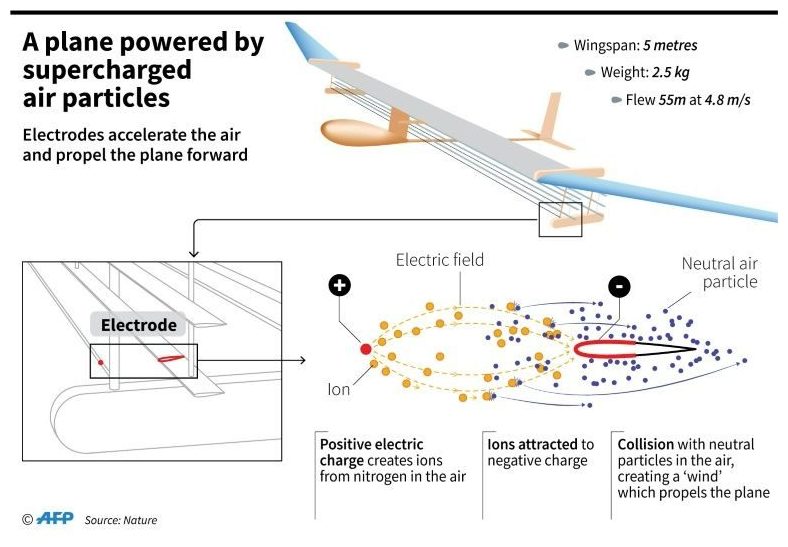
A plane powered by supercharged air particles
© Simon MALFATTO, AFPA plane powered by supercharged air particles.
The blue glowing jets of science fiction spacecraft came a step closer to reality on Wednesday as US physicists unveiled the world's first solid-state aeroplane powered in flight by supercharged air molecules.

More than a century on from the Wright brothers' first artificial flight, scientists hailed the "historic" test of the new technology, which could eventually slash greenhouse-gas emissions from aviation.

Ever since Orville and Wilbur Wright's momentous glide in the winter of 1903, aircraft have been driven by propellers or jets that must burn fuel to create the thrust and lift needed for sustained flight.

A team of experts from the Massachusetts Institute of Technology managed to unlock a process known as electroaerodynamics, previously never seen as a plausible way to power an aircraft.

They were able to fly the new plane, with a wingspan of five metres (16 feet), a distance of 55 metres at a speed of 4.8 metres-per-second.

That's hardly supersonic, but the implications of this unprecedented mode of flight could be stratospheric.

"The future of flight shouldn't be things like propellers and turbines," said Steven Barrett, who designed the prototype.

"It should be more like what you see in Star Trek with a kind of blue glow and something that silently glides through the air."

At first glance, the plane itself doesn't look lightyears away from other renewable aircraft, such as the Solar Impact II craft that in 2015-16 used energy from the Sun to fly around the world.

Unlike Solar Impact, Barrett's plane doesn't have any propellers or solar panels -- or any moveable parts whatsoever.

Instead of engines, it is powered by a system comprising two main sections.

At the front of the plane sit a series of parallel electrodes made up of lightweight wires that produce an enormous voltage -- +20,000v -- supercharging the air around it and splitting away negatively charged nitrogen molecules known as ions.

At the plane's rear are rows of aerofoils set to -20,000v. The ions automatically move from a positive to negative charge, dragging with them air particles that create the so-called "ionic wind" to provide the aircraft with lift.

Galaxy

'God of chaos': Milky Way star on the brink of massive gamma-ray supernova explosion

Illustration of a gamma ray burst in space
© NSF / LIGO / Sonoma State University / A. SimonnetIllustration of a gamma ray burst in space.
A star 8,000 light years from Earth is on the verge of a huge supernova explosion, which could produce the Milky Way's first gamma-ray explosion, a dangerous and extremely energetic event.

Australian scientists at the University of Sydney discovered the rare 'God of chaos' star, which they say could produce the Milky Way's first known gamma-ray burst, a lethal combination of dust and gas mixed with wind as fast as 12 million km/ph, which is one of the most extreme energetic events after the Big Bang.

The researchers published their findings in the latest issue of the journal 'Nature Astronomy'. 'God of chaos' is part of a two-star system named after the Egyptian serpentine Apep.

Apep comprises of two hot, luminous stars which orbit each other every hundred years or so. Scientists say one of the stars has the perfect conditions to create a gamma-ray burst which has the potential to strip Earth's ozone from the atmosphere, drastically increasing our exposure to UV light from the sun.

Fortunately, the star doesn't appear to be aimed at Earth, however researchers say they "can't be certain what the future has in store" for Apep.

"The system might slow down enough so it explodes as a normal supernova rather than a gamma-ray burst. However, in the meantime, it is providing astronomers a ringside seat into beautiful and dangerous physics that we have not seen before in our galaxy," said leader of the research group Professor Peter Tuthill.

Meteor

Bronze Age civilization collapse: Massive overhead meteor explosion wiped out Near East 3,700 years ago

Jordan meteor calamity
© FIGHTBEGIN/ISTOCK.COMANCIENT WIPEOUT Preliminary evidence indicates that a low-altitude meteor explosion around 3,700 years ago destroyed cities, villages and farmland north of the Dead Sea (shown in the background above) rendering the region uninhabitable for 600 to 700 years.

Archaeologists at a site in what's now Jordan have found evidence of a cosmic calamity


A superheated blast from the skies obliterated cities and farming settlements north of the Dead Sea around 3,700 years ago, preliminary findings suggest.

Radiocarbon dating and unearthed minerals that instantly crystallized at high temperatures indicate that a massive airburst caused by a meteor that exploded in the atmosphere instantaneously destroyed civilization in a 25-kilometer-wide circular plain called Middle Ghor, said archaeologist Phillip Silvia. The event also pushed a bubbling brine of Dead Sea salts over once-fertile farm land, Silvia and his colleagues suspect.

People did not return to the region for 600 to 700 years, said Silvia, of Trinity Southwest University in Albuquerque. He reported these findings at the annual meeting of the American Schools of Oriental Research on November 17.

via GIPHY

Comment: See also: Comets and the Bronze Age Collapse

For more information on the role of cometary bombardment in the cycles of civilization, read The Apocalypse: Comets, Asteroids and Cyclical Catastrophes by Laura Knight-Jadczyk.