Science & TechnologyS

Info

Lost continent buried beneath Europe uncovered by geologists

Greater Adria
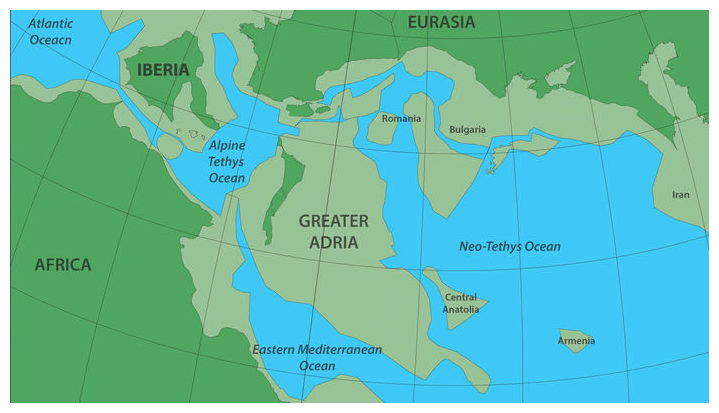
© VAN HINSBERGEN ET AL., GONDWANA RESEARCH (2019)About 140 million years ago, Greater Adriaโ€”which later got shoved beneath southern Europeโ€”was a Greenland-size landmass (submerged portions in gray-green) south of the continent.
Forget the legendary lost continent of Atlantis. Geologists have reconstructed, time slice by time slice, a nearly quarter-of-a-billion-year-long history of a vanished landmass that now lies submerged, not beneath an ocean somewhere, but largely below southern Europe.

The researchers' analysis represents "a huge amount of work," says Laurent Jolivet, a geologist at Sorbonne University in Paris who was not involved in the new study. Although the tectonic history of the landmass has been generally known for a few decades, he says, "[T]he amount of detail in the team's systematic time-lapse reconstruction is unprecedented."

The only visible remnants of the continent โ€” known as Greater Adria โ€” are limestones and other rocks found in the mountain ranges of southern Europe. Scientists believe these rocks started out as marine sediments and were later scraped off the landmass's surface and lifted up through the collision of tectonic plates. Yet the size, shape, and history of the original landmass โ€” much of which lay beneath shallow tropical seas for millions of years โ€” have been tough to reconstruct.

Info

Another possible interstellar comet headed our way in July 2020

Astronomers have discovered a potentially interstellar comet โ€” the second after 'Oumuamua โ€” and it's approaching the Sun, with a perihelion in mid-2020.
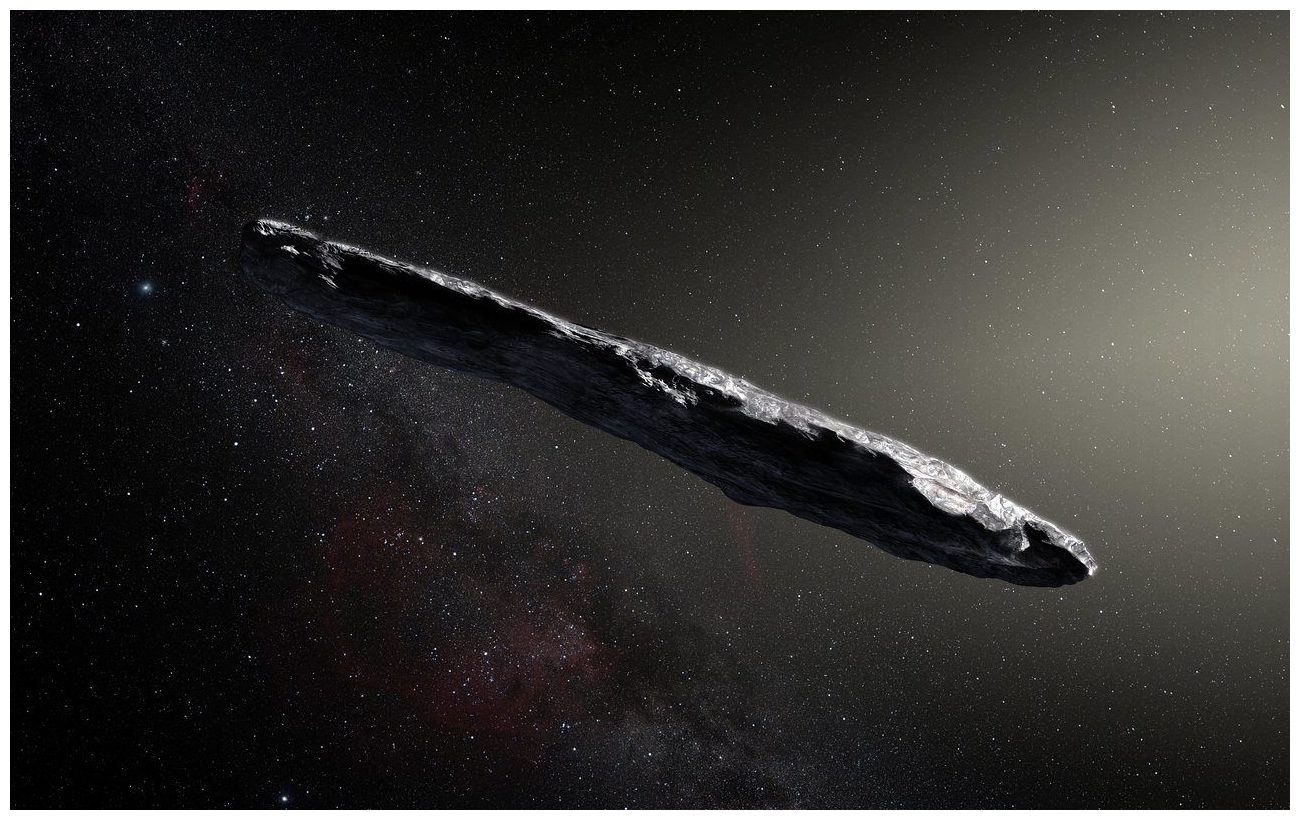
Oumuamua
© Universe Today
First there was 'Oumuamua. Now we might be in store for another interstellar flyby, this time by the recently discovered comet A/2019 Q1. Gennady Borisov captured the object on August 30, 2019, at the Crimean Astrophysical Observatory when it was about 5.5 astronomical units (a.u.) from the Sun. Unlike 'Oumuamua, which was discovered well after perihelion, the new comet is approaching the plane of the solar system and will reach perihelion on July 24, 2020 at a distance of 4.96 a.u., about the distance between Jupiter and the Sun.

But it's still early. Don't be surprised if these dates change as more observations come in.

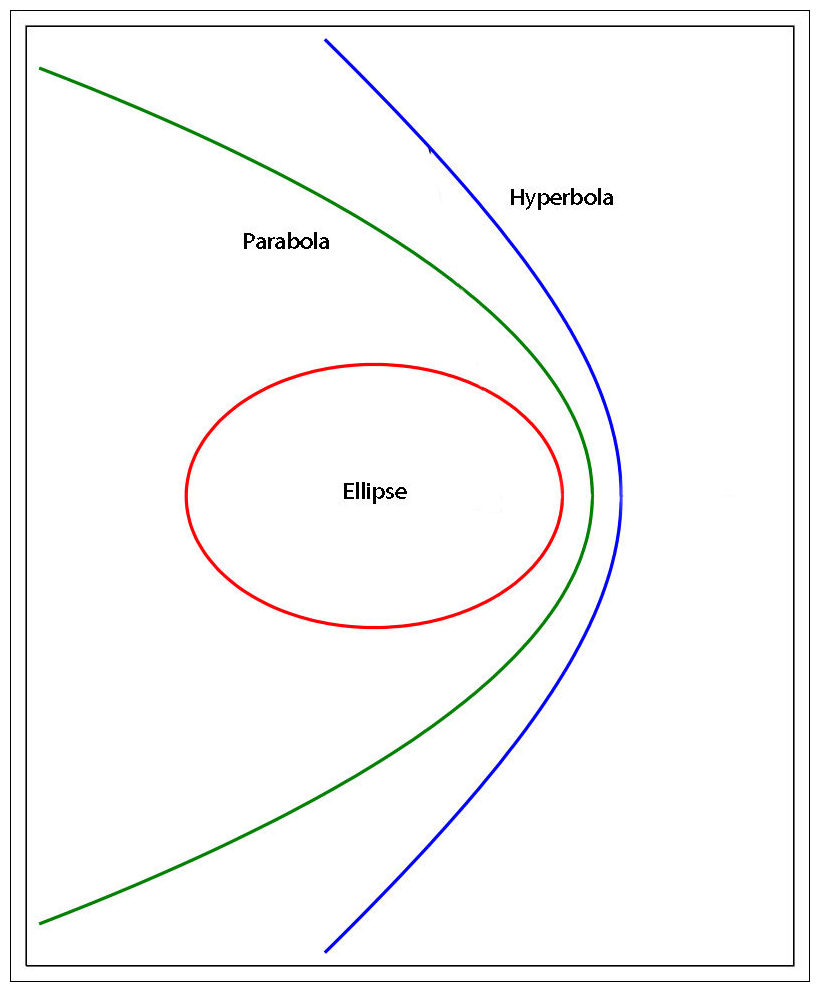
What sets A/2019 Q1 apart from nearly every other comet is the eccentricity of its orbit. Eccentricity measures how much an orbit deviates from a perfect circle, which has an eccentricity of 0. Elliptical orbits, typical of planets, asteroids and comets, have eccentricities between 0 and 1. Parabolas are equal to 1, and an eccentricity greater than 1 indicates a hyperbolic orbit.
Object Orbit
© Stamcose / CC BY-SA 4.0 with additions by the authorHow flat an object's orbit is called its eccentricity. An object on a hyperbolic orbit is likely from beyond the solar system.

Clipboard

5 Surprising scientific facts about the Earth's climate that don't make their way into alarmists' talking points

earth's climate
There are many environmental facts that run contrary to popular belief. Here are five of them.

On the weekend of August 10-11, as if in chorus, major online news websites called on people to stop consuming meat. The calls echoed a recent United Nations report that recommended doing so to fight climate change.

It surprised many, but there are other more surprising facts about climate change that are hardly published in our everyday news media.

Below are some facts โ€” scientifically recognized and published in peer-reviewed journals โ€” that may raise your eyebrows.

1. Climate Has Always Changed โ€” Always

All proxy temperature data sets reveal that there have been cyclical changes in climate in the past 10,000 years. There is not a single climate scientist who denies this well-established fact. It doesn't matter what your position on the causes and magnitude and danger (or not) of current climate change is โ€” you have to be on board on this one. Climate has always changed. And it has changed in both directions, hot and cold. Until at least the 17th century, all these changes occurred when almost all humans were hunters, gatherers, and farmers.

Archaeology

Last day of the dinosaurs revealed in stunning glimpse of asteroid disaster

asteroid impact
© guvendemir/iStock
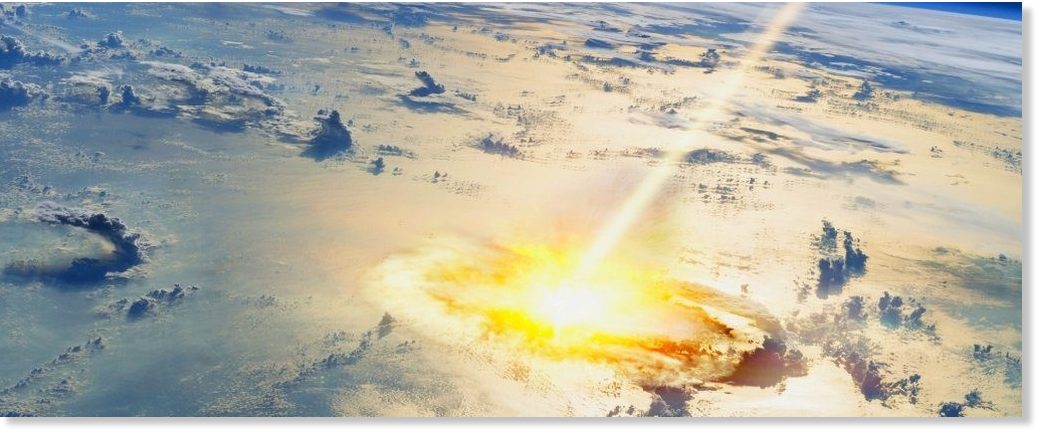
When the asteroid that wiped out the dinosaurs slammed into the planet, the impact set wildfires, triggered tsunamis and blasted so much sulfur into the atmosphere that it blocked the sun, which caused the global cooling that ultimately doomed the dinos.

That's the scenario scientists have hypothesized. Now, a new study led by The University of Texas at Austin has confirmed it by finding hard evidence in the hundreds of feet of rocks that filled the impact crater within the first 24 hours after impact.

The evidence includes bits of charcoal, jumbles of rock brought in by the tsunami's backflow and conspicuously absent sulfur. They are all part of a rock record that offers the most detailed look yet into the aftermath of the catastrophe that ended the Age of Dinosaurs, said Sean Gulick, a research professor at the University of Texas Institute for Geophysics (UTIG) at the Jackson School of Geosciences.

Eye 1

Show me your face: Google Nest Hub surveillance system lets you bring Big Brother home with you

nest devices
© Reuters / Stephen Lam
Google's Nest Hub surveillance system is constantly looking for its owner's face and technically can't be shut off, raising privacy concerns and questions about data misuse by the company that brags it toes the "creepy line."

The latest "smart-home" device from Mountain View comes equipped with a constantly-scanning facial-recognition-enabled camera that can't be shut off, only 'disabled' with a switch that also (supposedly) deactivates the microphone. Just as the device is constantly listening for its "wake word," it is prepared to leap into action at the sight of its owner's visage.

The Nest Hub, as its name suggests, serves as a "hub" for other internet-of-things devices like thermostats, surveillance cameras, and doorbells - which also come equipped with facial recognition, in case the user misses that feeling of being constantly spied on when they finally come home after a long day of surveillance outside. It also uploads video from phone calls and camera footage accessed remotely into the cloud and provides a window into your home for anyone with access to your Google or Nest account.

Recycle

Waste not: Research finds that "far from junk DNA," ERVs perform "critical cellular functions"

waste bin
© VanveenJF
In the past, reporting by Evolution News has documented a variety of important functions for endogenous retroviruses (ERVs) and other transposable elements and retrotransposons. These, of course, have frequently been called "junk DNA," mere evolutionary waste or flotsam, by critics of intelligent design. Evidence of this widespread function is nothing new. As a 2017 paper in Nature Reviews Genetics noted, "Transposable elements (TEs) are a prolific source of tightly regulated, biochemically active non-coding elements, such as transcription factor-binding sites and non-coding RNAs."

Now a pair of new articles in Nature Genetics acknowledge just how widespread ERV and retrotransposon functionality is. One is a research paper and the other is a summary article. The summary article opens by explicitly denying that retrotransposons are junk DNA:
Far from being junk DNA, the pervasive retrotransposons that populate the genome have a powerful capacity to influence genes and chromatin. A new study demonstrates how the transcription of one such element, HERV-H, can modify the higher-order 3D structure of chromatin during early primate development.
The summary further notes that "many ERVs have been co-opted for critical cellular functions." It reviews some of these functions:
For example, ERVs frequently act to distribute regulatory information and thus confer genes with new patterns of expression and function. Similarly, multiple ERVs have been re-purposed as novel genes themselves, including the ERV envelope-derived syntactins that drive trophoblast fusion and establish the placental fetal-maternal interface. Now, Zhang et al. have identified an additional activity of co-opted ERVs โ€” the alteration of the genome's 3D structure itself โ€” that may have the capacity to substantially affect gene regulation.

Comment: See also:


Microscope 2

Nunavik Inuit genetically unique among present-day world populations, study finds

kangiqsualjjuaq
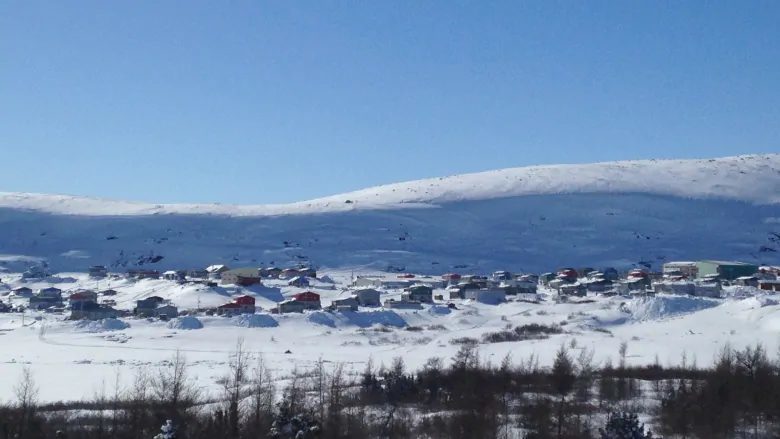
© Catou MacKinnon/CBCA file photo of the northern village of Kangiqsualujjuaq, Que. Some community members participated in a new study published Monday about the genetic architecture of Inuit in the Nunavik region.

Researchers mapped complete genetic profile of Inuit in Nunavik region for 1st time.


Researchers have found that Inuit from northern Quebec are genetically distinct from any present-day population in the world, and say studying the genes of minority Indigenous populations in Canada can help deliver better health care to these populations.

In a study published Monday in the journal Proceedings of the National Academy of Sciences, researchers mapped the complete genetic profile of Inuit in the Nunavik region โ€” what they claim is a first. Researchers then homed in to study the effects these genetic variants may have on disorders like brain aneurysms.

"That's the novelty of this study," said Sirui Zhou, the primary author of the study and a researcher with the Neuro (Montreal Neurological Institute and Hospital).

Moon

Intact in One Piece: India loses contact with Vikram lander during historic Moon landing attempt

ISRO chandrayaan2 failure
© Mirror Now
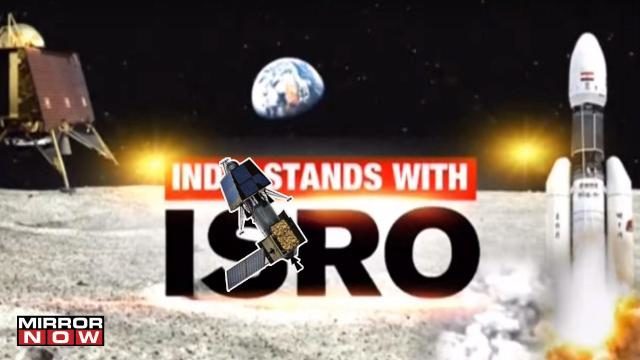
India lost contact with its Vikram lunar lander Friday (Sept. 6) during a daring attempt to make history as the first country to land near the south pole. The landing anomaly may have dashed Indian dreams of becoming just the fourth country to successfully soft-land a spacecraft on the moon.

Long, tense minutes stretched out inside the mission control center for the Indian Space Research Organization (ISRO), which designed the Chandrayaan-2 spacecraft. Prime Minister Narendra Modi had arrived onsite at the ISRO Telemetry, Tracking and Command Network (ISTRAC) in Bengaluru, India, about half an hour before touchdown of the landed component, dubbed Vikram, was scheduled to take place.

That announcement came at 4:48 p.m. EDT (2048 GMT) from K. Sivan, the director of ISRO. "Vikram lander descent was as planned and normal performance was observed up to an altitude of 2.1 kilometers [1.3 miles]," Sivan said in an announcement at mission control. "Subsequently the communications from the lander to the ground station was lost. The data is being analyzed."

Comment:
Chandrayaan-2 landing: 40% lunar missions in last 60 years failed, finds Nasa report

While many countries like India, China, US, Russia, Japan and Israel have sent missions to the moon, the success rate of lunar missions is about 60 per cent, with each country getting it right only after years and years of practice.


Info

Body's 'biological age' can be reversed suggest new study

Biological Age Reversal
© Patrick McDermott/GettyA personโ€™s biological age, measured by the epigenetic clock, can lag behind or exceed their chronological age.
A small clinical study in California has suggested for the first time that it might be possible to reverse the body's epigenetic clock, which measures a person's biological age.

For one year, nine healthy volunteers took a cocktail of three common drugs โ€” growth hormone and two diabetes medications โ€” and on average shed 2.5 years of their biological ages, measured by analysing marks on a person's genomes. The participants' immune systems also showed signs of rejuvenation.

The results were a surprise even to the trial organizers โ€” but researchers caution that the findings are preliminary because the trial was small and did not include a control arm.

"I'd expected to see slowing down of the clock, but not a reversal," says geneticist Steve Horvath at the University of California, Los Angeles, who conducted the epigenetic analysis. "That felt kind of futuristic." The findings were published on 5 September in Aging Cell.

"It may be that there is an effect," says cell biologist Wolfgang Wagner at the University of Aachen in Germany. "But the results are not rock solid because the study is very small and not well controlled."

Cow

FDA finds a surprise in gene-edited cattle: Antibiotic-resistant, non-bovine DNA

gene edited cattle
© Genetic Literacy Project
How do you get a better cow? You breed it. For decades, cattle ranchers, dairy farmers, and others have relied on a billion-dollar animal genetics industry to get fitter, happier, and more productive livestock, working with specialists to find the best parents in the barn, and paying top dollar for elite semen. It's a costly process, and some farmers mate selectively for generations before the whole herd comes out right.

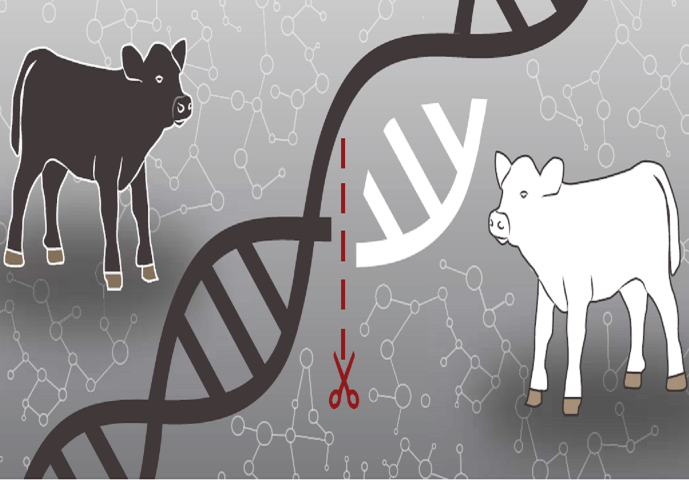
Imagine if that could happen faster โ€” say, in a year or two, instead of decades. That's the promise of gene-editing, a still-emerging technology in agriculture. Biologists use precision technology, such as CRISPR, to break the double helix, delete sections of those DNA strands, and then insert new genes that can occur naturally in other breeds. Boosters say these "molecular scissors" are a high-tech, rapid update on traditional cross-breeding, which has been practiced since time immemorial.

Comment: Objective:Health #30 - Gene Tech - What the Heck!?