
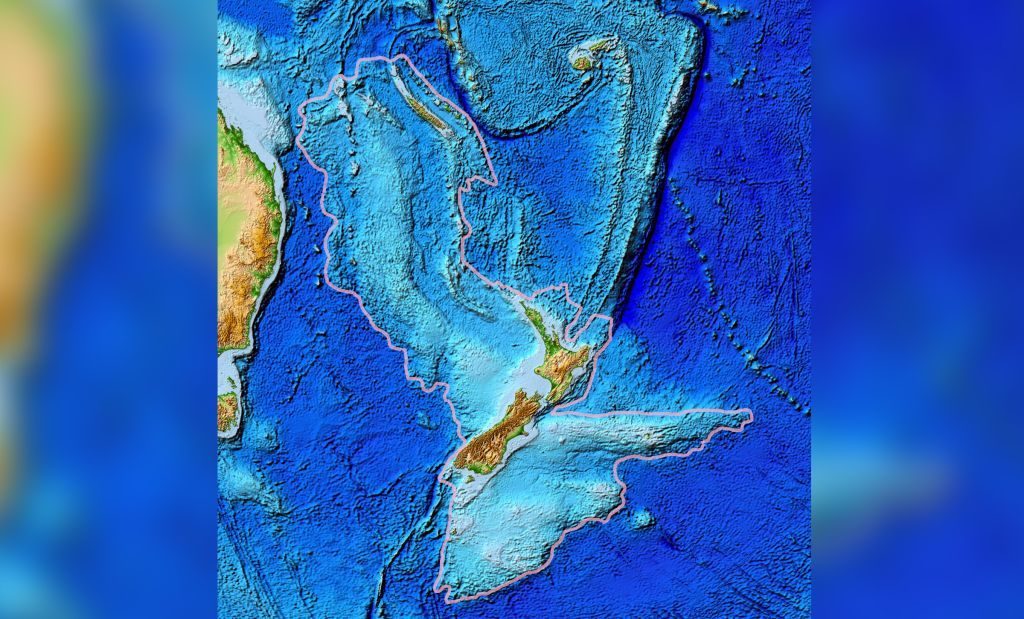
© NOAAA topographic map of Zealandia, a sunken continent that includes New Zealand.
Zealandia is a chunk of continental crust next door to Australia. It's almost entirely beneath the ocean, with the exception of a few protrusions, like New Zealand and New Caledonia. But despite its undersea status, Zealandia is not made of magnesium- and iron-rich oceanic crust. Instead, it is composed of less-dense continental crust. The existence of this odd geology has been known since the 1970s, but only more recently has Zealandia been more closely explored. In 2017, geoscientists reported in the journal GSA Today that Zealandia qualifies as a continent in its own right, thanks to its structure and its clear separation from the Australian continent.
Now, a new analysis of chunks of Zealandia drilled from beneath the ocean floor in 2017 reveals that this continent underwent a paroxysm of change between 35 million and 50 million years ago. As the continental collision process known as subduction started in the western Pacific, parts of northern Zealandia rose by as much as 1.8 miles (3 kilometers), and other sections dropped in elevation by a similar amount. (Subduction occurs when one tectonic plate collides with another and sinks underneath it.)
"These dramatic changes in northern Zealandia, an area about the size of India, coincided with buckling of rock layers (known as strata) and the formation of underwater volcanoes throughout the western Pacific," study co-authors Rupert Sutherland, a geophysicist at Te Herenga Waka-Victoria University of Wellington, and Gerald Dickens of Rice University in Texas, wrote in The Conversation.
It was, in a nutshell, the birth of the Ring of Fire, the arc of subduction zones that circles the Pacific. The Ring of Fire's tectonic activity is accompanied by relatively frequent earthquakes and regions of volcanic activity.
"One of the amazing things about our observations is that they reveal the early signs of the Ring of Fire were almost simultaneous throughout the western Pacific," Sutherland said in a statement.











Comment: What are lost continents and why are we discovering so many?