Science & TechnologyS


Bizarro Earth

75% of Amazon rainforest shows signs of loss, a 'tipping point' of dieback, study shows

Amazon Rainforest
© Pixabay/CCO
The Amazon rainforest may be nearing a "tipping point" of dieback, the point where rainforest will turn to savanna, a new study shows.

Signs of loss have been found in more than 75% of the rainforest since the early 2000s, according to research that outlines this troubling trend.

"Deforestation and climate change are likely the main drivers of this decline," said study co-author Niklas Boers, a professor at the Technical University of Munich.

Using satellite remote sensing data, researchers found what they call "resilience" — the ability to recover from events such as droughts or fires — has declined consistently in the vast majority of the Amazon rainforest.

Loss of resilience is most prominent in areas that are closer to human activity, as well as in those that receive less rainfall, the study said.

Overall, the Amazon rainforest is becoming much less resilient — raising the risk of widespread dieback, the research shows. "The rainforest can look more or less the same, yet it can be losing resilience — making it slower to recover from a major event like a drought," said study co-author Tim Lenton of the University of Exeter in the United Kingdom.

The study was published Monday in the peer-reviewed British journal Nature Climate Change.

Microscope 1

"A Journey to the Center of Our Cells" provides inadvertent support for intelligent design

cell structures
© David S. Goodsell/New York MagazineJCVI-syn3A, the “minimal cell,” is a base model designed for expansion.
When I first started writing for Evolution News back in 2005, we were overwhelmed with media outlets misreporting on intelligent design and evolution. This was in fact one of the original reasons for launching Evolution News — to fact-check and critique media coverage. Every once in a while, however, it's nice to highlight media stories that do a good job of covering science.

A recent article in The New Yorker, "A Journey to the Center of our Cells," says hardly anything about evolution and it says nothing about intelligent design. There's no evidence that the article's author or the scientists he interviews are sympathetic to ID. But it provides new insights into the complexity of the cell — insights that unwittingly pose a challenge to theories of a fully natural chemical origin of life.

The article explains that biologists are beginning to "grasp the strangeness of the zone [inside the cell], bigger than atoms but smaller than cells, in which the machinery of life exists," further noting that "It's proteins that run the cellular world, by sparking chemical reactions, sending signals, and self-assembling into biological machines."

Magnify

Physicists create a bizarre 'Wigner crystal' made purely of electrons

Wigner crystal electrons
© Olena Shmahalo/Quanta MagazineThe Wigner crystal locks electrons into stable positions only when two electron sheets assume a particular triangular geometry.
The unambiguous discovery of a Wigner crystal relied on a novel technique for probing the insides of complex materials.

In 1934, Eugene Wigner, a pioneer of quantum mechanics, theorized a strange kind of matter — a crystal made from electrons. The idea was simple; proving it wasn't. Physicists tried many tricks over eight decades to nudge electrons into forming these so-called Wigner crystals, with limited success. In June, however, two independent groups of physicists reported in Nature the most direct experimental observations of Wigner crystals yet.

"Wigner crystallization is such an old idea," said Brian Skinner, a physicist at Ohio State University who was not involved with the work. "To see it so cleanly was really nice."

To make electrons form a Wigner crystal, it might seem that a physicist would simply have to cool them down. Electrons repel one another, and so cooling would decrease their energy and freeze them into a lattice just as water turns to ice. Yet cold electrons obey the odd laws of quantum mechanics — they behave like waves. Instead of getting fixed into place in a neatly ordered grid, wavelike electrons tend to slosh around and crash into their neighbors. What should be a crystal turns into something more like a puddle.

Brain

The remarkable things we're learning about bird intelligence

Crow
© John Gerrard Keulemans/Wikimedia CommonsNew Caledonian Crow
At one time, there was an assumption — not really a theory — that vertebrates would be more intelligent than invertebrates and mammals would be more intelligent than birds. Well along came the octopus, which turns out to be as intelligent as a typical mammal. And the New Caledonian crow, which can be as smart as an ape. These life forms have significantly different brains from each other so intelligence does not appear to reside in a specific organization of the brain.

Comment: See also:


Bizarro Earth

Geologists unravel plate tectonic chain reaction

A plate tectonic chain reaction.
© Utrecht UniversityA plate tectonic chain reaction.
Geologists at Utrecht University are working hard to unravel the secrets of plate tectonics, the mechanism that continuously shapes Earth's crust and is causing earthquakes and volcanic eruptions. This time, another mystery has been dissected. In the Earth's geological past, there were 'short' periods of a few million years during which many tectonic plates around the world suddenly changed their speed and direction. What caused these abrupt changes in plate movements? Earlier research showed that changes in movement between two plates can result from continental collisions or rising mantle plumes. But could such collisions or mantle plumes set off a global chain reaction? Now geologists have succeeded in finding evidence that supports this. "With this discovery, we are able to better understand the driving forces behind plate movements, and thus processes such as mountain formation or volcanism."

This paper, published in Nature Geoscience, was a collaboration between geoscientists from Utrecht University, Australian National University, and Ben-Gurion University of the Negev. To test their hypothesis, the researchers asked themselves the following question: did the formation of a new subduction zone north of Arabia that was triggered by a mantle plume that caused a super volcano near Madagascar ~100 million years ago set off a chain reaction? Utrecht professor of plate tectonics and paleogeography Douwe van Hinsbergen, geologist, former Utrecht PhD student and first author Derya Gürer, and geophysicist Roi Granot, analysed the consequences step by step. "If our hypothesis is correct, the new subduction zone that formed north of Arabia should have caused forces that accelerated, and rotated the African Plate in the 10 million years after subduction initiation. However, to analyse this, we had to solve a major problem," says Gürer.

Fireball 5

Scientists uncover the largest crater on Earth under 100,000 years old

china largest crater 100,000 years
© Lauren Dauphin, using Landsat data from the U.S. Geological SurveyNASA Earth Observatory image of the relatively young crater found in China
The impact crater is the second discovered in China.

A crescent-shaped crater in Northeast China holds the record as the largest impact crater on Earth that formed in the last 100,000 years.

Prior to 2020, the only other impact crater ever discovered in China was found in Xiuyan county of the coastal province of Liaoning, according to a statement from the NASA Earth Observatory. Then, in July 2021, scientists confirmed that a geological structure in the Lesser Xing'an mountain range had formed as a result of a space rock striking Earth. The team published a description of the newfound impact crater that month in the journal Meteoritics and Planetary Science.

The Yilan crater measures about 1.15 miles (1.85 kilometers) across and likely formed about 46,000 to 53,000 years ago, based on radiocarbon dating of charcoal and organic lake sediments from the site, the NASA statement says. Researchers collected these sediment samples by extracting a drillcore from the center of the crater, Forbes reported.

Info

Astronomers see an enormous shockwave, 60 times bigger than the Milky Way

Huge Shockwave
© Francesco de Gasperin, SARAOImage of the larger shockwave front, and an image of the Milky Way for scale.
Astronomers have a thing for big explosions and collisions, and it always seems like they are trying to one-up themselves in finding a bigger, brighter one. There's a new entrant to that category - an event so big it created a burst of particles over 1 billion years ago that is still visible today and is 60 times bigger than the entire Milky Way.

That shockwave was created by the merger of two galaxy clusters to create a supercluster known as Abell 3667. This was one of the most energetic events in the universe since the Big Bang, according to calculations by Professor Francesco de Gasperin and his time from the University of Hamburg and INAF. When it happened over 200 million years ago, it shot out a wave of electrons, similar to how a particle accelerator would. All these years later, those particles are still traveling at Mach 2.5 (1500 km / s), and when they pass through magnetic fields, they emit radio waves.

Cassiopaea

Merging Waltz: Caltech finds two supermassive black holes set to collide, warping space & time

black hole illustration
© ESO/L. Calçada
The object in space that showed evidence of the future collision is called a quasar. Quasars are galaxies' active cores, where a supermassive black hole sucks material from a disk that surrounds it. The supermassive black hole in some quasars produces a jet that travels at almost the speed of light.

Two huge black holes will merge in 10,000 years, causing repercussions throughout the universe, newly published research by Caltech astronomers has revealed.

According to the press release, two massive black holes, nearly 9 billion light-years out in deep space, rotate around each other every two years. The mass of each of the supermassive black holes is hundreds of millions of times that of our Sun.

Comment: See also:


Info

Searching for earthquakes in the Ionosphere

Earthquake Damage
© Adam DuBrowa/FEMAA magnitude 7.2 earthquake damaged roads across northwestern Mexico and Southern California (like this one in Calexico) when it struck on 4 April 2010.
In 2010, at 40 minutes past 3:00 in the afternoon on 4 April — Easter Sunday — northwestern Mexico started to shake. A magnitude 7.2 earthquake was rattling the Baja California region, ultimately causing three deaths and more than 100 injuries. The quake caused widespread damage in the border cities of Mexicali, Mexico, and Calexico, Calif. The quake made skyscrapers sway in San Diego, more than 160 kilometers west.

The earthquake sent waves through the ground around it, but high in the atmosphere, a very different sort of perturbation might have offered a forewarning of the earthquake's impending arrival, had anyone been able to see it. Subtle fluctuations in Earth's ionosphere, a region of charged particles high above the surface, preceded the Baja earthquake, said the authors of a new paper published in Advances in Space Research. Somehow, the fault that caused the earthquake may have been telegraphing its impending rupture, sending out a rush of electrically charged particles that resonated in the ionosphere.

The ionosphere, which begins about 48 kilometers above Earth's surface and stretches to around 965 kilometers, is where incoming energy from the Sun ionizes molecules in the atmosphere, knocking off electrons. The abundance of charged particles means the ionosphere reacts to electric and magnetic fields, something other regions of the atmosphere generally do not do.

Using data from the Massachusetts Institute of Technology's Haystack Observatory on the density of electrons in the ionosphere, a team of Chinese and U.S. researchers analyzed the atmosphere above the Baja California region for 72 days both before and after the earthquake. After controlling for other things that might have been affecting the ionosphere, they said they saw a clear anomaly — a spike in the number of ionospheric electrons — on 25 March, 10 days before the earthquake. The electron spike was located over the earthquake's epicenter, and it didn't look like anything else they'd seen in the data.

We can imagine it to be something like ripples in a lake, said Chen Zhou, a researcher at Wuhan University in China and a coauthor of the paper. The electron signal looked like a brief, but telling, redistribution of particles from their normal movements and positions, one researchers were able to catch as it went by.

Zhou and his colleagues said their work could support a theory that faults release electrical energy in the days leading up to an earthquake. How exactly this happens isn't clear — some scientists think it's the result of radon gas released by a fault ionizing air molecules, whereas others hold that rocks under stress can release bursts of electrons.

Family

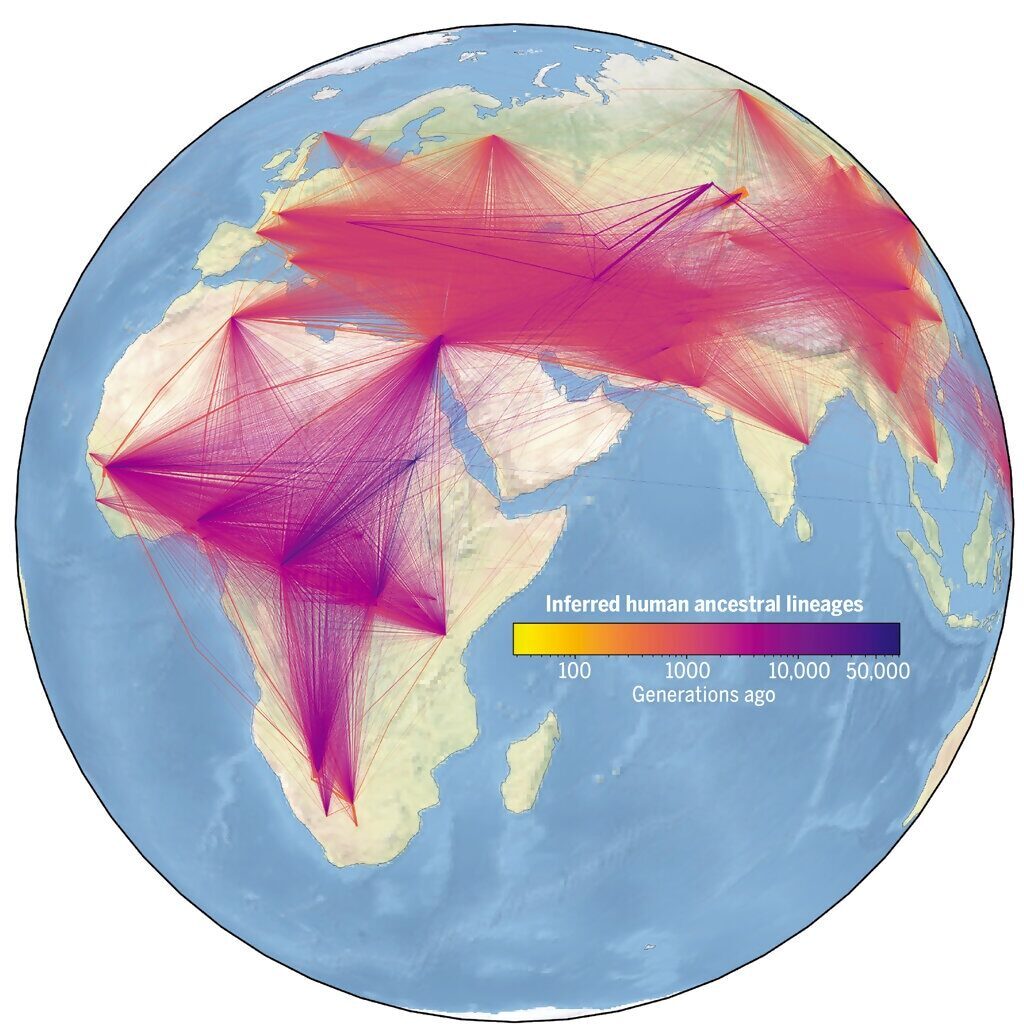
University of Oxford researchers create largest ever human family tree

detail human family tree
© Dr Yan Wong, et alA single genealogy that traces the ancestry of all of us
Researchers from the University of Oxford's Big Data Institute have taken a major step towards mapping the entirety of genetic relationships among humans: a single genealogy that traces the ancestry of all of us. The study* has been published in Science.

The past two decades have seen extraordinary advancements in human genetic research, generating genomic data for hundreds of thousands of individuals, including from thousands of prehistoric people. This raises the exciting possibility of tracing the origins of human genetic diversity to produce a complete map of how individuals across the world are related to each other.

Until now, the main challenges to this vision were working out a way to combine genome sequences from many different databases and developing algorithms to handle data of this size. However, a new method published today by researchers from the University of Oxford's Big Data Institute can easily combine data from multiple sources and scale to accommodate millions of genome sequences.