Science & TechnologyS


Cheeseburger

Gut bacteria might be responsible for your food cravings

Food Cravings
© University of Pittsburgh
Eggs or yogurt, veggies or potato chips? We make decisions about what to eat every day, but those choices may not be fully our own. New University of Pittsburgh research on mice shows for the first time that the microbes in animals' guts influence what they choose to eat, making substances that prompt cravings for different kinds of foods.

"We all have those urges — like if you ever you just feel like you need to eat a salad or you really need to eat meat," said Kevin Kohl, an assistant professor in the Department of Biology in the Kenneth P. Dietrich School of Arts and Sciences. "Our work shows that animals with different compositions of gut microbes choose different kinds of diets."

Despite decades of speculation by scientists about whether microbes could influence our preferred diets, the idea has never been directly tested in animals bigger than a fruit fly. To explore the question, Kohl and his postdoc Brian Trevelline (A&S '08), now at Cornell University, gave 30 mice that lacked gut microbes a cocktail of microorganisms from three species of wild rodents with very different natural diets.

The duo found that mice in each group chose food rich in different nutrients, showing that their microbiome changed their preferred diet. The researchers published their work today in the journal Proceedings of the National Academy of Sciences

While the idea of the microbiome affecting your behavior may sound far-fetched, it's no surprise for scientists. Your gut and your brain are in constant conversation, with certain kinds of molecules acting as go-betweens. These byproducts of digestion signal that you've eaten enough food or maybe that you need certain kinds of nutrients. But microbes in the gut can produce some of those same molecules, potentially hijacking that line of communication and changing the meaning of the message to benefit themselves.

Biohazard

Bill Gates-funded biotech firm claims GMO mosquito project a 'success,' but critics cite lack of proof

mosquito
© GettyHealth officials have confirmed the first death in Maricopa County from West Nile virus since this year's mosquito season began in May.
Oxitec this week announced results of the first open-air study of genetically engineered mosquitoes in the U.S.

The U.K.-based firm described the results as "positive," but said, "Larger tests are still needed to determine whether the insects can achieve the ultimate goal of suppressing a wild population of potentially virus-carrying mosquitoes."

The company's self-reported results are not yet independently confirmed or peer-reviewed.

Oxitec, the recipient of a grant from the Bill & Melinda Gates Foundation (BMGF) for "self-limited mosquito field trials," in April 2021 launched its pilot project in the Florida Keys.

Comment: See also:


Brain

An ocean in your brain: interacting brain waves key to how we process information

brainwaves
For years, the brain has been thought of as a biological computer that processes information through traditional circuits, whereby data zips straight from one cell to another. While that model is still accurate, a new study led by Salk Professor Thomas Albright and Staff Scientist Sergei Gepshtein shows that there's also a second, very different way that the brain parses information: through the interactions of waves of neural activity. The findings, published in Science Advances on April 22, 2022, help researchers better understand how the brain processes information.

"We now have a new understanding of how the computational machinery of the brain is working," says Albright, the Conrad T. Prebys Chair in Vision Research and director of Salk's Vision Center Laboratory. "The model helps explain how the brain's underlying state can change, affecting people's attention, focus, or ability to process information."

Researchers have long known that waves of electrical activity exist in the brain, both during sleep and wakefulness. But the underlying theories as to how the brain processes information — particularly sensory information, like the sight of a light or the sound of a bell — have revolved around information being detected by specialized brain cells and then shuttled from one neuron to the next like a relay.

This traditional model of the brain, however, couldn't explain how a single sensory cell can react so differently to the same thing under different conditions. A cell, for instance, might become activated in response to a quick flash of light when an animal is particularly alert, but will remain inactive in response to the same light if the animal's attention is focused on something else.

Mars

Solar eclipse on Mars captured in NASA footage: 'Truly fascinating'

mars solar eclipse phobos
© NASA/JPL-Caltech/ASU/MSSS/SSINASA’s Perseverance Mars rover used its Mastcam-Z camera to shoot video of Phobos, one of Mars’ two moons, eclipsing the Sun. It’s the most zoomed-in, highest-frame-rate observation of a Phobos solar eclipse ever taken from the Martian surface.
NASA's Perseverance rover raptures solar eclipse on Mars

Look at Phobos go!

The oblong Martian moon was captured making a solar transit by NASA's Perseverance rover on April 2, in footage released earlier this week.

The radical video provides a clear shot of our radiant orange star before the silhouette of what looks to be a potato.

"I knew it was going to be good, but I didn't expect it to be this amazing," gushed Rachel Howson, rover Mastcam-Z operator at Malin Space Science Systems in San Diego, Calif., in a NASA news release. On Twitter, NASA called it "truly fascinating."

Info

Holographic doctors can now provide medical advice on the International Space Station

Holographic Doctor
© Universe Today
In recent years, the practice of "telemedicine" has grown considerably. Similar to "telepresence" and "telecommuting," this technology relies on high-speed internet and live-video streaming to allow a person in one part of the world to interact with people in another without being physically present. The technology has come in handy during the two-year COVID-19 pandemic, where doctors were in high demand, but physical travel was restricted.

This process has also allowed for the emergence of "holoportation," which relies on holographic technology and 3-D modeling for the same purpose. In October 2021, the first "holoportation handshake" was conducted between Earth and space and demonstrated the technology's potential for future missions. On this occasion, NASA flight surgeon Dr. Josef Schmid, AEXA Aerospace CEO Fernando De La Pena Llaca, and their teams had a two-way conversation with ESA astronaut Thomas Pesquet aboard the International Space Station (ISS).

To break it down, holoportation is a type of technology that allows high-quality 3D models of people to be captured, reconstructed, compressed, and live-transmitted anywhere in real-time. Combined with mixed reality displays, it allows users to see, hear, and interact with other participants as if they were present in the same physical space. While Microsoft has used holoportation since 2016, this was the first time it was used to connect people between Earth and space.

Microscope 1

Tiny axles and rotors made of protein could power molecular machines

Molecular engines
© Shutterstock / fusebulbMolecular engines were created inside E. coli
The first components of a molecular engine - self-assembling axles and rotors made of specially designed proteins - have been created entirely from scratch.

"We are starting very simply," says Alexis Courbet at the University of Washington. But as he and his team create more basic parts, it will become possible to combine them into ever more sophisticated nanomachines, he says.

"There could really be an incredible number of applications," says David Baker, a team member also at the University of Washington. For instance, nanomachines might one day be used to unclog arteries or to repair damaged cells, he says.

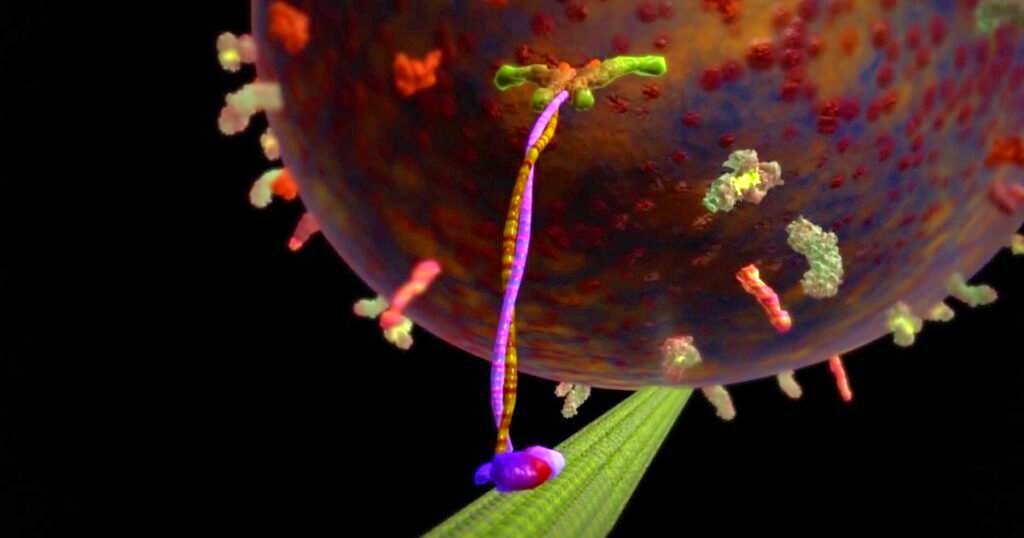
There are already countless molecular machines on Earth. Living organisms are essentially made of protein machines, including innumerable forms of rotary engines, such as the "tail" or flagellum of some bacteria.

Comment: Perhaps their discoveries will add to the evidence that our existing molecular machinery couldn't have happened by random chance...


Info

Massive meteorite impact created the hottest mantle rock ever

Lake Mistastin
© Planet Observer/Universal Images Group via Getty ImagesThe rock was found within the Mistastin impact crater in Labrador, Canada, shown here in this satellite image.
It's confirmed: The hottest rock ever discovered in Earth's crust really was super-hot.

The rock, a fist-sized piece of black glass, was discovered in 2011 and first reported in 2017, when scientists wrote in the journal Earth and Planetary Science Letters that it had been formed in temperatures reaching 4,298 degrees Fahrenheit (2,370 degrees Celsius), hotter than much of the Earth's mantle. Now, a new analysis of minerals from the same site reveals that this record-scorching heat was real.

The rocks melted and reformed in a meteorite impact about 36 million years ago in what is today Labrador, Canada. The impact formed the 17-mile-wide (28 kilometers) Mistastin crater, where Michael Zanetti, then a doctoral student at Washington University St. Louis, picked up the glassy rock during a Canadian Space Agency-funded study of how to coordinate astronauts and rovers working together to explore another planet or moon. (Mistastin crater looks a lot like a moon crater and is often used as a stand-in for such research.)

The chance find turned out to be an important one. An analysis of the rock revealed that it contained zircons, extremely durable minerals that crystallize under high heat. The structure of zircons can show how hot it was when they formed.

But to confirm the initial findings, researchers needed to date more than one zircon. In the new study, lead author Gavin Tolometti, a postdoctoral researcher at Western University in Canada, and colleagues analyzed four more zircons in samples from the crater. These samples came from different types of rocks in different locations, giving a more comprehensive view of how the impact heated the ground. One was from a glassy rock formed in the impact, two others from rocks that melted and resolidified, and one from a sedimentary rock that held fragments of glass formed in the impact.

Chalkboard

The sphere-packing problem: Out of a magic mathematical function, one solution to rule them all

electrons gif capture mathematica
© DVDP for Quanta MagazineFree electrons
Mathematicians used "magic functions" to prove that two highly symmetric lattices solve a myriad of problems in eight- and 24-dimensional space.

Three years ago, Maryna Viazovska, of the Swiss Federal Institute of Technology in Lausanne, dazzled mathematicians by identifying the densest way to pack equal-sized spheres in eight- and 24-dimensional space (the second of these in collaboration with four co-authors). Now, she and her co-authors have proved something even more remarkable: The configurations that solve the sphere-packing problem in those two dimensions also solve an infinite number of other problems about the best arrangement for points that are trying to avoid each other.

The points could be an infinite collection of electrons, for example, repelling each other and trying to settle into the lowest-energy configuration. Or the points could represent the centers of long, twisty polymers in a solution, trying to position themselves so they won't bump into their neighbors. There's a host of different such problems, and it's not obvious why they should all have the same solution. In most dimensions, mathematicians don't believe this is remotely likely to be true.

Satellite

Eye in the sky: Satellite imagery proves vital to understanding Ukraine war

Satellite image
© APSatellite image shows a new deployment of troops, tents, vehicles west of Soloti, Russia
April 11, 2022
Without personnel in Ukraine, the United States has been forced to rely on alternative intelligence streams to understand what's happening there, including commercial satellite companies that have come into play.

The National Geospatial-Intelligence Agency partners with more than 100 companies and is using imagery from at least 200 commercial satellites, David Gauthier, director of commercial and business operations at the National Geospatial-Intelligence Agency, said during the 37th Space Symposium, according to Space News.

One of the companies that has become pivotal is Maxar Technology, which has four satellites in orbit that can provide "sub-meter and, in this case, sub-50 centimeter imagery," Stephen Wood, senior director of the Maxar News Bureau, told the Washington Examiner in an interview on Wednesday.

Their satellites are able to capture images above Ukraine, which are then transmitted to a platform the U.S. government can access within 30 to 45 minutes, he explained, calling it a "significant improvement from where we were ten to fifteen years ago." The satellites, considering they travel in a circular orbit around the Earth, are only able to capture photos of any specific terrain for a short period of time each day.

Galaxy

NASA discovers 'rapidly growing black hole' linking to younger galaxies

black hole fast growing GNz7q
© NASA, ESA, N. BartmannNASA announced researchers used data from the Hubble Space Telescope to find a "missing link" on the first black holes.
Astronomers have found evidence of a "rapidly growing black hole" in the early universe, according to NASA.

This discovery has been labeled a "crucial missing link" as it could help us to understand the connection between the first supermassive black holes and young galaxies.

NASA explained: "Astronomers have identified a rapidly growing black hole in the early universe that is considered a crucial "missing link" between young star-forming galaxies and the first supermassive black holes, using data from the Hubble Space Telescope to make this discovery."

The US space agency also released an artistic impression of a supermassive black hole as well as an image taken by the Hubble Space Telescope.