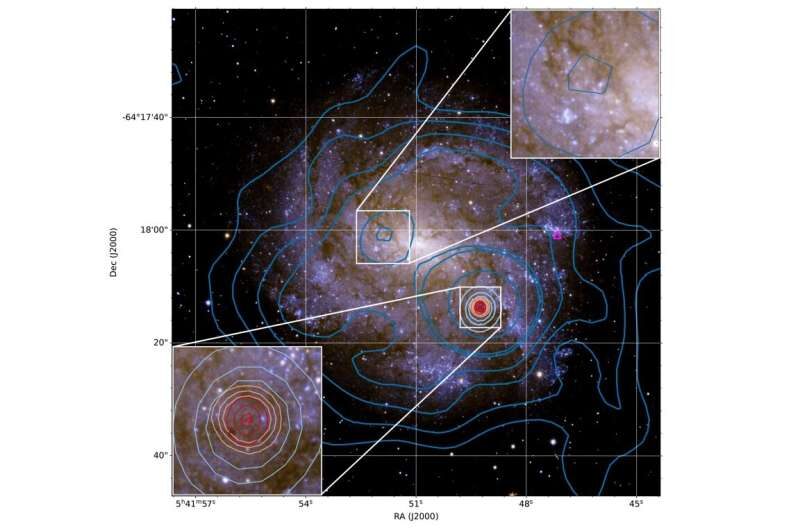
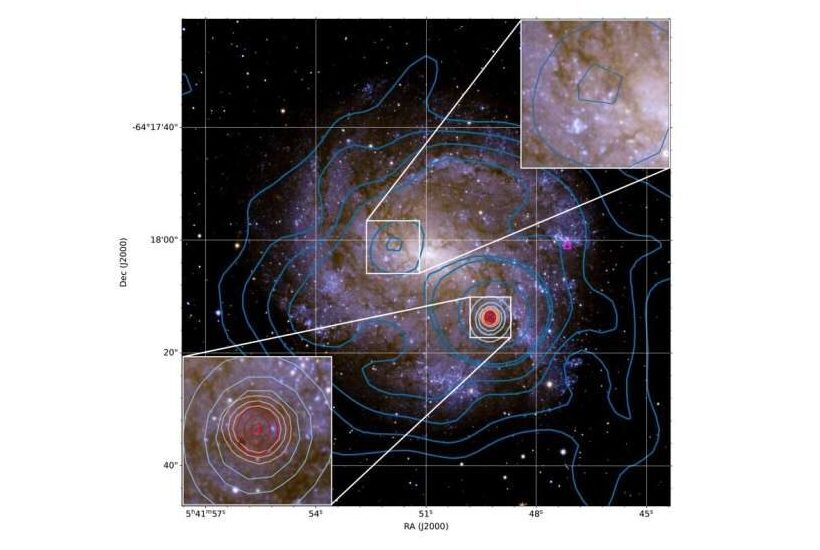
© Balzan et al., 2022.Three-color HST image of NGC 2082 overlaid with ASKAP and ATCA contours. The inset image in the bottom-left provides a zoom in of J054149.24–641813.7, showing the absence of any optical counterpart.
During radio continuum observations of a spiral galaxy known as NGC 2082, Australian
astronomers have discovered a mysterious bright and compact radio source, which received designation J054149.24-641813.7. The
origin and nature of this source is unknown and requires further investigation. The finding is reported in a paper published May 23 on the arXiv pre-print repository.
In general, radio sources are various objects in the universe that emit relatively large amounts of radio waves. Among the strongest sources of such emission are pulsars, certain nebulas, quasars, and radio galaxies.
Now, a team of astronomers led by Joel Balzan of Western Sydney University in Australia, report the finding of a new radio source, whose true nature is still uncertain. While observing NGC 2082 using Australian Square Kilometer Array Pathfinder (ASKAP), Australia Telescope Compact Array (ATCA) and Parkes radio telescope, they identified a strong point radio source positioned 20 arcseconds from the galaxy center. NGC 2082 is a G-type spiral galaxy in the Dorado constellation, located some 60 million light years away from the Earth, with a diameter of approximately 33,000 light years.
"We present radio continuum observations of NGC 2082 using ASKAP, ATCA and Parkes telescopes from 888 MHz to 9,000 MHz. Some 20 arcsec from the center of this nearby spiral galaxy, we discovered a bright and compact radio source, J054149.24-641813.7, of unknown origin," the researchers wrote in the paper.

















Comment: See also: