
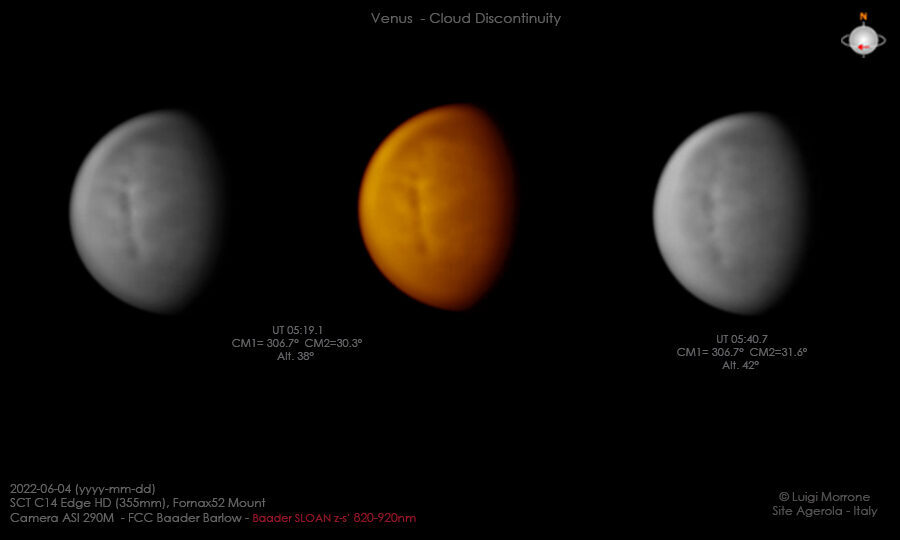
© Luigi MorroneA towering wall of acid clouds is racing through the atmosphere of Venus. Luigi Morrone photographed it from Agerola, Italy, on June 4th
The Venus Cloud Discontinuity is a relatively new discovery, photographed by Japan's Venus orbiter Akatsuki in 2016 and first spotted by JAXA scientist Javier Peralta. The massive structure cuts vertically across Venus's equator, stretching almost 5000 miles from end to end, and circles the planet faster than 200 mph, making one lap every ~5 Earth days.
Researchers following up on the discovery soon stumbled onto another surprise. Older photographs of Venus showed it, too. "[The Cloud Discontinuity] is a recurrent phenomenon that has gone unnoticed since at least the year 1983," they wrote in a May 2020 Geophysical Research Letter.
How do you overlook something so big? Visually, the Cloud Discontinuity is hidden underneath Venus's opaque cloudtops. To see it, you have to use an infrared filter, which reveals heat trickling up from below. Indeed, this is how amateurs are tracking the disturbance: "I used a Baader SLOAN 820-920nm near-infrared filter," notes Morrone.
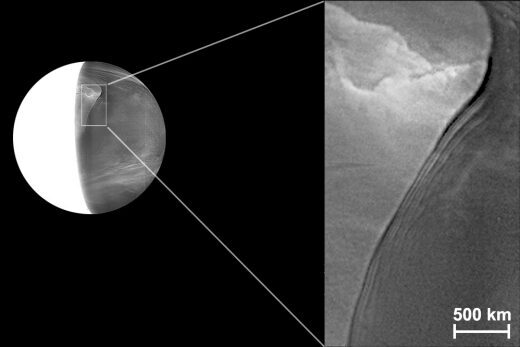
© Javier Peralta/JAXA-Akatsuki team.Above: Undulations behind the Cloud Discontinuity on April 15, 2016.
Researchers still aren't sure what the Cloud Discontinuity is. "This atmospheric disruption is a new meteorological phenomenon, unseen on other planets. Because of this it is difficult to provide a confident physical interpretation," says Peralta. Numerical simulations suggest that it might be some kind of exotic nonlinear Kelvin wave; the jury's still out.
Whatever it is, the structure might help solve a longstanding mystery: Why does Venus's atmosphere rotate so much faster than the planet itself? The hot, deadly air on Venus spins nearly 60 times faster than its surface, an effect known as "super-rotation." Venus's Cloud Discontinuity could be assisting the spin-up by transporting angular momentum from the deep atmosphere to the cloudtops.
Amateur astronomers, if you would like to monitor this phenomenon, check out the preprint "Amateur Observers Witness the Return of the Venus Cloud Discontinuity," which discusses observing techniques. Venus is waiting in the morning sky.
SOLAR CYCLE 25 (UPDATED)
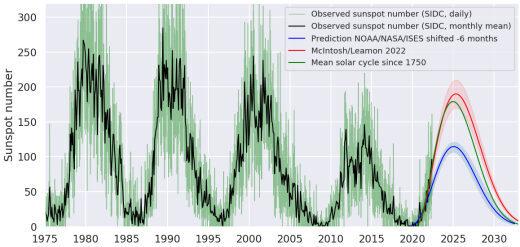
Once again, Solar Cycle 25 is exceeding predictions. Sunspot numbers in May 2022 were the highest in almost 8 years, more than doubling NOAA's official forecast:
© Helio4castImage credit: Helio4cast, a group of scientists based in Austria working on basic and applied space weather research.
The plot, above, compares current sunspot numbers to a selection of benchmarks. The blue curve is the "official forecast" issued by NOAA's Solar Cycle Prediction Panel in 2019. At the time, panel members anticipated a cycle similar to weak Solar Cycle 24. Zooming in shows how much the sun is overshooting that target.
The green curve is the average of all solar cycles since 1750, and the slightly taller red curve is a new prediction based on the Termination Event. Current sunspot counts match both. Even if Solar Cycle 25 turns out to be merely average, it will still far exceed previously low expectations. Stay tuned.








Comment: See also: 'Monster' quake recorded on Mars by NASA's InSight, largest quake ever detected on another planet