
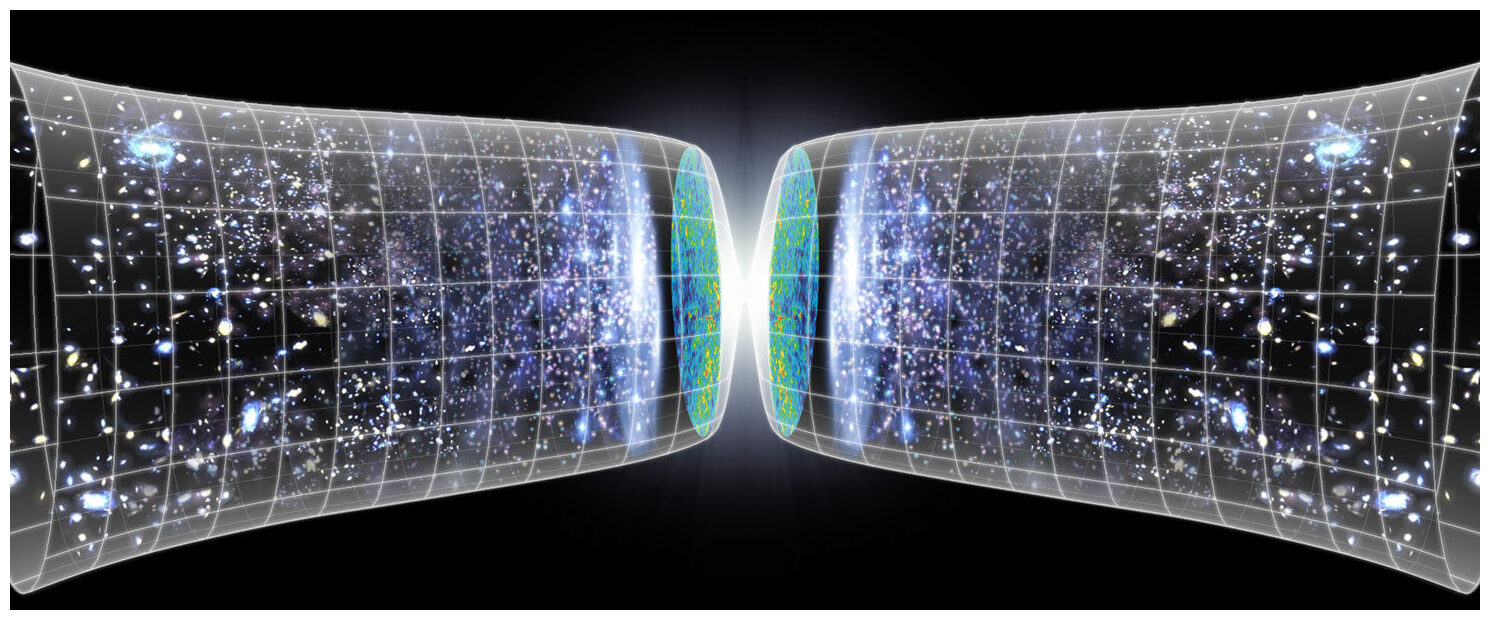
© Universe Today
The Hubble constant, or Hubble parameter, is a measure of the rate at which our universe expands. This expansion was first demonstrated by Edwin Hubble, using data from Henrietta Leavitt, Vesto Slipher, and others. Over the next several decades, measurements of this expansion settled on a rate of about 70 km/sec/Mpc. Give or take quite a bit. Astronomers figured that as our measurements became precise, the various methods would settle on a common value, but that didn't happen. In fact, in the past several years measurements have become so precise they outright disagree. This is sometimes known as the cosmic tension problem.
At this point the observed values of the Hubble constant cluster into two groups. Measurements of fluctuations in the cosmic microwave background point toward a lower value, around 67 km/sec/Mpc, while observations of objects such as distant supernovae yield a higher value around 73 km/sec/Mpc. Something clearly doesn't add up, and theoretical physicists are trying to figure out why. This is where the mirror universe might come in.
© Beate Bachmann, via PixabayA mirror of our world in the stars.
The team discovered an invariance in what are known as unitless parameters. The most famous of these is the fine structure constant, which has a value of about 1/137. Basically, you can combine measured parameters in such a way that all the units cancel out, giving you the same number no matter what units you use, which is great if you are a theoretician. The team found that when you tweak cosmological models to match the observed expansion rates, several unitless parameters stay the same, which suggests an underlying cosmic symmetry. If you impose this symmetry more broadly, you can scale the rate of gravitational free-fall and the photon-electron scattering rate so that the different methods of Hubble measurement better agree. And if this invariance is real, it implies the existence of a mirror universe. One that would affect our universe through a faint gravitational pull.
It should be pointed out that this study is mostly a proof of concept. It lays out how this cosmic invariance might solve the Hubble constant problem, but doesn't go so far as to prove it's a solution. A more detailed model will be needed for that. But it's an interesting idea. And it's good to know that if your evil doppelganger is out there, they can only influence your life gravitationally...
Reference: Cyr-Racine, Francis-Yan, Fei Ge, and Lloyd Knox. "Symmetry of Cosmological Observables, a Mirror World Dark Sector, and the Hubble Constant." Physical Review Letters 128.20 (2022): 201301.



Reader Comments
Here it is - it is kind of spooky...
Gamemaster - [Link]
of mind, as well - false math, false gods
(flosses teeth...)
[Link] - Clay Pigeons and such!
ha, ha.
Ken
2
+2
(+1 dark number from the mirror universe)
=
5
As long as these imaginary fudge factor gnomes remain in cosmology, it will remain the meaningless mathemagical conjecture it's been for a century or more.
The "Hubble Constant" is based firmly on the red-shift fallacy of cosmic distance and direction which was firmly destroyed by Halton Arp's work, particularly his book Seeing Red .
Some old articles mentioning the Hubble Constant on thunderbolts: [Link] [Link]
The Model is Wrong, you can't fix wrong, you must start from scratch. Game Over, Try Again.
Myself, I consider myself a po-dunk hillbilly bumpkin intellectual and that is what I said to my neighbor just up the road who is selling their home about six months ago when I slapped my left behind part and sort of pushed my whole ass back towards him and said - " I ain't no country bumpkin - screw these jabs "....I ain't gonna play the game is what I said to him. Man, I'm still annoyed about it all, but I'll get over it.
You know in history, it was often the intellectual's they had to wipe off the scene first just to make sure everybody believed their lies.
Not again is what I say. This time we will fight back.
The future is either going to be suicide inducing or just a giant moment of cringe as the rest of the sheep finally see that the emperors has no clothes.