
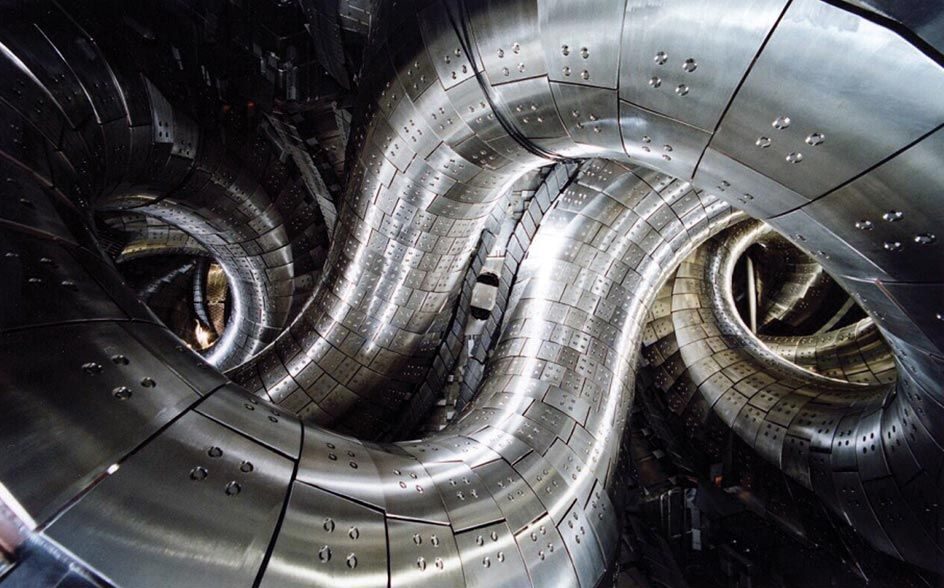
© Justin RuckmanInside Japan's Large Helical Device (LHD) stellarator, built to test plasma fusion confinement.
In order to achieve fusion in a power plant, it is necessary to stably confine a plasma of more than 100 million degrees Celsius in a magnetic field and maintain it for a long time.
A research group led by Assistant Professor Naoki Kenmochi, Professor Katsumi Ida, and Associate Professor Tokihiko Tokuzawa of the National Institute for Fusion Science (NIFS), National Institutes of Natural Sciences (NINS), Japan, using measuring instruments developed independently and with the cooperation of Professor Daniel J. den Hartog of the University of Wisconsin, USA, discovered for the first time in the world that turbulence moves faster than heat when heat escapes in plasmas in the Large Helical Device (LHD). One characteristic of this turbulence makes it possible to predict changes in plasma temperature, and it is expected that observation of turbulence will lead to the development of a method for real-time control of plasma temperature in the future.
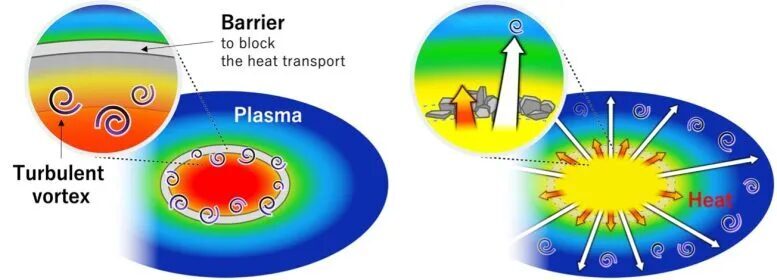
© National Institute for Fusion ScienceLeft: Forming a barrier in the plasma to confirm heat inside. Right: By breaking the barrier, turbulence was discovered that moves faster than the heat, as the heat escapes from inside the plasma.
A "barrier" can form in the plasma, which acts to block the transport of heat from the center outward. The barrier makes a strong pressure gradient in the plasma and generates turbulence. Assistant Professor Kenmochi and his research group have developed a method to break this barrier by devising a magnetic field structure. This method allows us to focus on the heat and turbulence that flow vigorously as the barriers break, and to study their relationship in detail. Then, using electromagnetic waves of various wavelengths, we measured the changing temperature and heat flow of electrons and millimeter-sized fine turbulence with the world's highest level of accuracy. How close the measured value conforms to the correct value." Previously, heat and turbulence had been known to move almost simultaneously at a speed of 5,000 kilometers per hour (3,100 miles per hour), about the speed of an airplane, but this experiment led to the world's first discovery of turbulence moving ahead of heat at a speed of 40,000 kilometers per hour (25,000 miles per hour). The speed of this turbulence is close to that of a rocket.
Assistant Professor Naoki Kenmochi said, "This research has dramatically advanced our understanding of turbulence in fusion plasmas. The new characteristic of turbulence, that it moves much faster than heat in a plasma, indicates that we may be able to predict plasma temperature changes by observing predictive turbulence. In the future, based on this, we expect to develop methods to control plasma temperatures in real-time."
Reference: "Preceding propagation of turbulence pulses at avalanche events in a magnetically confined plasma" by N. Kenmochi, K. Ida, T. Tokuzawa, R. Yasuhara, H. Funaba, H. Uehara, D. J. Den Hartog, I. Yamada, M. Yoshinuma, Y. Takemura and H. Igami, 16 May 2022, Scientific Reports.
DOI: 10.1038/s41598-022-10499-z



Reader Comments
I was also, in the next instant, wondering when someblun (sic) would *try* to break that barrier on a star (white hole, whatever...)
I should probably delete that last clause before posting this, but then, some blunderer has likely already thought of doing it - heading back to that SAFIRE search (tx again)