© National Science Foundation
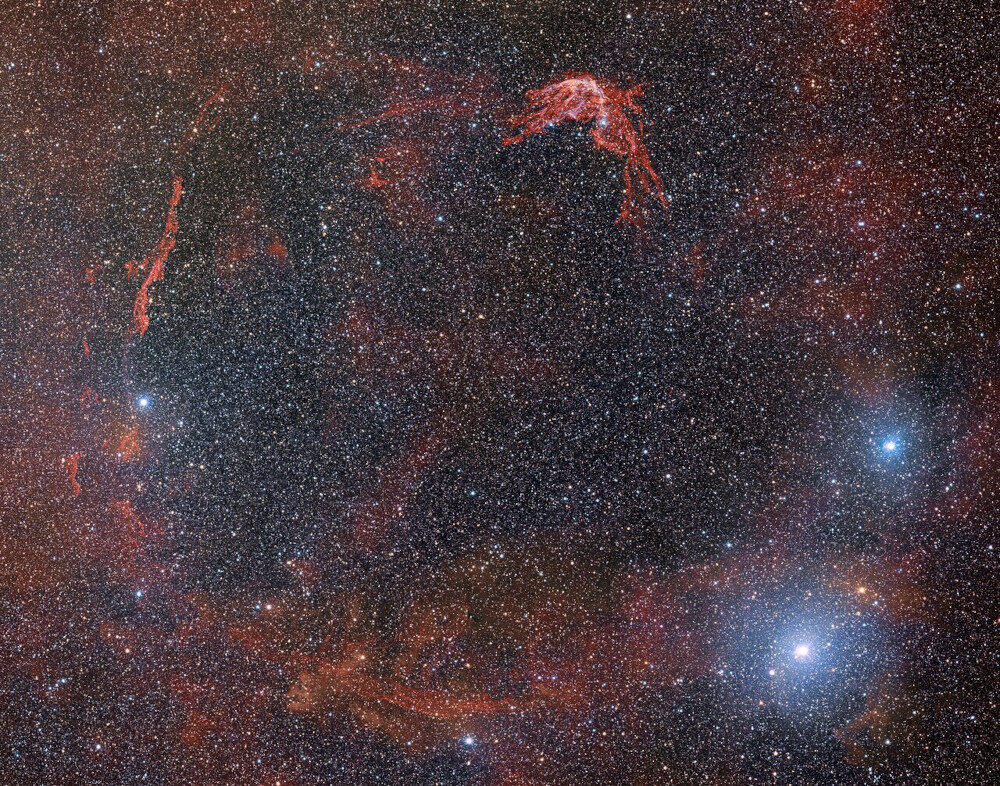
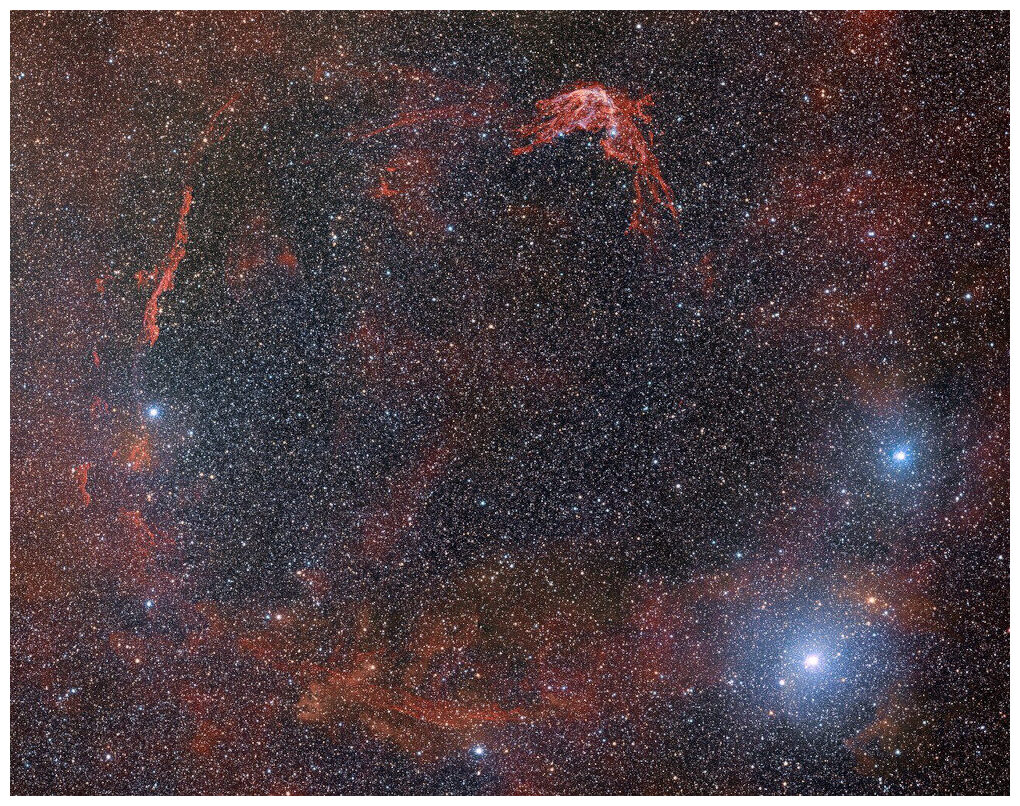
The tattered shell of the first-ever historically recorded supernova was captured by the US Department of Energy-fabricated Dark Energy Camera, which is mounted on the National Science Foundation's (NSF) Víctor M. Blanco 4-meter Telescope at Cerro Tololo Inter-American Observatory in Chile, a Program of NSF's NOIRLab. RCW 86's ring of debris is all that remains of a
white-dwarf star that exploded more than 1800 years ago, when it was recorded by Chinese stargazers as a 'guest star.'
Draped around the outer edges of this star-filled image are wispy tendrils that appear to be flying away from a central point, like the tattered remains of a burst balloon. These cloud-like features are thought to be the glowing remains of a supernova that was witnessed by Chinese astronomers in the year 185 C.E. When it appeared, this baffling addition to the night sky was referred to as a 'guest star' by ancient astronomers. It remained visible to the naked eye for about eight months before fading from view.
This historical supernova, which astronomers now refer to as SN 185, occurred more than 8000 light-years away in the approximate direction of Alpha Centauri, between the constellations of Circinus and Centaurus. The resulting structure, RCW 86 — as imaged by the Dark Energy Camera (DECam) mounted on the Víctor M. Blanco 4-meter Telescope at Cerro Tololo Inter-American Observatory in Chile, a Program of NSF's NOIRLab — helps shed light on how the remains of the supernova evolved over the past 1800 years. DECam's amazing wide-field vision enabled astronomers to create this rare view of the entire supernova remnant as it is seen today.
Though the link between RCW 86 and SN 185 is now well established, that wasn't always the case. For decades, astronomers thought it would take about 10,000 years for a traditional core-collapse supernova — one in which a massive star blows material away from itself by exploding — to form the structure as we see it today. This would make the structure far older than the supernova observed in the year 185.











Comment: Rather than this being simply an issue of albedo caused by the light of our sun, could plasma be playing a part here? After all, we see the effect of the auroras on Earth, as well as from space.
See also: