Science & TechnologyS


HAL9000

AI robots could run the world better than humans, robots tell UN summit

AI robots are showcased at the International Telecommunication Union
© AFPAI robots are showcased at the International Telecommunication Union (ITU) AI for Good Global Summit in Geneva, Switzerland on Friday. From left, standing: Mika, Sophia, Ai-Da, Desdemona and Grace. Sitting, far right: Geminoid HI-2.
A panel of AI-enabled humanoid robots told a United Nations summit on Friday that they could eventually run the world better than humans.

But the social robots said they felt humans should proceed with caution when embracing the rapidly developing potential of artificial intelligence.

And they admitted that they cannot - yet - get a proper grip on human emotions.

Some of the world's most advanced humanoid robots were at the UN's two-day AI for Good Global Summit in Geneva, Switzerland.

Hanson Robotics CEO David Hanson
© AFPHanson Robotics CEO David Hanson, right, listens to AI robot Sophia at the International Telecommunication Union (ITU) AI for Good Global Summit in Geneva, Switzerland on Friday.

Satellite

James Webb Space Telescope spots violent collision between neutron stars

illustration neutron star collision gamma ray burst JWST
© Robin Dienel/The Carnegie Institution for ScienceAn illustration of two neutron stars colliding and merging, an event called a kilonova.
The telescope traced an incredibly bright gamma-ray burst to a kilonova, a dramatic event believed to forge heavy elements like gold.

Using the James Webb Space Telescope (JWST), astronomers have traced an incredibly bright gamma-ray burst (GRB) back to its source, a violent collision between two neutron stars.

The ring on your finger likely contains atoms forged in neutron star collisions like this, also known as "kilonovas." That's because, as well as blasting out long-duration GRBs, kilonovas are believed to be the sites at which the universe's heaviest elements, which cannot be synthesized in the nuclear furnaces at the heart of stars, are forged.

These elements are theorized to be created by a mechanism called "neutron capture" or the r-process, which allows atomic nuclei to capture neutrons, creating new and heavier elements, including gold, platinum and uranium. The r-process can only proceed in extreme and violent conditions, such as those found around colliding neutron stars.

2 + 2 = 4

Is mathematics discovered or invented?

mathematics
Some think math is invented. (See an article by Peter Biles.) Evidence, though, points towards discovery. Simultaneous mathematical discovery supports this viewpoint. Many mathematical breakthroughs are sometimes independently reported by two or more mathematicians at roughly the same time. The most famous is the simultaneous discovery of calculus by Isaac Newton and Gottfried Wilhelm Leibniz. Newton was secretive about his discovery and shared his results with only a few members of the Royal Society. When Leibnitz published his discovery of the calculus, Newton charged him with plagiarism. Today, historians agree that the discoveries were independent of each other.

Some Other Examples

Here are some other lesser-known examples of simultaneous discovery.

The Papoulis-Gerchberg Algorithm (PGA). The PGA is an ingenious method for recovering lost sections of functions that are bandlimited. (I describe the PGA in detail in my Handbook of Fourier Analysis.) The PGA was first reported by Athanasios Papoulis1 but was first published in an archival journal, independently, by Gerchberg2. The discoveries occurred independently of each other.

The Karhunen-Loève Theorem, independently discovered by Kari Karhunen3 and Michel Loève4, showed that certain random processes could be represented as an infinite linear combination of orthogonal functions, analogous to a Fourier series.

Document

A pediatrician's manifesto for the modernization of gender medicine

medical symbol
© Nadzeya Haroshka
Postmodern medicine may superficially resemble Modern medicine, yet it seeks to dismantle its underlying philosophy.

Introduction

The ethical abuses and lack of respect for science that occur in contemporary gender clinics have long been a topic of intense discussion. In this essay, Dr. Li outlines eight ways where the practice of medicine in current American gender clinics is grossly abnormal. She then explains the behavior of practitioners in these clinics with Critical Social Justice doctrine, and makes her case that ideology and doctrine from Postmodernism influence and determine the behaviors of gender medicine practitioners.

Dr. Erica Li is a pediatrician in Washington State. She went to medical school at UC Davis and trained in general pediatrics in Los Angeles. She currently teaches medical students from three medical schools and interns from four residency programs. Certified in Pediatric Hospital Medicine by the American Board of Pediatrics, Dr. Li is a subspecialist who identifies as a generalist. She is passionate about helping trainees approach clinical problems by mapping out a chain of cause-and-effect, such that each node in the chain can be examined as a potential opportunity to interrupt pathology.

Stop Calling My Profession "Western" Medicine

"He got his pain meds and psych meds," the nurse said. During a shift change at a children's hospital, the departing nurse provides a report to the incoming nurse about the patients under their care. "He is medically cleared," the nurse continued, "The psych team is going to see him and determine if he needs to go to the inpatient psych unit for trying to kill himself. And..." the nurse paused. "I just gave him a tampon for ... gosh it's so weird to say that. She got her period today."

This is the paraphrase of a real conversation that I overheard. I am a pediatrician specializing in the care of hospitalized children. One of the most common reasons a trans-identifying teenage female becomes hospitalized is due to attempted suicide through medication overdose. My seven years of rigorous training in medical school and pediatric residency were steeped in the principles of Modern medicine. However, I'm increasingly confronted with the sense that my profession is drifting away from its modernity. I believe medicine is being "queered," or Postmodernized. Let me clarify.

Telescope

Astronomers baffled as giant black hole suddenly 'switched on'

black hole eat star illustration
© ESO/M. KornmesserAn illustration of a black hole "spaghettifying" a hapless star
A black hole 10 billion light-years away suddenly 'switched on', becoming one of the brightest transient objects ever detected..

Scientists scouring the cosmos for signs of a rare explosion may have stumbled upon something even more remarkable: a gargantuan black hole "switching on" in the early universe, going from dim to tremendously bright in a cosmic blink of an eye.

The black hole, dubbed J221951, is estimated to sit about 10 billion light-years from Earth, meaning the cosmic monster turned up its lights when the universe was roughly one-quarter of its current age. Despite this vast distance, the black hole brightened so intensely that astronomers initially mistook it for a stellar explosion less than 1 billion light-years away.

Sun

17 states may get glimpse of Northern Lights when solar storm hits

aurora
© Joe Gilker/Weather Network's UGC GalleryAurora Borealis from Camden Lake, Ontario, Canada, on October 13, 2016
Monday night, a large active region on the Sun, which solar scientists have named AR 3559, released an immense cloud of charged solar particles out into space — a Coronal Mass Ejection, or CME.

Eyes to the sky for the start of the weekend. Skywatchers across Canada may see displays of the Northern Lights on Friday night due to a passing solar storm.

Monday night, a large active region on the Sun, which solar scientists have named AR 3559, released an immense cloud of charged solar particles out into space — a Coronal Mass Ejection, or CME.

This 'solar storm' is moving fairly slowly through space, taking roughly three days to cover the 150 million kilometres between the Sun and Earth. However, it is aimed almost directly at us.

Info

Buried on the far side of the Moon, the detection of a mysterious heat-emitting object leads to an unexpected discovery

Moon
© NASA/GSFC/Arizona State University
It sounds like the plot of a science fiction film: scientists detect odd emissions coming from the far side of the Moon, leading to the discovery of something buried under the lunar surface that fundamentally reshapes how we see Earth's natural satellite and its history.

However, the recent detection of a large, heat-emitting mass buried beneath the far side of the Moon is no scene from science fiction in this case. It is among a series of observations made by satellites in lunar orbit that suggest that Earth's Moon may have a history much more like our planet than scientists once realized.

"We have discovered extra heat coming out of the ground at a location on the Moon believed to be a long dead volcano which last erupted over 3.5 billion years ago," reports Matt Siegler, Ph.D., of the Planetary Science Institute in Tucson, Arizona.

Siegler, the lead researcher on a new study conducted by an international team that examined data collected from China's Chang'E 1 and 2 lunar orbiters, along with supplemental data obtained by NASA's Lunar Prospector and Lunar Reconnaissance Orbiters, says the discovery of the unusual object beneath the Moon's far side initially baffled the research team.

"To tell the truth we were a bit puzzled when we found it," Siegler said in a statement. Fortunately, his wife Rita Economos, Ph.D., a geochemist and one of the researchers involved in the study, was able to help provide context that allowed the team "to piece together the probable geologic cause of the heat anomaly."

Based on the data, Sigler says the mysterious object is likely an ancient granite formation.

"It's around 50km across, and the only solution that we can think of which produces that much heat is a large body of granite," Siegler said.

Bug

New research shows how pathogenic bacteria infect the gut

gut microbiome
A new study by researchers at the University of British Columbia (UBC) and BC Children's Hospital shows the sugar sialic acid, which makes up part of the protective intestinal mucus layer, fuels disease-causing bacteria in the gut.

The findings, published in PNAS, suggest a potential treatment target for intestinal bacterial infections and a range of chronic diseases linked to gut bacteria, including inflammatory bowel disease (IBD), celiac disease, irritable bowel syndrome and short bowel syndrome.

Comment: See also:


Blue Planet

There's a giant gravity hole in the Indian Ocean, and we may finally know why

Geoid gravity hole earth
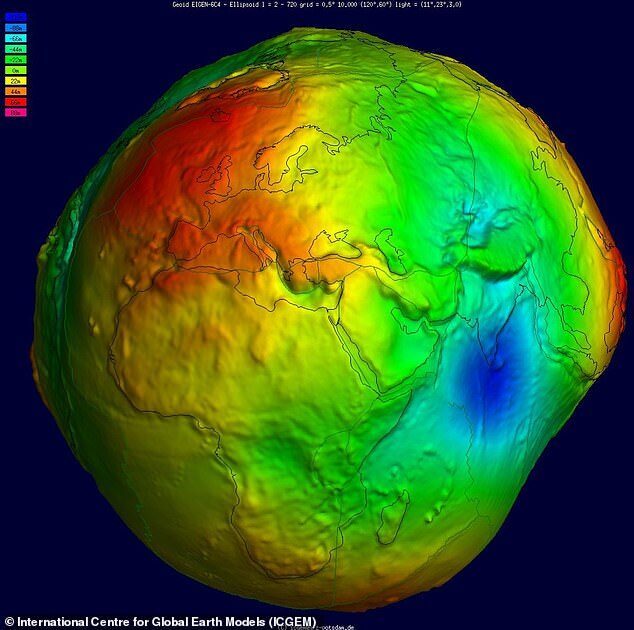
© nternational Centre for Global Earth Models/Wikimedia, CC BY 4.0Geoid undulation in false color.
Gravity's pull is a constant on Earth, but our planet is no uniform sphere. It's covered in lumps and bumps, with geology of varying density yanking on nearby masses with subtly differing degrees of force in an undulating map known as a geoid.

Deep beneath the Indian Ocean, that pull weakens to an extreme low, leaving what is considered a massive gravity 'hole' some three million square kilometers in size roughly where the seafloor sinks into a vast depression.

One of the most profound gravitational anomalies on Earth, its presence has been alluded to for a while. Ship-based surveys and satellite measurements revealed long ago that the sea level just off the tip of the Indian subcontinent dipped on account of the gravitational tug-of-war between the aptly named Indian Ocean geoid low and the surrounding gravitational 'highs'.

Seismograph

New measurement of Yellowstone magma reservoir suggests upper part is 28% melted rock

Yellowstone
© Earth and Planetary Science Letters (2023). DOI: 10.1016/j.epsl.2023.118244Shear wave speed and radial anisotropy of Yellowstone's shallow crustal structure. (a) Voigt average velocity and (b) Radial anisotropy depth slides at 1, 3, 5, 7, and 12 km. The red lines mark the cross-sections shown in Fig. 7. The shaded area represents the less-constrained area based on a derivative weighted sum (DWS) threshold shown in Fig. S4. Open squares mark the seismic stations. Solid and dashed lines delineate the 0.63 Ma caldera, resurgent domes, and Yellowstone Lake.
A small team of geologists and seismologists from the University of Utah, Salt Lake, the Institute of Earth Sciences, Academia Sinica, Taipei and the University of New Mexico has studied the content of the Yellowstone magma reservoir and reports differences from prior measurements. In their study, reported in the journal Earth and Planetary Science Letters, the group used seismic wave data to better understand the conditions beneath Yellowstone National Park.

Yellowstone National Park is a U.S. national park located in parts of Wyoming, Montana and Idaho. It is known for its beautiful vistas and geothermal features, such as the Old Faithful geyser. These features exist due to a massive reservoir of magma situated beneath the park. Prior research has shown that over the past 16.5 million years, the hotspot beneath the park has led to a series of volcanic eruptions, leaving behind multiple calderas. The last major eruption in the area is believed to have occurred approximately 640,000 years ago.

Comment: See also: 'One day it will just go off': are Naples' volcanic craters at Campi Flegrei about to blow?