
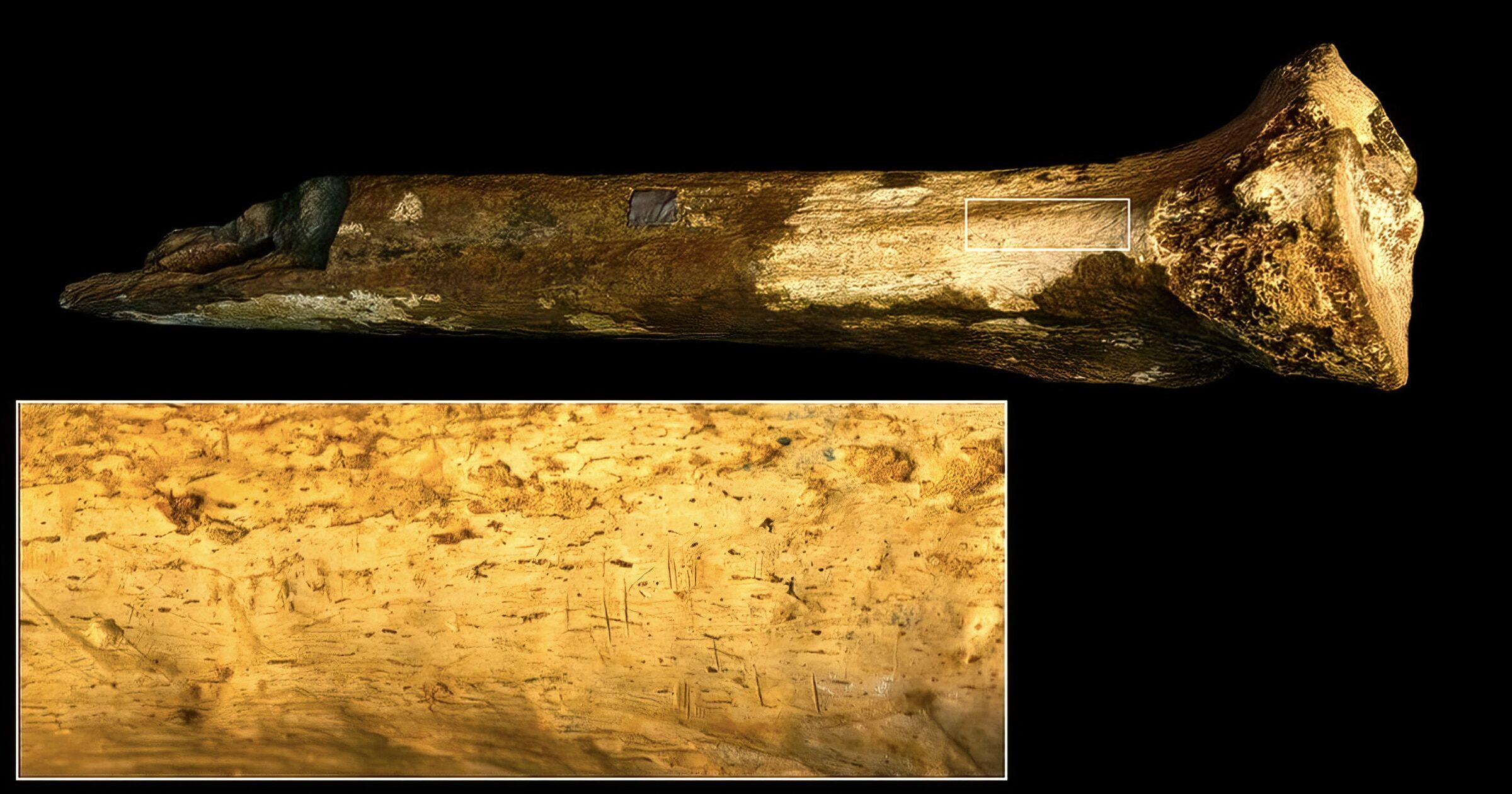
© Pobiner et al. 2023Hominin tibia KNM-ER 741, after Fig. 1
In 1970 the famous paleoanthropologist Mary Leakey discovered a fragment of a hominin tibia at the Koobi Fora locality in the Turkana region of Kenya. It was first considered as belonging to Australopithecus (Leakey 1971, Leakey & Leakey 1977), but later attributed to Homo erectus (Walker & Leakey 1993). However, Wood (2011) remarked about this fossil in the prestigious Wiley-Blackwell Encyclopedia of Human Evolution that its "current conventional taxonomic allocation is H. erectus or Hominin gen et sp. indet." and "because so little is known about the tibial morphology of early hominins other than Australopithecus afarensis it may be premature to rule out the possibility that it belongs to Homo habilis or Paranthropus boisei." Consequently, Pobiner et al. (2023) cautioned that "due to the taxonomic uncertainty of this fossil, we simply refer to it in this study as a hominin (hominin gen. et sp. indet)."
Cut Marks by Stone Tools
More than a half century after the initial discovery of the fossil bone, Pobiner et al. (2023) had reanalyzed the material and found on this leg bone several cut marks that were probably made by stone tools. Control experiments indeed confirmed that similar marks result from butchering activity with stone tools, which the authors interpreted as evidence for cannibalism among early humans.
Even though this fossil is slightly younger than the youngest known finds of Homo habilis, it is still contemporary with other ape-like hominins of the genera Australopithecus and Paranthropus. Considering its taxonomic uncertainty, the bone more likely belonged to an australopithecine-like Homo habilis than to a contemporary member of genuine Homo erectus (= Homo ergaster), who could rather have been the hunter. In the latter case this could hardly be called cannibalism and instead would simply be an instance of human hunting and butchering of large hominid primates that is still common in the notorious bushmeat trade of West Africa today. An article in the New York Times agreed that the cannibalism claim might rather be mere clickbait and that "the field has a long history of overstating such claims" (Lidz 2023). You don't say.
Anyway, this case arguably represents yet another empirical prediction by Darwin critics, which is vindicated by modern science, confirming a consistent pattern that I recently emphasized in another article for Fossil Friday (Bechly 2023b).
References:
- Bechly G 2023a. Fossil Friday: To Be or Not to Be Homo. Evolution News June 23, 2023.
- Bechly G 2023b. Fossil Friday: Cloudina Still Lacks the Guts to Be a Worm. Evolution News July 14, 2023.
- Bower B 2023. Fossil marks suggest hominids butchered one another around 1.45 million years ago. ScienceNews June 26, 2023.
- Leakey RE 1971. Further evidence of lower Pleistocene Hominids from East Rudolf, North Kenya. Nature 231(5300), 241-245. DOI: doi.org/10.1038/231241a0
- Leakey MG & Leakey RE (eds) 1977. Koobi Fora Research Project Volume 1: The Fossil Hominids and an Introduction to Their Context, 1968-1974. Oxford University Press, Oxford (UK), 191 pp.
- Lidz F 2023. Cannibalism, or 'Clickbait' for Paleoanthropology? The New York Times July 1, 2023.
- Metcalfe T 2023. 1.5-million-year-old bone may be earliest evidence of cannibalism by human ancestors. National Geographic June 26, 2023.
- Pobiner B, Pante M & Keevil T 2023. Early Pleistocene cut marked hominin fossil from Koobi Fora, Kenya. Scientific Reports 13:9896, 1-12. DOI: doi.org/10.1038/s41598-023-35702-7
- Tozer L 2023. Did our human ancestors eat each other? Carved-up bone offers clues. Nature News June 26, 2023. DOI: doi.org/10.1038/d41586-023-02082-x
- Walker A & Leakey R (eds) 1993. The Nariokotome Homo Erectus Skeleton. Springer, Berlin (DE), 458 pp.
- Wood B 2011. Wiley-Blackwell Encyclopedia of Human Evolution. 2 vols. Wiley-Blackwell, Hoboken (NJ), 1264 pp.
- Zhao C 2023. Did our ancient relatives practice cannibalism? Science News June 26, 2023.
Günter Bechly, Senior Fellow, Center for Science and Culture, is a German paleo-entomologist who specializes in the fossil history and systematics of insects (esp. dragonflies), the most diverse group of animals. He served as curator for amber and fossil insects in the department of paleontology at the State Museum of Natural History (SMNS) in Stuttgart, Germany. He is also a Senior Fellow with Discovery Institute's Center for Science and Culture. Dr. Bechly earned his Ph.D. in geosciences from Eberhard-Karls-University in Tübingen, Germany.



Reader Comments
to our Newsletter