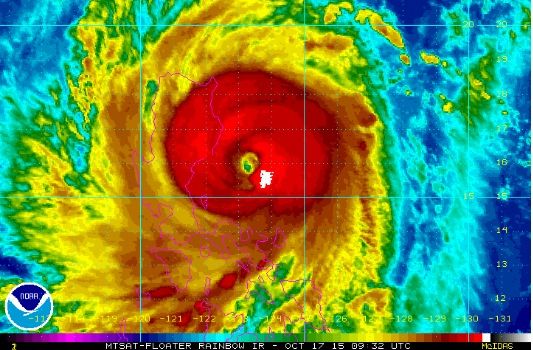
Typhoon Koppu will put lives and property across Luzon Island of the Philippines in danger through early this week.
Koppu developed into a typhoon early Friday morning local time and strengthened through the end of the week, reaching super typhoon status late Saturday evening. With wind gusts up to 295 km/h (180 mph), Koppu intensity was similar to that of a Category 4 hurricane in the Atlantic Ocean.
Very early Sunday morning, Koppu made landfall near Casiguran, Aurora on the eastern coastline of Luzon as a very dangerous cyclone the equivalent of a Category 4 hurricane. Koppu has weakened and is no longer a super typhoon, but still poses a significant threat to those in the Philippines.
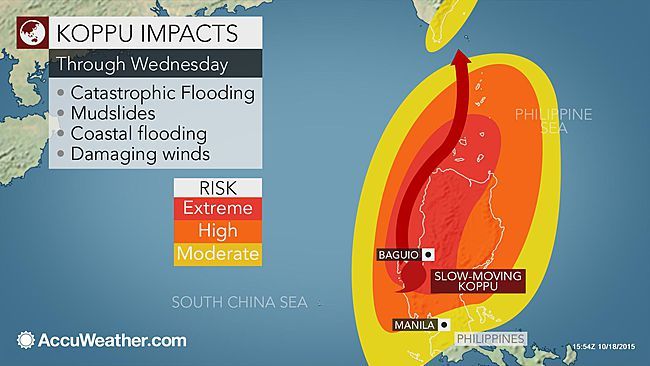
In addition to Koppu's increased strength as it approached the Philippines, the system also has slowed down significantly. The combination of a powerful and slow-moving typhoon spells a disastrous situation for residents and communities in its path across northern Luzon.
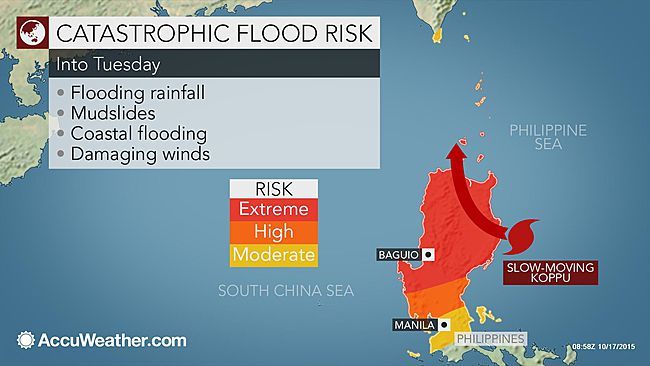
Koppu crawled toward towards northern Luzon Island throughout the day Saturday, local time, making landfall early Sunday morning. Koppu is expected to move slowly northward along the west coast of Luzon through the first half of the week. While the threat for damaging wind will decrease during this time, life-threatening flooding will remain a major concern.
In Baguio, over 200 mm (8 inches) of rain had already fell by Sunday evening. The city could receive another 250 mm (10 inches) of rain before Koppu pulls away.
"A total of 300 to 600 mm (12 to 24 inches) of rain is expected to be widespread," AccuWeather Meteorologist Adam Douty said.
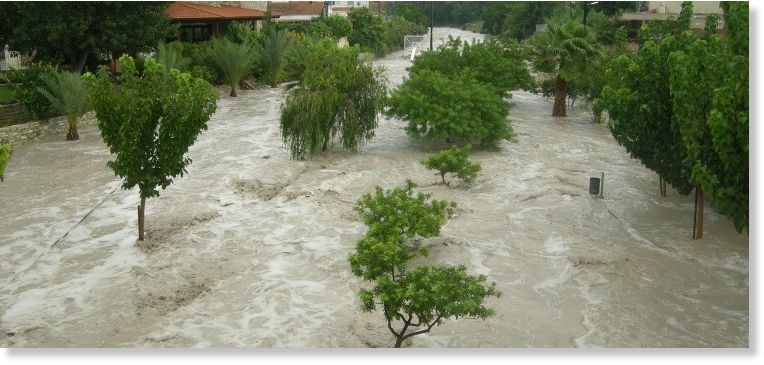
There will even be localized amounts upwards or in excess of 900 mm (36 inches). Such rain is sure to trigger severe and life-threatening flooding and mudslides.
"The most significant rain will fall in the mountainous terrain of northern Luzon," Douty added.