Animals
S


Question

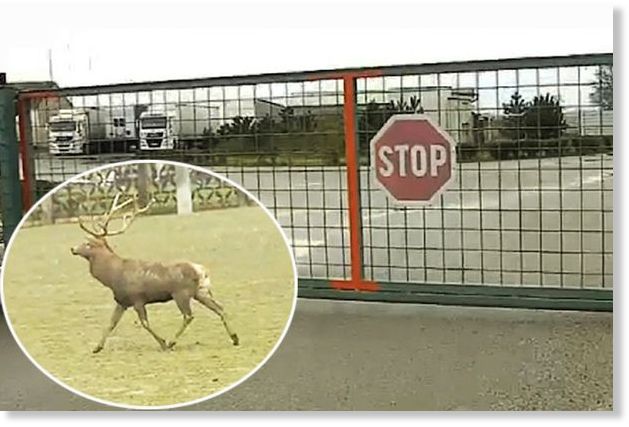
More animal lunacy: White-tailed deer breaks through 2 doors at New Jersey home

Image
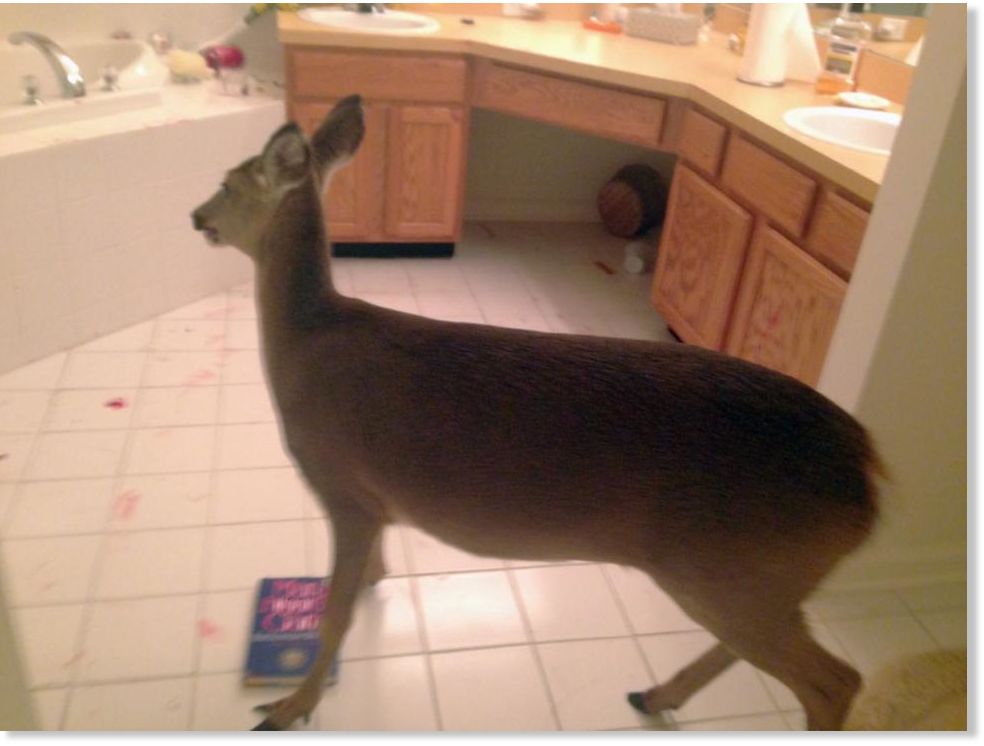
© APA deer stands in the bathroom of a house in Galloway, N.J
The deer apparently worked its way through a storm door and the home's main door to get into the Galloway home, where a woman living there locked it in a bathroom before it was freed by police. The bathroom suffered significant damage.

Police say a deer burst through the front doors of a New Jersey home, darted through the residence and ransacked the master bathroom.

Galloway police received a 911 call at around 3:30 p.m. Saturday from a woman reporting that a deer ran through her house while she was putting sweet potatoes in the oven. The woman said she followed the deer into the back of the house and locked it in a bathroom.

Responding officers found the glass on the front storm door shattered. They also found the frame on the main door damaged, indicating that the deer muscled its way through two doors to enter the home.

After a brief standoff, police escorted the deer from the home and released it into the wild.

The bathroom was significantly damaged.

Source: AP

Arrow Down

'Catastrophic' Bangladesh oil spill threatens rare dolphins

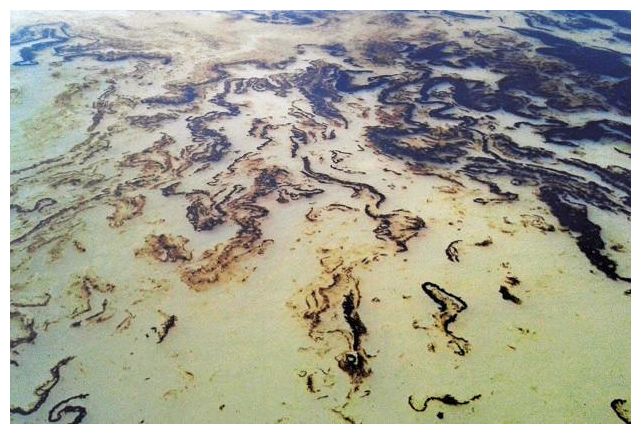
Oil Spill Bangladesh
© Agence France-PresseThe oil tanker was carrying an estimated 357,000 litres (77,000 gallons) of oil when it sank in the Sundarbans’s Shela river, home to rare Irrawaddy and Ganges dolphins.
Dhaka: An oil spill from a crashed tanker in Bangladesh is threatening endangered dolphins and other wildlife in the vast Sundarbans delta, officials warned on Thursday, branding the leak an ecological "catastrophe".

The tanker was carrying an estimated 357,000 litres (77,000 gallons) of oil when it sank in the Sundarbans' Shela river, home to rare Irrawaddy and Ganges dolphins, after colliding with another vessel on Tuesday.

Rescue vessels have now salvaged the tanker, but officials said the damage had already been done as the slick had spread to a second river and a network of canals in the Sundarbans, the world's largest mangrove forest, which straddles India and Bangladesh.

"It's a catastrophe for the delicate ecology of the Sundarbans," the area's chief forest official Amir Hossain said. "The oil spill has already blackened the shoreline, threatening trees, plankton, vast populations of small fishes and dolphins."

Hossain said the oil had already spread over a 60-km-long area of the Sundarbans. Spread over 10,000 square kilometres, the Sundarbans is a Unesco-listed World Heritage Site and home to hundreds of Bengal tigers. The delta comprises a network of rivers and canals.

Attention

Dead sperm whale found off Odisha coast, India

Image
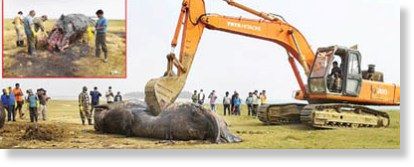
An eight-member team of palaeontologists from the Regional Museum of Natural History in Odisha's capital city of, Bhubaneswar has begun the exercise to retrieve the skeleton of the giant whale that was washed ashore near Kelua river mouth on December 3.

The team, led by Dr Siba Prasad Parida, began work on Tuesday morning. After spraying chemical powders, the team started cutting out the flesh of the whale.

The extraction process was delayed due to excessive secretion of oil and worms from the body of the dead whale. "We had to re-position the whale 20 feet away with the help of a bulldozer to get going," said local forester Umesh Mohanty.

Igloo

Mastodons weren't hunted to extinction by Ice Age humans - they simply froze to death, new study finds

Mastodons_1
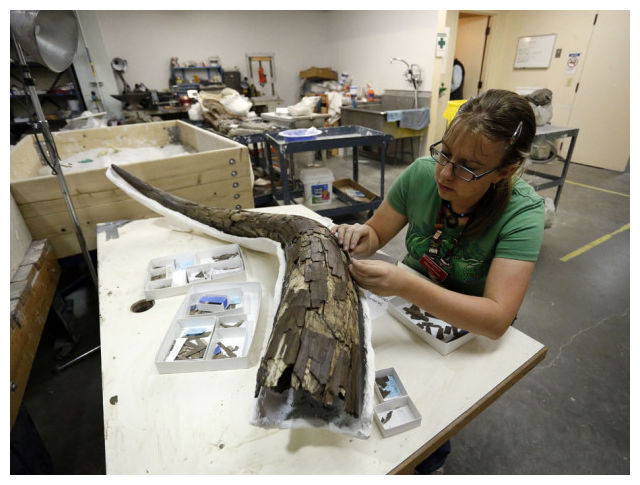
© National PostPaleontology student Hillary McLean pieces together a tusk of an ancient mastodon, part of an extensive discovery unearthed from Snowmass, Colo., inside a workroom at the Denver Museum of Nature and Science.
Despite popular belief that North American mastodons were hunted to extinction by Ice Age humans, a new Canadian-led study is claiming that the prehistoric beasts simply froze to death.

"To think of scattered populations of Ice Age people with primitive technology driving huge animals to extinction, to me is almost silly," said Grant Zazula, chief paleontologist for the Yukon Territory and the study's lead author.

"It's not human nature just to see everything in your path and want to kill it," he said.

The paper, published this week in the Proceedings of the National Academy of Sciences, carbon dated 36 mastodon bones from across Canada and the United States.

Attention

2 men attacked and injured by wild boar in Shizuoka, Japan

Image
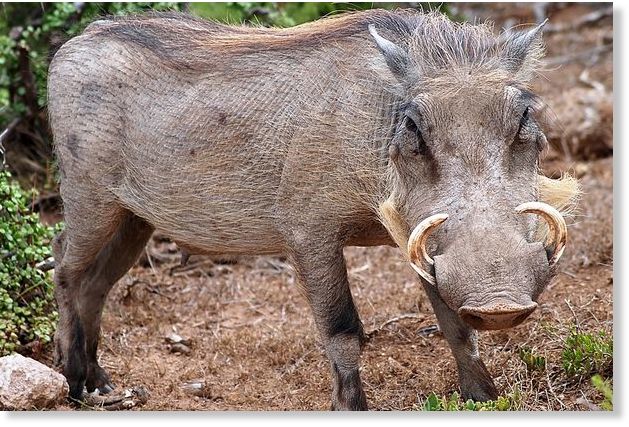
Two men were injured by a wild boar in Kakegawa, Shizuoka Prefecture, on Tuesday.

According to police, a 63-year-old man was attacked at around 11:30 a.m. in a field. NTV reported that he suffered injuries to his face, neck, hands and legs.

About 20 minutes later, a 64-year-old man was attacked by the same boar a few hundred meters away. He suffered injuries to his stomach and legs
.

Police said neither man's injuries are life-threatening.

Members of a local hunting association captured the 1-meter-long boar about an hour later on a riverbank and disposed of it.

Attention

Man dies following ferocious deer attack at Slovakian farm

Image
© CENPaid deer price: One of animals at agricultural cooperative in Surovce
Police who opened a murder enquiry after a man died from more than 20 stab wounds have found the killer - a male stag that had speared him with its antlers.

Plumber Vladimir Kostur, 59, was installing a new watering system at a farm in the village of Surovce, Slovakia, when the 660lb beast charged, knocking him to the ground.

The raging stag, one of many deer being kept at the farm, then attacked stunned Kostur with its antlers, puncturing his body 20 times as he lay on the ground.

Pal Frantisek Cerny, 54, said: "I was just arriving to give Vlad a hand when I saw the stag appear out of nowhere and attack him.

Comment: See also: Deer farmer, 75, dies five days after being gored by stag in rutting season in Wales

Even more strange animal behavior: Deer crashes into restaurant in Iowa


Attention

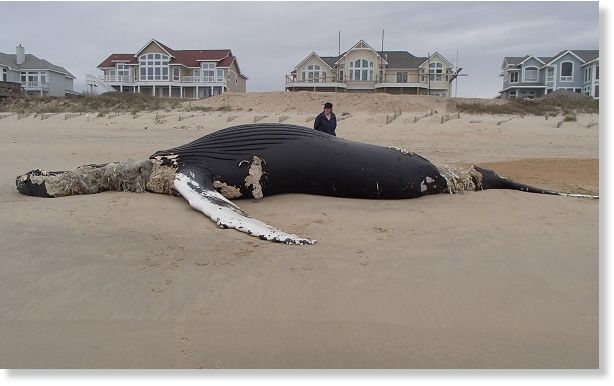
Remains of humpback whale found in Corolla, North Carolina

Image
© Karen ClarkThe whale was first discovered off Pine Island.
What remained of a badly decomposed juvenile humpback whale washed up off Corolla on Friday, then was swept away by the nor'easter, only to turn up Monday five miles to the south in Duck.

The Outer Banks Marine Mammal Stranding Network received a phone call Friday about a large dead whale floating off the sand bar in Pine Island, according to N.C. Wildlife Resources Commission program coordinator Karen Clark.

"On Saturday the team measured a 34-foot juvenile male humpback whale with severe scavenging," Clark said. "Externally there was nothing indicative for cause of death."

Ice Cube

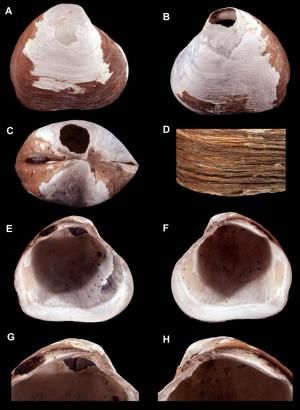
New species of bivalve mollusk discovered in depths of Arctic Ocean

new species bivalve mollusk
© Paul Valentich-ScottNew species of bivalve mollusk was recently described and named Wallerconcha sarae.
In the depths of the Arctic Ocean, buried deep in the sediment, an ancient creature waited for over a million years to be discovered. Paul Valentich-Scott, from the Santa Barbara Museum of Natural History (California), and three scientists from the United States Geological Survey (USGS, Menlo Park, California), Charles L. Powell, Brian D. Edwards, and Thomas D. Lorenson were up to the challenge. Each with different expertise, they were able to collect, analyze, and identify a new genus and new species of bivalve mollusk.

The path to discovery is seldom simple or easy. This discovery is no exception. Brian Edwards was the chief scientist on a joint US-Canadian ice breaker expedition aboard the US Coast Guard Cutter Healy in the summer of 2010. The primary purpose of the expedition was to map the Arctic seafloor and the sediments beneath. Dr. Edwards took deep sediment core samples to further understand the geology of the region including the unusual seafloor mound where these samples were collected. In several of these cores he uncovered bivalve seashells buried nearly 15 feet (4.5 m) below the seafloor surface.

Upon returning to his USGS laboratory in Menlo Park, California, Brian worked with Tom Lorenson on sampling the cores and extracting the shells. The recovered shells were then taken to USGS paleontologist Chuck Powell, for identification. While Chuck was able to ascertain the higher level classification of the clam shells (Family Thyasiridae), he was unable to determine the genus or species. Chuck contacted Paul Valentich-Scott, a clam specialist from the Santa Barbara Museum of Natural History in California.

Comment: For news of other recently discovered species of flora and fauna see:

New species of deep-sea coral discovered off California coast

Two new species of venomous jellyfish found off Australia coast

New species of dinosaur discovered lying forgotten in a museum


Arrow Down

Pit bull attack on San Diego woman results in surgery and permanent scars

Image
A 70-pound female Pit Bull, who appeared to have recently had puppies, viciously attacked a beagle being walked by his owners and then bit the owner in the face on Sunday. The incident occurred near the intersection of 40th and Myrtle in City Heights, California, around 4 p.m., according to 10News.

Craig Moreno, who lives nearby, said he had just come home when he saw the woman on the corner in a position that looked like she was a hugging a dog. Then he heard her scream for help and realized she was trying to pull a beagle out of the jaws of the huge Pit Bull.

Several other people were also trying to help, Moreno said, so he just jumped right in and also held onto the beagle.

But the Pit Bull did not let loose - not even when a neighbor hit it with a golf club. It continued until someone found the woman's water bottle and began pouring water onto the dog's face. Moreno described to 10News how they pulled harder as they poured the rest of the water into the dog's face and it finally let go.

Comment: Canine attacks by pit bulls as well as other breeds are becoming all too common recently. However, it is not only dogs that are behaving strangely as there have been reports of wild animal attacks by numerous diverse species across the globe.

SOTT EXCLUSIVE: Global canine insurrection? Another week of savage dog attack reports


Attention

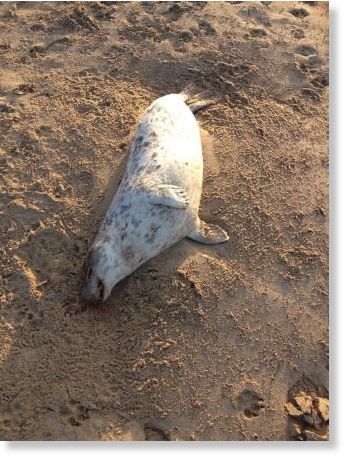
Large number of grey seals washing up dead on Cornish beaches, UK

Image
© Caz Waddell
Huge numbers of dead seals have been found stranded on Cornish beaches recently, and wildlife experts admit they are baffled.

Cornwall Wildlife Trust says it has attended almost twice as many strandings of seals as would normally be expected for this time of year adding that, throughout October and November, 35 dead seals have washed up along the Cornish coastline, and over the same period a further 37 seals have been rescued alive from Cornish beaches by British Divers Marine Life Rescue.

Caz Waddell, from Cornwall Wildlife Trust said: "While bad weather will undoubtedly have been the cause of some of these strandings, the sheer number of cases has left us slightly baffled. We don't yet have any answers as to why this is happening, but it shows just how important it is for people to tell us about any stranded marine animal they see. The more animals we can study, the more we can try to get to the bottom of what might be going on."