Animals
S


Attention

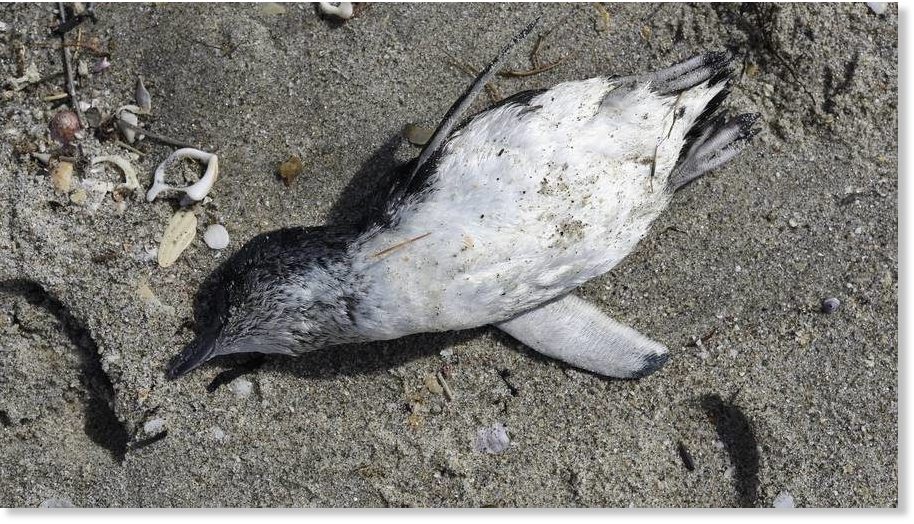
Mass of dead and dying seabirds on Bay of Plenty shores in New Zealand

A blue penguin washed up on Mount main beach on Wednesday.
© George NovakA blue penguin washed up on Mount main beach on Wednesday.
The Western Bay and ARRC Wildlife Trusts are urging the public to be aware of seabirds washing up on Bay of Plenty shores.

Julia Graham, Western Bay Wildlife Trust chairperson, said there was a mass seabird mortality with many dead or dying birds being washed up on the beach.

"Many of these are juveniles that cannot survive in this rough weather and episodes of mass die-off are a natural course of events," she said.

Arrow Down

Florida child dies after being scratched by rabies-infected bat

child dies rabies infected bat
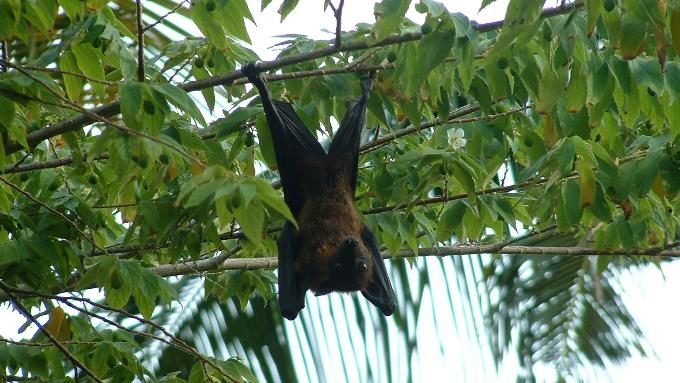
A 6-year-old Eustis boy reportedly died of rabies Sunday at an Orlando hospital after being scratched by a sick bat that Lake County officials said had been living in his home.

Henry Roque confirmed his son Ryker Roque's death to NBC News after previously telling the "Today" show that Ryker became infected when the bat scratched him.

Lake County deputies responded to the Eustis home about two weeks ago after they were told the family's pit bull may have had rabies. When they arrived, somebody told them the residents were at the hospital with their son, who had been scratched by a bat, sheriff's Maj. Chris Delibro said.

"We're told the bat had been in the house for a week or two prior to the boy going to the hospital," Delibro said.

During that time, authorities said the bat may have come in contact with the dog.

Question

Rash of dead birds found in Destin, Florida

Dead gannets
Dead gannets
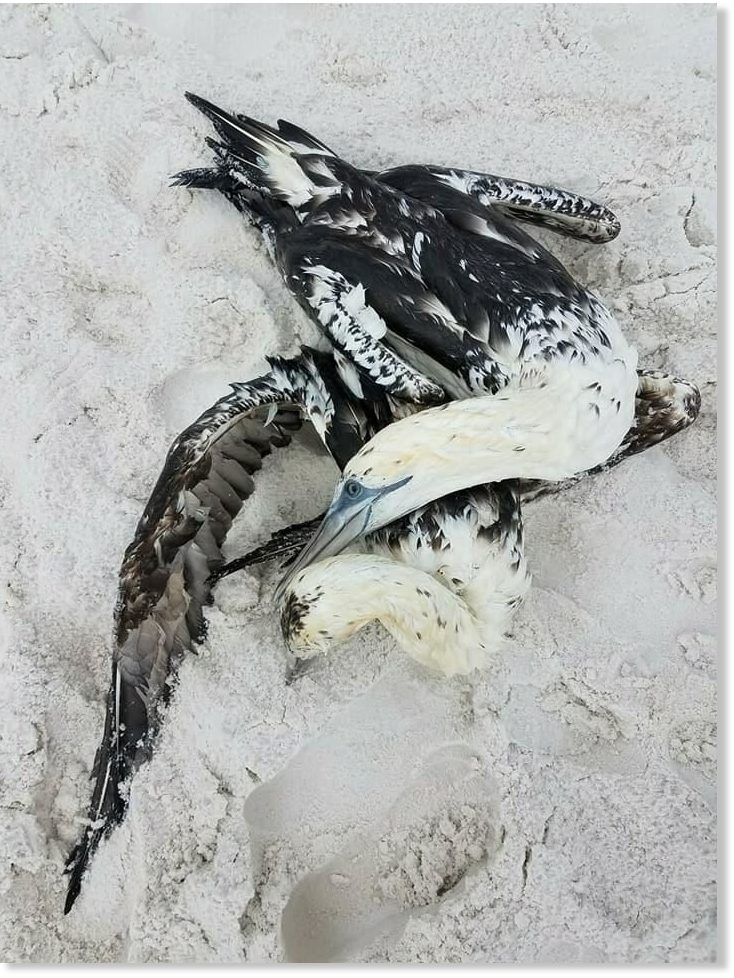
More than a dozen dead sea birds were discovered on local beaches last Friday. Their cause of death is waiting to be determined by a Florida Fish and Wildlife Conservation Commission veterinarian.

A mix of common loons and young gannets were found on beaches at Henderson Beach State Park, June White Decker Park and O'Steen Public Beach Access. ECWR wildlife health technician Shelby Proie said staff collected six of the bodies to be sent to an FWC veterinarian based in Gainesville where the bodies will undergo necropsies.

Michelle Pettis, who is also a wildlife tech at ECWR, said there were groupings of around four birds at the beaches. At the O'Steen site, some residents from a nearby condo helped point out the birds to ECWR, one of which was still alive.

Wolf

Young girl killed by pit bull terrier in Duncan, Oklahoma

PIT BULL ATTACK
A young Oklahoma girl was killed in a dog attack over the weekend.

Jason Dodge told KFOR he left his 3-year-old daughter, Rylee, at home with his mom.

He had only been gone about 20 minutes when he got the terrible phone call that Rylee had been mauled by a dog.

Dodge says he had just taken in the pit bull 5 days earlier from a friend and that there were no warning signs that the dog could be vicious.


Eye 2

Signs and Portents: Two-headed snake found outside Branson, Missouri

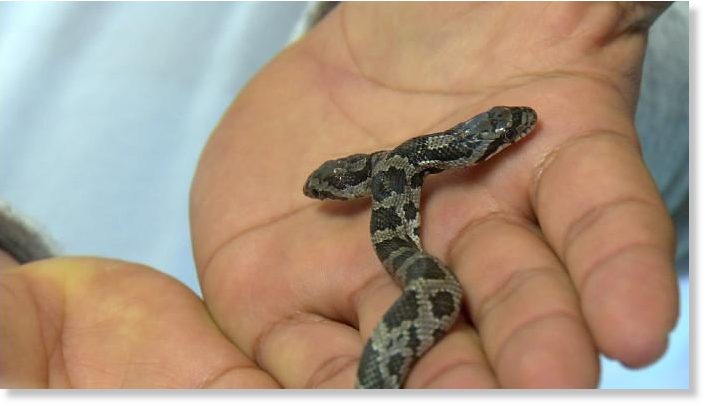
This two-headed western ratsnake found last fall in Stone County is currently on display at the Missouri Department of Conservation's Shepherd of the Hills Hatchery in Branson.
A two-headed snake — or is it snakes? — found this fall by a southwestern Missouri teenager is now on display at a hatchery outside Branson, the Missouri Department of Conservation announced Friday.

The unusual reptile, a nonvenomous western rat snake, was found in October by Terry Lowery under the deck of his family's home in Hurley, about 45 minutes south of Hurley, according to the department.

After the family took photographs of the young dual-headed snake, they contacted the Dickerson Park Zoo in Springfield, and zoo staff forwarded them to the Shepherd of the Hills Fish Hatchery operated by the Department of Conservation.

The hatchery near Branson is primarily a trout-raising facility producing hundreds of thousands of trout a year, but its staff agreed to observe the snake.

Fire

Australian birds have weaponized fire: Astonishing research indicates black kites are purposefully spreading wildfires

Raptors, including the whistling kite, are intentionally spreading grass fires in northern Australia, a research paper argues. The reason: to flush out prey and feast

Black kites
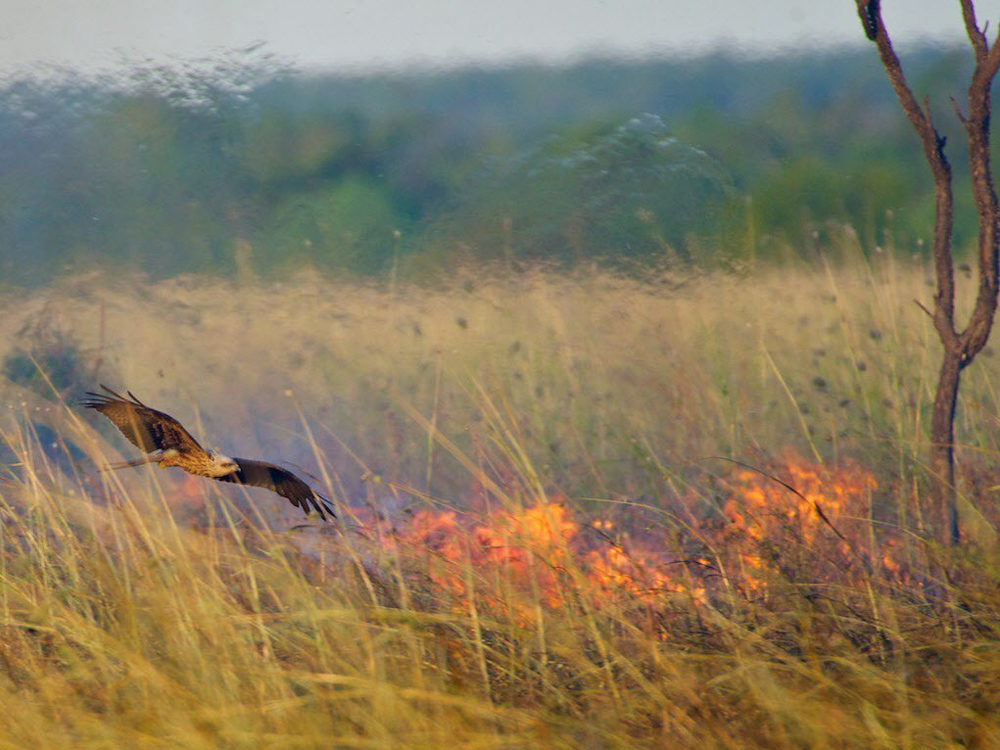
© Bob GosfordBlack kites (Milvus migrans) visit a grass fire in Borroloola, Northern Territory, Australia, in 2014.
Dick Eussen thought he had the fire beat. It was stuck on one side of a highway deep in the Australian outback. But it didn't look set to jump. And then, suddenly, without warning or obvious cause, it did.

Eussen, a veteran firefighter in the Northern Territory, set off after the new flames. He found them, put them out, then looked up into the sky.

What he saw sounds now like something out of a fairy tale or dark myth. A whistling kite, wings spread, held a burning twig in its talons. It flew about 20 metres ahead of Eussen and dropped the ember into the brittle grass.

And the fire kicked off once again.

Black Cat

Leopard attacks five people in Maharashtra, India

leopard attack
First recorded incident of a leopard finding its way into Mulund-east; the cat covered a distance of nearly 5 km outside the National Park.

A leopard that strayed into a residential colony in Mulund east early Saturday morning attacked five people and could be trapped only after a marathon rescue operation by forest officials that left the neighbourhood on the edge for over five hours.

This was the first recorded incident of a leopard finding its way into Mulund-east and forest officials said the cat covered a distance of nearly 5 km outside the Sanjay Gandhi National Park, its natural habitat.

Among the five injured in the leopard attack was Ganesh Pujari, 45, an electrician, who fought off the leopard to save his 18-year-old son's life after being pounced upon in their house in Nane Pada.

Info

Evidence of something much bigger: New bee species found thriving in former Arctic nuke site - study

Bees
© Sina Schuldt / AFP
A species of bee has been discovered that is miraculously capable of surviving in the high arctic region where the Soviet Union once tested nuclear weapons for decades, according to a new study.

The 'Bombus glacialis' species lives on the archipelago of Novaya Zemlya, which the Soviet Union closed off decades ago to carry out scores of nuclear tests. While previously considered to be a subspecies of the B. polaris - one of the only other arctic bee types in the world - a recent study published in Polar Biology confirmed B. glacialis to be its own species.

Specimens of the bees were often collected by explorers who visited the island in the early 20th century, and are now preserved in natural history museums. Their existence, however, could be evidence of something much bigger.

Comment: See also: Russian military deploys radar array facility on remote Arctic island


Wolf

Wolf discovered in northern Belgium, first time in over 100 years

Wolf
© AFP
A wild wolf has been found in the northern Belgian region of Flanders for the first time in more than a century, an environmental group said on Saturday (Jan 13).

"Our country was the only one in continental Europe to have not been visited by a wolf," since the animal began recolonising the continent, Landschap said.

Overhunting, industrialisation and urban sprawl progressively led to the disappearance of the wolf from most of Western Europe since the beginning of the 20th century.

Since the Bern Convention of 1979, the wolf has gone from public enemy to a protected species as "a fundamental element of our natural European heritage".

In some countries, like Romania and Poland where there have always been wolves, people adapt to treat an attack on sheep "like an accident, like a flock that falls into a ravine", says Farid Benhammou, a specialist on predators.

Attention

Thousands of dead fish on Alabama beaches likely died of cold temperatures

Residents near Little Lagoon in Gulf Shores are dealing with the effects of a large fish kill
© Brian KellyResidents near Little Lagoon in Gulf Shores are dealing with the effects of a large fish kill that occurred this week. Thousands of dead mullet in Gulf Shores can be seen in this photograph taken off of Minnow Lane Thursday, Jan. 11, 2018.
A large fish kill at Little Lagoon in Gulf Shores has locals holding their nose and gritting their teeth around usually scenic docks and beaches, but it's all part of the natural order of things, according to the Alabama Department of Conservation and Natural Resources.

"This is not a new phenomenon," said Kevin Anson, a marine biologist with the ADCNR's Marine Resources Division. "In 2014 there was a small fish kill, in 2011 I think, we had another cold event, and it's been documented going back into the 1960s."

Thousands of fish -- mostly white mullet -- have gone belly-up on the surface of Little Lagoon or washed up on shore this week, leaving behind an ugly scene, a terrible smell, and a feeding frenzy for birds who don't mind dead mullet, even if they're a few days old.