
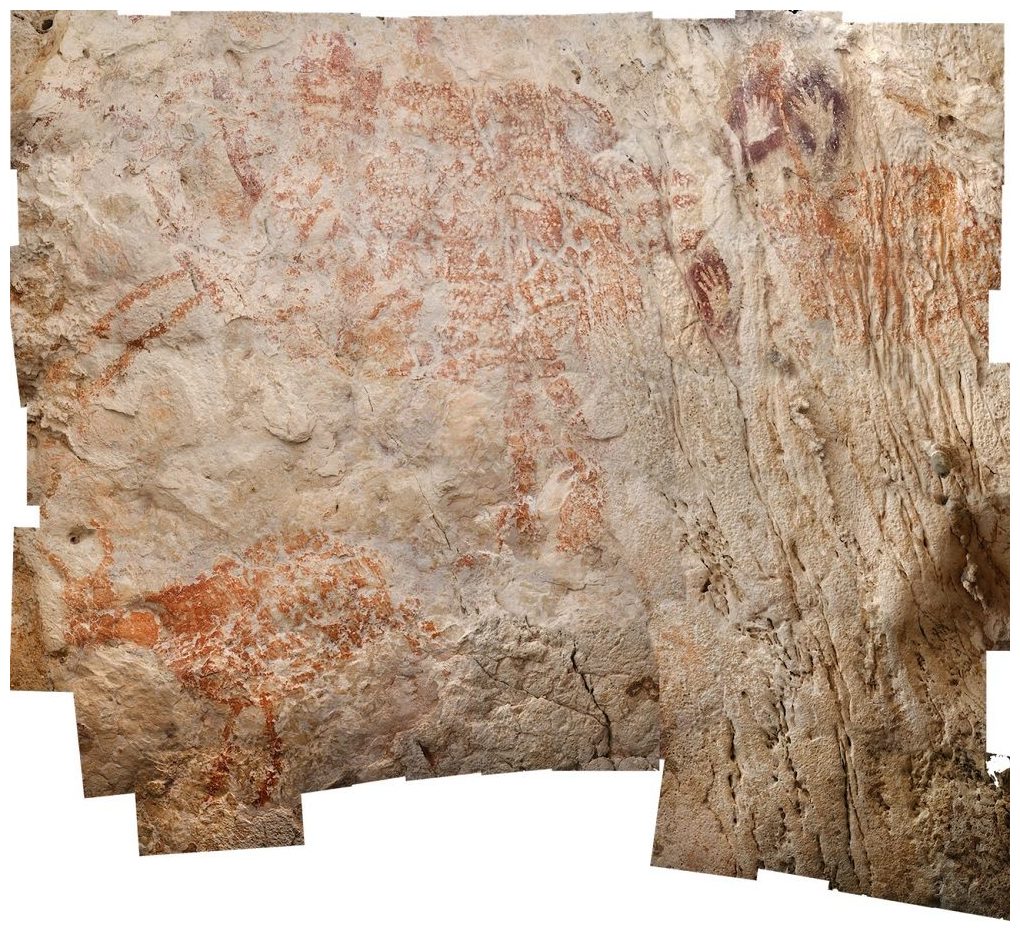
© LUC-HENRI FAGEIndistinct, but definite, the animal depiction in the centre of this image is perhaps the oldest figurative art in the world.
In a paper published in the journal Nature, Maxime Aubert from Australia's Griffith University, reveals the red-orange painting - faint now, and depicting an animal that is not readily identifiable - as one of many put onto the walls of the caves in an area known as Lubang Jeriji Saléh, on island's Sangkulirang-Mangkalihat Peninsula.
After conducting uranium-series analysis of calcium carbonate deposits that have accreted on top of the painting, the scientists concluded that the minimum age for it was 40,000 years.
This is, write the researchers, "currently the oldest date for figurative artwork from anywhere in the world". As well as many other depictions of animals, the caves also contain scores of "hand stencils" - art created by placing a hand on the wall and then covering it with pigment, resulting in a negative rendition.












Comment: There is a lot of fear and uncertainty around the rollout of 5G technology at the moment, but it seems likely that these new frequency waves are significantly more dangerous than existing wireless technology. Until it's proven safe, it seems the best course of action is to avoid areas blasting 5G as much as possible.
See also: