Animals
S


Sherlock

Horseshoe crab throws theory of arachnid evolution into disarray

horseshoe crab
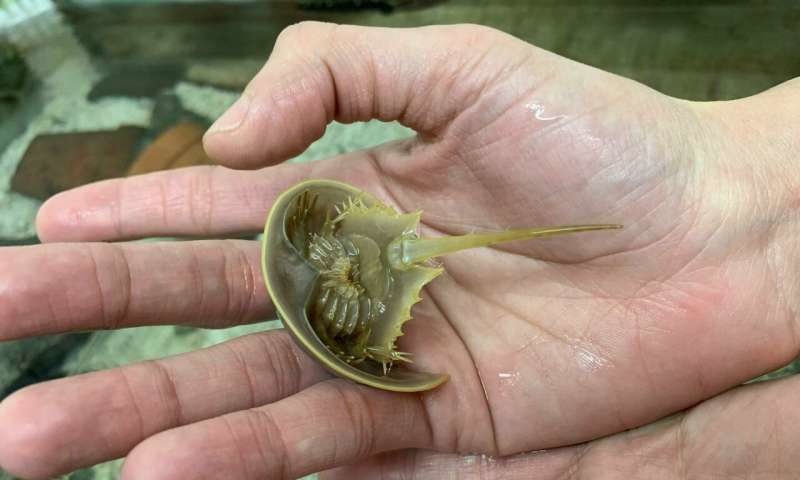
© Jesús BallesterosUniversity of Wisconsin-Madison postdoctoral researcher Jesús Ballesteros holds a small horseshoe crab. A study he led with Integrative Biology Professor Prashant Sharma used robust genetic analysis to demonstrate that horseshoe crabs are arachnids like spiders, scorpions and ticks.
Blue-blooded and armored with 10 spindly legs, horseshoe crabs have perhaps always seemed a bit out of place.

First thought to be closely related to crabs, lobsters and other crustaceans, in 1881 evolutionary biologist E. Ray Lankester placed them solidly in a group more similar to spiders and scorpions. Horseshoe crabs have since been thought to be ancestors of the arachnids, but molecular sequence data have always been sparse enough to cast doubt.

University of Wisconsin-Madison evolutionary biologists Jesús Ballesteros and Prashant Sharma hope, then, that their recent study published in the journal Systematic Biology helps firmly plant ancient horseshoe crabs within the arachnid family tree.

By analyzing troves of genetic data and considering a vast number of possible ways to examine it, the scientists now have a high degree of confidence that horseshoe crabs do indeed belong within the arachnids.

Comment: It seems that were these evolutionary biologists to question their foundational theory for evolution, things may become a little less 'complicated': Why Darwinism Is Wrong, Dead Wrong - Part 1: Intelligent Design and Information

See also: And check out SOTT radio's:


Info

Tiny insect uses plant stems to communicate

Planthopper
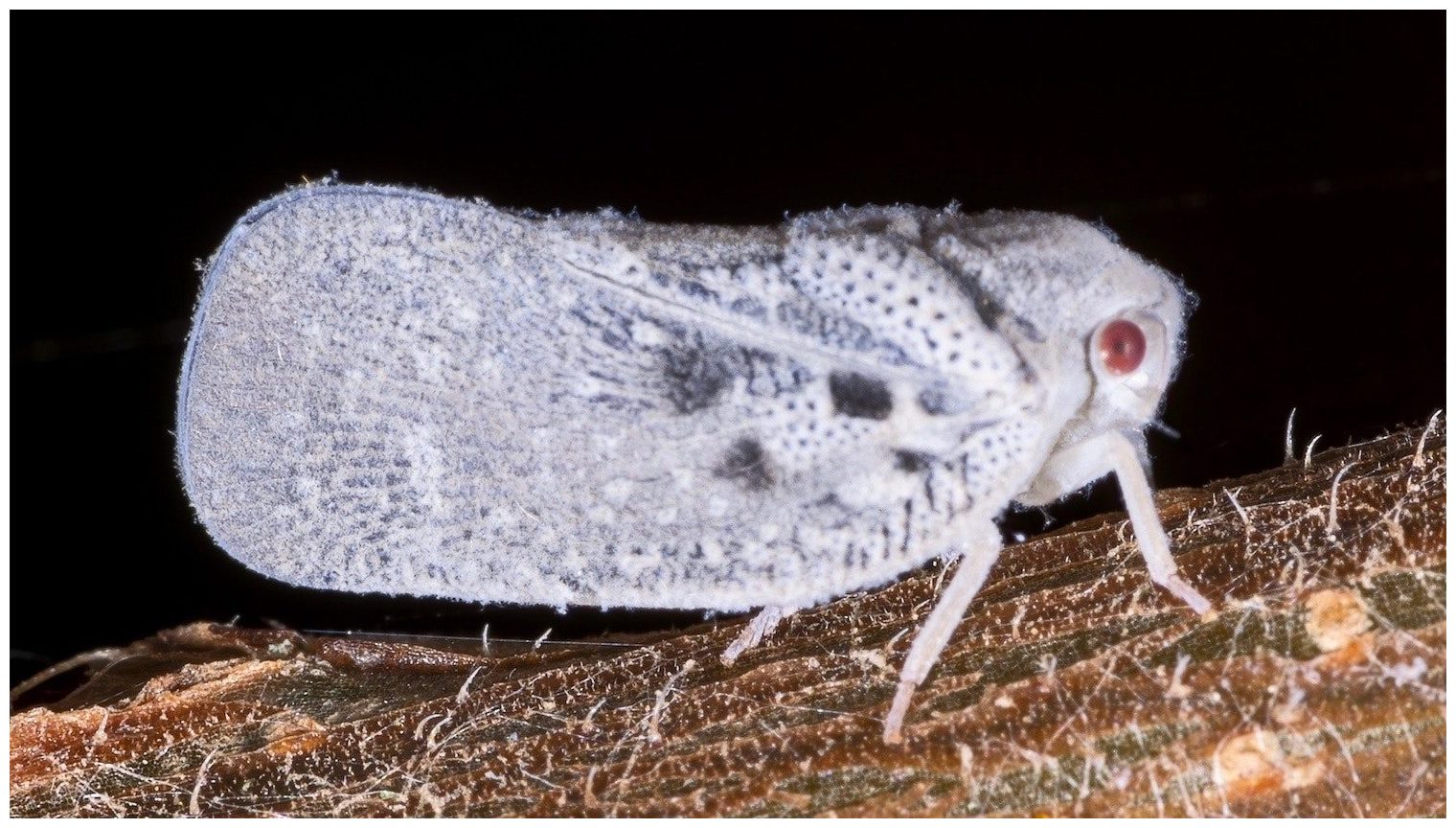
© WIKIPEDIAA happy-snapping planthopper.
A small-sized but common group of insects known as planthoppers - comprising the order Fulgoromorpha - advertise their presence to potential mates by deploying a unique, and only now discovered, organ to send long-distance messages along plant stems.

There are more than 12,000 species of planthopper worldwide, and their secret communication device - dubbed the "snapping organ" - was found by researchers led by zoologist Leonidas-Romanos Davranoglou from the University of Oxford in the UK while examining one of them, Agalmatium bilobum.

Locating the organ answered a key question about the group. How could each insect produce a sustained thrumming vibration along plant stems when its musculature was simply not capable of moving fast enough to produce it?

The answer, Davranoglou and colleagues found, lies in the mechanics of the snapping organ.

It functions through the explosive release stored elastic energy. A catapult provides a reasonable approximation, except that for the planthoppers the release forms one half of a high-speed cycle of capture and release that results in a shaking movement of the abdomen and the narrowcast of mating signals.

Doberman

Man injured by dogs dies shortly afterwards in Lubbock, Texas

canine attack
© Angela Antunes / CC by 2.0
The unidentified man who was injured in a dog attack Friday afternoon has died from what police are calling a medical incident.

Lubbock Police responded to a dog-related incident in the 7900 block of Oak Avenue at around 5:30 p.m. Friday. KAMC News reports that 2 dogs were fighting and one person was trying to break up the fight.

According to a statement from LPD, the man had minor injuries to his hands after breaking up the dogs, but several minutes later began feeling ill and had trouble breathing.

He was pronounced deceased at the scene.

Cow

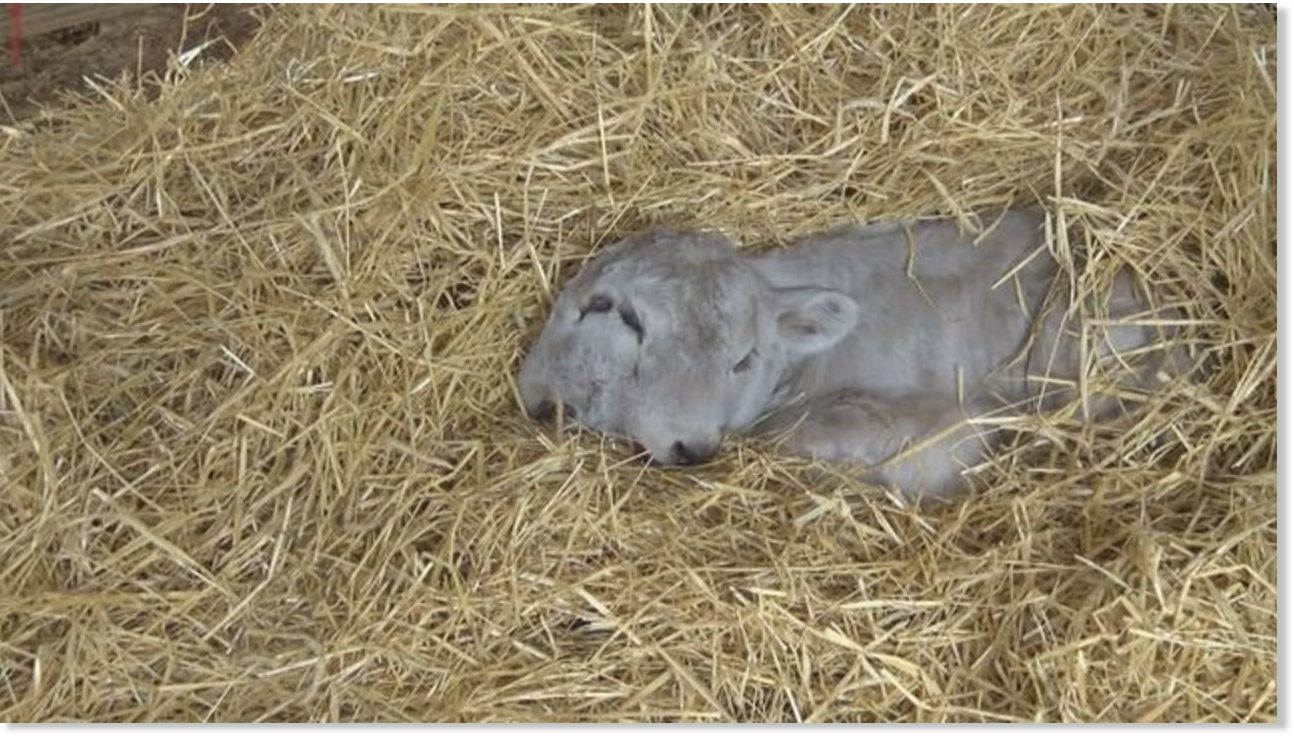
Signs and Portents: Two-headed calf born in Washington County, Tennessee

Two-headed calf
Two-headed calf
Two-headed calf named 'Chance' born in Washington County, Tennessee


Sun

'Falling out of trees': Dozens of dead possums blamed on extreme heat stress in Victoria, Australia

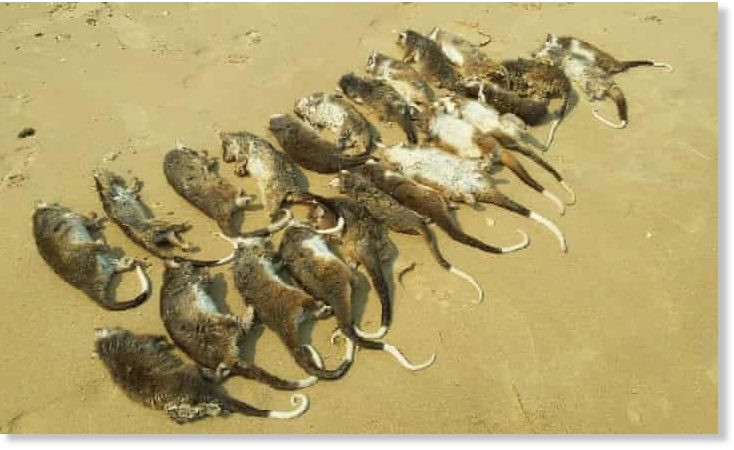
Wildlife rescuers found 127 dead and injured ringtail possums at Somers Beach in Victoria during a four-day heat spell.
© Wildlife rescuers found 127 dead and injure Alyse HuytonWildlife rescuers found 127 dead and injured ringtail possums at Somers Beach in Victoria during a four-day heat spell.
Rescuers found 127 ringtail possums along the shoreline and in the water on Victoria's Mornington Peninsula

More than 100 dead and injured ringtail possums have been found by wildlife rescuers along a single stretch of beach in Victoria in what ecologists say is becoming an annual occurrence due to extreme heat.

Rescuers and wildlife carers discovered 127 ringtail possums along the shoreline and in the water at Somers Beach on the Mornington Peninsula on Saturday during a four-day period that saw consistent temperatures in the high 30s, warm nights and bushfires in parts of the state.

Melanie Attard, a wildlife rescuer and foster carer with Aware Wildlife in Frankston, said rescuers suspected the animals had become so dehydrated and desperate they had left an area of scrub and come down to the beach and attempted to drink salt water.

"We assume they've come out due to the heat stress heading for the water in desperation," she said.

Magnify

Every animal pulled from the deepest part of the ocean had plastic in its gut

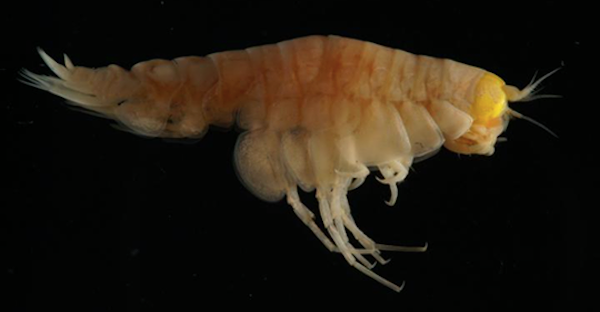
shrimp
© GPSEN
"What you put in the trench stays in the trench."

Stories of whales, turtles, and seabirds with guts filled with plastic have become increasingly common.

Recently, a team of scientists wanted to determine the extent of plastic pollution and its effects on animals by investigating the most remote regions of the ocean, sending vehicles to the deepest marine trenches to collect tiny amphipods - shrimp-like creatures - that scavenge for food in the harsh environment.

Comment: World's deepest plastic bag found at bottom of Mariana Trench - highlights spread of ocean pollution


Doberman

Toddler mauled to death by 2 family dogs in High Springs, Florida

canine attack
© Angela Antunes / CC by 2.0
A Florida toddler was mauled to death by a family dog on Friday. The attack happened in the community of High Springs, just outside of Gainesville.

The Alachua County Sheriff's Office says the 2-year-old boy was with his grandmother as she went to her daughter's home to check on the dogs. The grandmother let the dogs out in the yard with the boy while she went inside to prepare food.

"She's inside briefly. When she goes back outside, she can no longer see her grandson, can no longer see the dogs," explained Lt. Brett Rodenizer with the Alachua County Sheriff's Office.


Attention

Pack of pit bulls attack four people in Akron, Ohio

pit bull  in cage
One of the three dogs that allegedly attacked four people in Akron.
Four people, including a mail carrier, were bitten by a pack of three dogs in two separate incidents in Akron Monday morning, according to police.

At about 10:30 a.m., officers were called to the 800 block of Reed Avenue for a report of three dogs biting. When police arrived, the dogs had already left the scene. One victim said she was getting out of her van when she was attacked. She said she was brought to the ground by the dogs, who then bit her on both sides of her body from her torso to her feet.

A man overhead the woman screaming, and tried to fight the dogs off from the woman, an Akron police report states. He was bitten numerous times in the left arm.

Blue Planet

Unidentified "Type D" killer whale finally discovered in Southern Ocean

killer whales
© J.P. SylvestreA rare photo of "type D" killer whales off South Georgia island, located between South America and Antarctica, shows the whales' blunt heads and tiny white eye patches.
Scientists say they've found a mysterious type of killer whale that they've been searching for for years. It lives in parts of the ocean near Antarctica - and it could be the largest animal to have remained unidentified by biologists.

The notion that there might be some unusual kind of killer whale emerged in 1955. Photos from New Zealand showed a bunch of whales stranded on a beach. "This was a very different-looking group of killer whales," says Robert Pitman, a marine ecologist with the National Oceanic and Atmospheric Administration.

The whales were smaller than other killer whales, and they had rounded heads and pointier fins. "And most importantly," Pitman adds, "they had a little tiny eye patch," a white spot under each eye characteristic of killer whales. These patches were unusually small, in some cases almost nonexistent.

Comment: It seems there's been a number of discoveries or rediscoveries recently: Scientists found the world's largest bee which they believed had become extinct, and in Taiwan a leopard, having not been seen for 30 years, was spotted:
Leopard Thought to Be Extinct Is Spotted in Taiwan for First Time in Over 30 Years

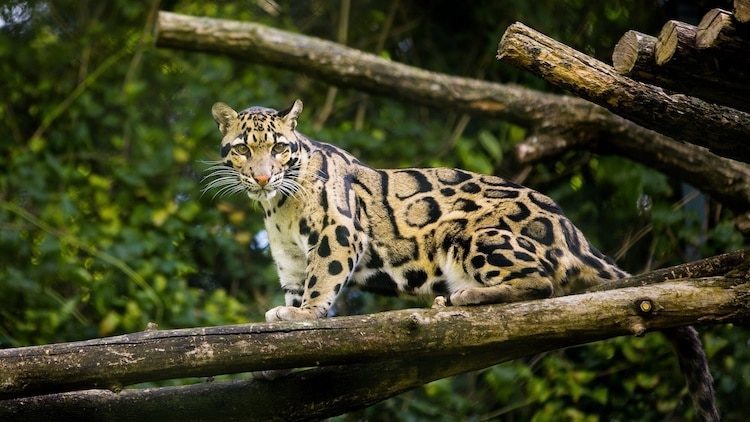
Formosan clouded leopard
© Stock Photos from Khaled Azam Noor/ShutterstockThe Formosan clouded leopard is a subspecies of the rare clouded leopard (pictured).
Hopeful news for animal lovers is coming out of Taiwan, where rangers say they've spotted a leopard thought to be extinct. The Formosan clouded leopard was declared extinct in 2013, though the last official sighting occurred in 1983. Locally known as Li'uljaw, these elusive creatures are not easy to trap, but a group of rangers in Taitung County's Daren Township have been patrolling since last summer hoping to spot the cat that locals claim to have seen.

Village chief of the Paiwan Tribe, Kao Cheng-chi, confirmed that rangers have been on alert since last June and that they'd held tribal meetings to discuss the sightings and ensure that hunters were kept at bay. Now, rangers have reported seeing Formosan clouded leopards hunting goats on a cliff, while a separate group spotted one run up a tree after roaming near some scooters.

The Formosan clouded leopard is a subspecies of the clouded leopard, a Himalayan cat that has been on the IUCN's vulnerable list since 2008. Known for its beautiful dusky-grey markings, the Formosan clouded leopard was endemic to Taiwan and, at one time, it was the island's second largest carnivore. Extensive logging ate away at its habitat, forcing it to retreat into the mountains.

This rare animal is considered sacred by the Paiwan tribe and is still listed as protected wildlife by Taiwan's Forestry Bureau. The Paiwan have implored the government to stop logging in order to allow the Formosan clouded leopards to come out of hiding and there have been reports of encounters past 1983, even if they weren't official sightings. Liu Chiung-hsi, a professor at the National Taitung University of Department of Life Sciences, said that a group of indigenous hunters told him that they had killed several cats in the 1990s, but burned their pelts for fear of repercussion from the government.

Now that these new sightings have been reported, the Taitung Forest District Office is hoping to confirm the sightings and start scientific research regarding them. For his part, Professor Chiung-hsi believes the reports. He told local reporters, "I believe this animal still does exist," stating that it's not surprising that they haven't been seen regularly due to their vigilance and natural elusive behavior.

It wouldn't be the first time a seemingly extinct species popped back up. Just recently the Fernandina giant tortoise, thought to be extinct after a last official sighting in 1906, was spotted by rangers at the Galápagos National Park. Fingers crossed that the same is true for the Formosan clouded leopard.
See also:


Attention

Beached gray whale spotted off San Pedro coastline, California

Beached whale found on San Pedro
Beached gray whale found on San Pedro coast
Television news crew this week captured a view of a beached gray whale near the San Pedro coastline. The KABC video surfaced on March 5 and it was unclear how long the whale had been there.

The rocky shoreline just off of Point Fermin Park may have made it difficult to completely wash ashore. This is the time of year when gray whales are migrating north from Baja California to Alaska.

Recently, false killer whales were spotted along the coast - a rare sighting for the tropical species. Sightings can be followed on the Facebook page for the Los Angeles chapter of the American Cetacean Society which conducts a migration census every year.