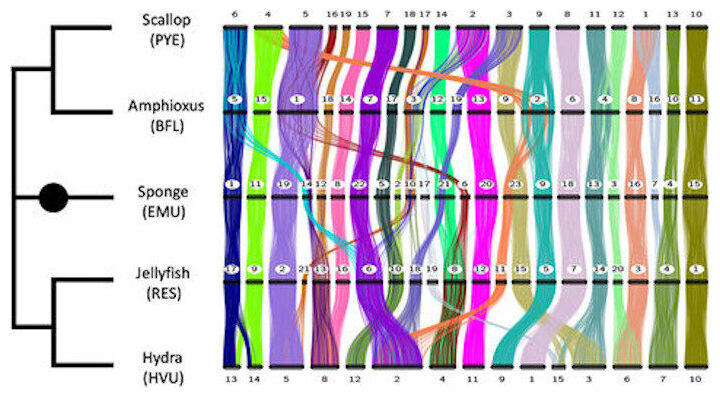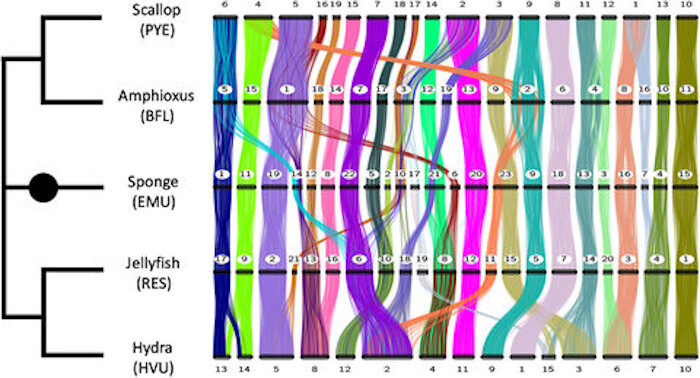
© Science Advances.The numbered horizontal bars represent the chromosomes of five species. Each colored strip shows how different sections of gene groups correspond or vary in their location within the different genomes. Two or more colors converging on a chromosome (as can be seen four times with the scallop) indicate that mixing has occurred between two ancestral chromosomes or chromosome sections. The image appeared in the publication in Science Advances.
Scientists have discovered that the
genomes of marine invertebrates have been surprisingly stable across deep time. Published in Science Advances, this new study provides an overarching analysis of distantly related animal groups, including sponges, jellyfish, scallops, and the invertebrates most closely related to humans, and found that their chromosomes are remarkably similar.
Think of a genome as the instruction manual located in each cell and written in DNA code. It contains all the inherited information for the operation of an organism. This instruction manual is divided into chapters — the chromosomes — and those are, in turn, further subdivided into pages — the genes.
"Over deep time — and by that, I mean at least 550 million years — due to random mutations, the order of genes within chromosomes become scrambled, kind of like mixing up pages within a chapter of a book. And more dramatically, sometimes we find that two chromosomes have come together and become mixed, as if the chapters were merged and shuffled." explained Prof. Daniel Rokhsar, last author of the paper and principal investigator of the
Molecular Genetics Unit at the Okinawa Institute of Science and Technology Graduate University (OIST) in Japan. "But overall, we found a remarkable amount of stability. Even though the last common ancestor of these three groups lived over half a billion years ago, many of their chromosomes are recognizably similar in the sense that they contain the same groups of genes."