Volcanoes
S


Attention

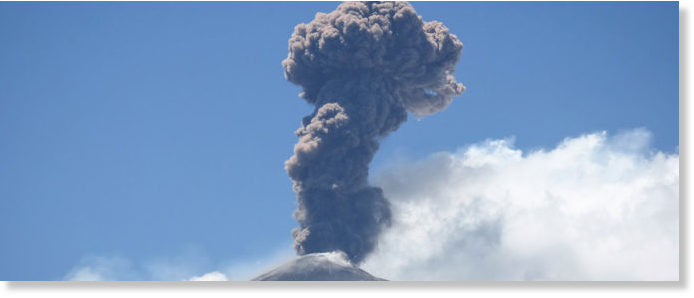
Mount Etna spewing out smoke rings and setting off eruption

etna

Mount Etna has been showing off lately by spewing out Smoke Rings & having a good size Eruption!!
Attention

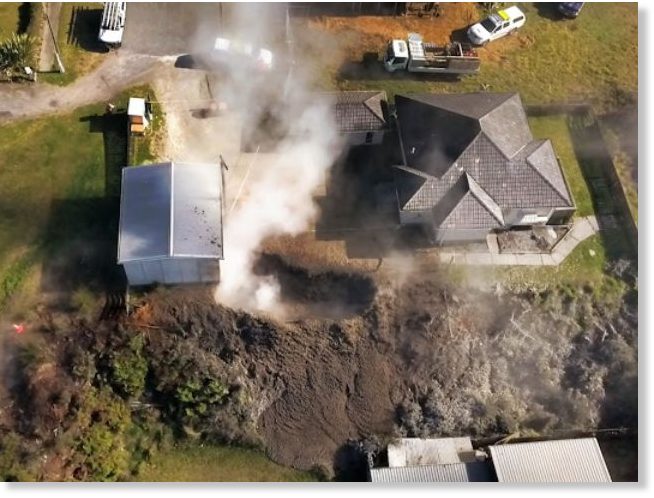
Woman wakes to find 30-foot hot mud geyser outside kitchen window in Rotorua, New Zealand

geyser
Woken by shaking and noise in the middle of the night, Susan Gedye headed downstairs, thinking an earthquake had struck her town in the north of New Zealand.

But as she went into the kitchen the noise got louder. Then she spotted the windows had steamed up.

Looking out into the back garden, Gedye saw a geyser had sprung up overnight and was now spewing steam and mud over the kitchen walls as it grew in size.

The family has had to move out due to the risk of the house collapsing.


Attention

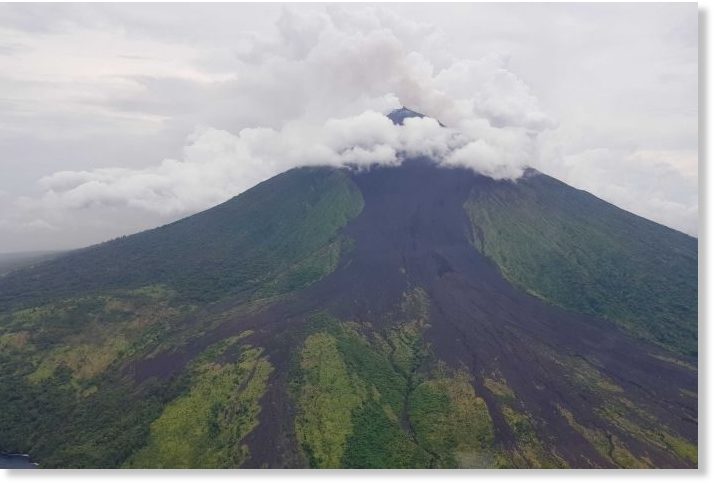
Papua New Guinea rocked with 2nd volcanic eruption within 2 days

Manam Island is one of the Pacific nation's most active volcanoes.
© Storyful, fileManam Island is one of the Pacific nation's most active volcanoes.
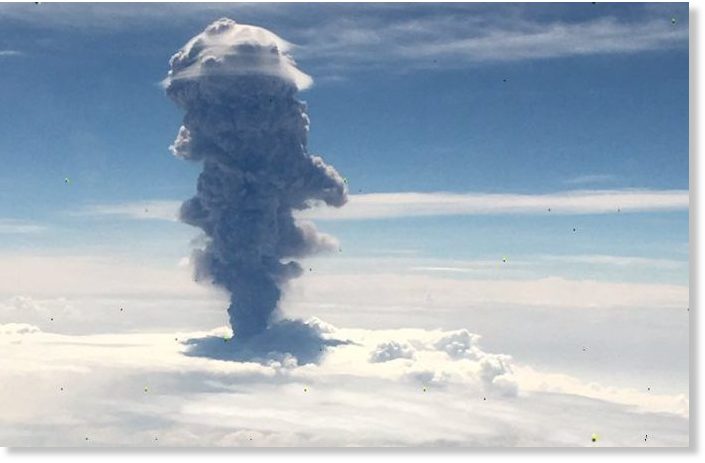
Just two days after the sudden eruption of Papua New Guinea's (PNG) Mount Ulawun, a second volcano on the island of Manam also erupted on Friday, sending volcanic ash into the air and sparking concerns regarding already stretched emergency response efforts.

The 10-km Manam Island in PNG's northern province of Madang began erupting at roughly 8:50 a.m. local time, according to the Australian Bureau of Meteorology's Volcanic Ash Advisory Center (VAAC) Darwin.

Manam Island is one of PNG's most active volcanoes, as well as being home to roughly 9,000 people.

The eruption created a large ash cloud reaching a height of roughly 15,240 meters which has since dissipated, with a subsequent ongoing eruption continuing to produce an ash plume to a height of roughly 4,572 meters.

Comment: Ulawun volcano erupts in Papua New Guinea, sends residents fleeing - ash sent over 13km into the air


Arrow Up

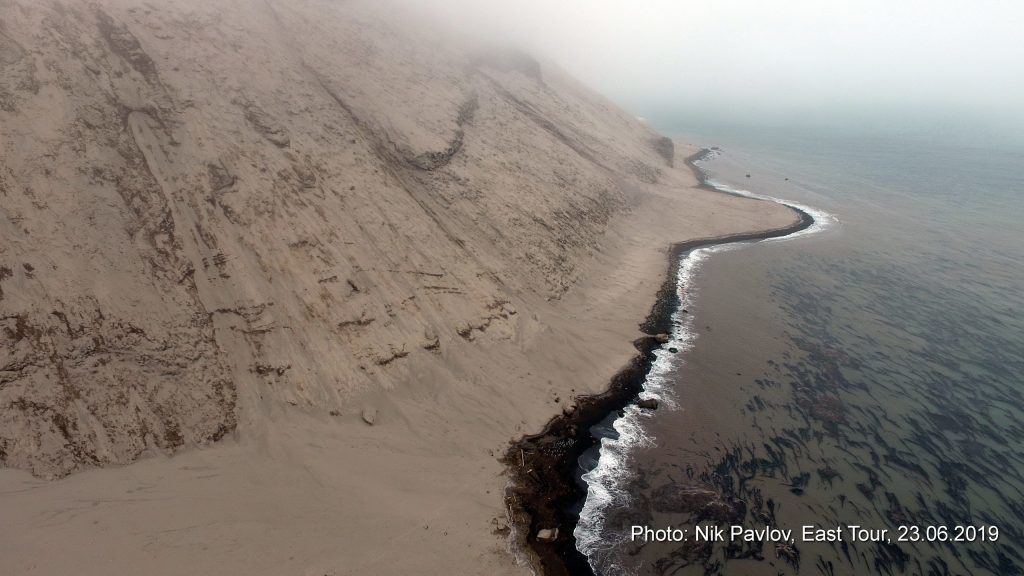
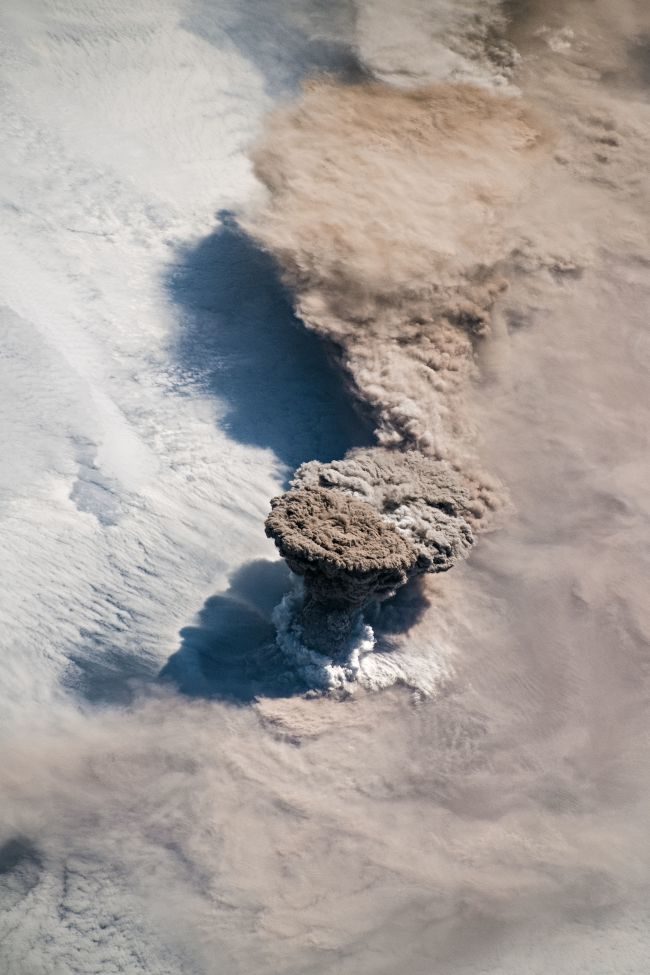
Eruption of Russian volcano, dormant for almost 100 years, captured from space

An astronaut's photo of the Raikoke volcano erupting on June 22, 2019
© NASAAn astronaut's photo of the Raikoke volcano erupting on June 22, 2019.
The volcano sat dormant for almost a century. Then at 4 a.m. last Saturday, it awoke.

In striking photos captured by satellites and astronauts on the International Space Station, smoke billows from the volcano on Raikoke, northeast of Japan. The uninhabited island saw its first volcanic eruption since 1924.

The photos released this week by NASA show volcanic plumes that rarely rise from the stratovolcano, which is almost a half-mile wide and 650 feet deep.

Raikoke is a tiny island of not even 2 square miles in the Sea of Okhotsk and has been under Russia's control since World War II.

The eruption consisted of at least nine explosions and lasted into the evening, according to the Smithsonian Institution's Global Volcanism Program.

The ash plumes containing large amounts of sulfur dioxide rose as high as 42,700 feet, or 8 miles. Lightning was detected in the plumes as they drifted east and northeast, the report said.


Comment: According to Marina Chibisova, a senior researcher at the laboratory of volcanology and volcanic danger at the Institute of Marine Geology and Geophysics of the Far East Branch of the Russian Academy of Sciences, the eruption of the Raikok volcano on the eponymous Kuril island resulted in the death of flora and fauna in the region.

"The flora and fauna of the island, which was restored after the last eruption of Raikoke in 1924, was destroyed by pyroclastic flows and ash falls," she said.

Post apocalyptic photos of Raikoke eruption on June 22, 2019
© Nikolay Pavlov / http://easttour.ruPost apocalyptic photos of Raikoke eruption on June 22, 2019.


Attention

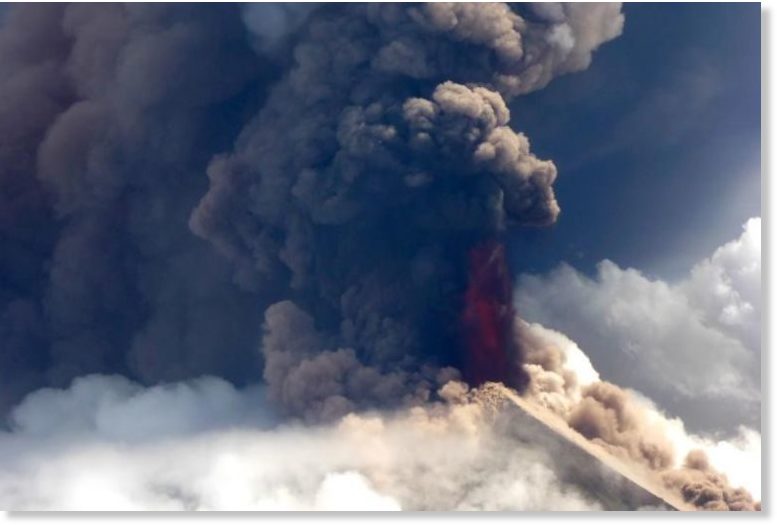
Ulawun volcano erupts in Papua New Guinea, sends residents fleeing - ash sent over 13km into the air

A pilot for Niugini Helicopters flying near the crater witnessed a column of lava spurting vertically into the equatorial sky, along with ash that has been belching since early morning on June 26, 2019
© AFP/NIUGINI HELICOPTERSA pilot for Niugini Helicopters flying near the crater witnessed a column of lava spurting vertically into the equatorial sky, along with ash that has been belching since early morning on June 26, 2019
Papua New Guinea's volatile Ulawun volcano - designated one of the world's most hazardous - erupted on Wednesday (June 26), spewing lava high in the air and sending residents fleeing.

A pilot for Niugini Helicopters flying near the crater witnessed a column of lava spurting vertically into the equatorial sky, along with ash that has been belching since early morning.

Ulawun, on the remote Bismarck Archipelago chain, is listed as one of 16 "Decade Volcanoes" targeted for research because they pose a significant risk of large, violent eruptions.


Attention

Adapt 2030 Ice Age Report: Your life is about to change - are world events adding up yet?

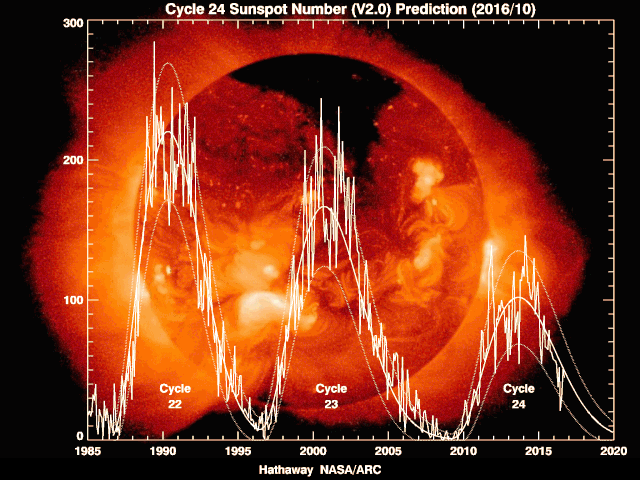
Solar Cycle Prediction
© David Hathaway, NASA, Marshall Space Flight CenterNASA predicts weakest solar activity in 200 years
NASA comes out with a shocking announcement that starting in 2020 we will experience the lowest solar activity in 200 years, and global temperatures will drop. With this jet stream will shift creating new precipitation patterns and volcanic eruptions will cause even more of a feed back loop intensifying cooling and global crop losses.


Comment: See also: David DuByne of Adapt 2030 recently had a two part discussion with Laura Knight-Jadczyk and Pierre Lescaudron, editors at SOTT.net and authors of Earth Changes and the Human Cosmic Connection: The Secret History of the World.

The news cycle is largely distraction from increasing food prices and societal changes as Earth shifts to a cooler climate. As the Eddy Grand Solar Minimum intensifies, a 400-year cycle in our Sun is affecting crop production, the economy and everyone on our planet. This is a timeline for what you can expect from now to 2030 as the frequency from our Sun changes.

See here for Part 1 and Part 2.

Review of Earth Changes and the Human-Cosmic Connection. The book is available to purchase here.

 Earth Changes and the Human-Cosmic Connection


Arrow Up

Mexican volcano's spectacular eruption captured on video from passenger plane

Mexico’s Popocatépetl volcano eruption
© Coordinación Nacional de Protección Civil / TwitterOn June 17, Mexico’s Popocatépetl volcano exploded and sent a large fumarole of ash, gas, and smoke into the sky.
A Mexican volcano's dramatic eruption has been captured in spectacular footage taken from inside a plane as it flew past the shocking sight.

The Popocatépetl volcano began erupting on Monday, sending large plumes of smoke and ash as high as 5km into the sky. Passengers flying near the active volcano at the time were able to get a clear view of the terrifying eruption.


Comment: Further details from electroverse.net:
According to the Volcanic Ash Advisory Center (VAAC) Washington, the largest eruption fired a thick ash column to an estimated 42,000 feet (12.8 km) above sea level, and comfortably into the stratosphere. Within a 24 hour window, the Popocatépetl volcano monitoring network detected 187 exhalations.

Popocatépetl, whose name means Smoking Mountain in Nahuatl, the language of the Aztecs, sprang back to life in 1994 (solar minimum of cycle 22) after half a century of quiescence.

Over the past few months, violent activity at the volcano has increased tenfold, correlating neatly with the sharp drop-off in solar activity (see 'UPTICK' below).

BACKGROUND

Stratovolcano: 5426 m / 17,802 ft
Central Mexico: 19.02°N / -98.62°W
Current status: ERUPTING (4 out of 5)

Eruption list: 1345-47, 1354, 1363(?), 1488, 1504, 1509(?), 1512, 1518, 1519-23(?), 1528, 1530, 1539-40, 1542, 1548, 1571, 1580, 1590, 1592-94, 1642, 1663-65, 1666-67, 1697, 1720, 1802-04, 1827(?), 1834(?), 1852(?), 1919-22, 1923-24, 1925-27(?), 1933, 1942-43, 1947, 1994-ongoing

UPTICK

Seismic and Volcanic activity has been correlated to changes in our sun.

The recent global uptick in earthquakes and volcanic eruptions is likely attributed to the drop-off in solar activity, coronal holes, a waning magnetosphere, and the influx of Cosmic Rays penetrating silica-rich magma.
See also: NASA predicts weakest solar activity in 200 years


Bizarro Earth

Is a long-dormant Russian volcano waking up?

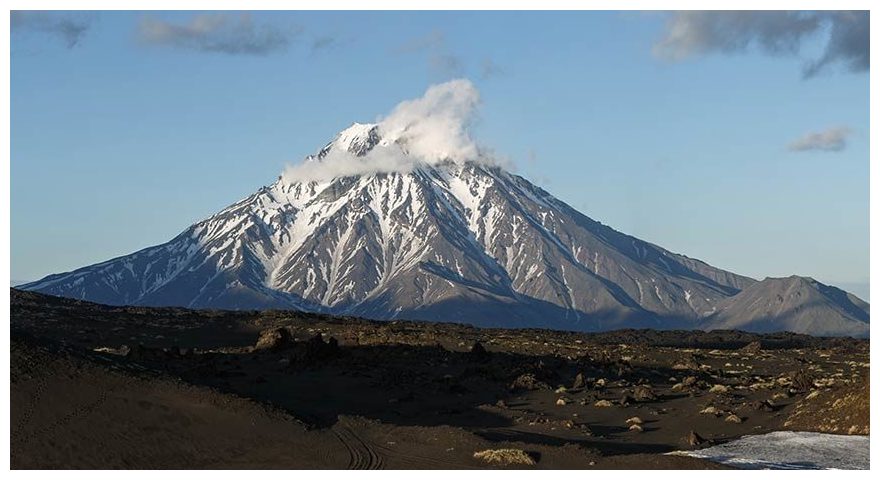
Bolshaya Udina Volcano
© gezyer/iStock/Getty Images PlusSLEEPING GIANT - Bolshaya Udina, a volcano on Russia’s Kamchatka Peninsula, has long been inactive. Some scientists suggest the volcano is waking up, based on nearby seismic activity. But others say those rumblings may be linked to active volcanoes in the region.
Seismic rumbles beneath a long-dormant volcano on Russia's Kamchatka Peninsula could herald an imminent eruption, a team of scientists says. But other researchers say that the observed seismic activity could be related to already erupting volcanoes in the region.

Fewer than 10,500 people live within 100 kilometers of the volcano, called Bolshaya Udina, making a catastrophic eruption that would affect large numbers of people extremely unlikely. When the volcano last erupted is unknown, but it hasn't for at least 10,000 years, so many volcanologists consider it no longer active, or "extinct." But Kamchatka is home to numerous active volcanoes, including nearby Bezymianny, which most recently erupted March 15.

Scientists had detected an apparent increase in seismic activity in the vicinity of Bolshaya Udina beginning in late 2017. So researchers, led by geophysicist Ivan Koulakov of the A.A. Trofimuk Institute of Petroleum Geology and Geophysics in Novosibirsk, Russia, installed four temporary seismic stations near the volcano. From May 5 to July 13, 2018, the stations recorded a swarm of 559 earthquakes.

Overall, from October 2017 through February 2019, researchers detected about 2,400 seismic events, the strongest of which was a magnitude 4.3 earthquake in February. Previous to that 16-month period, scientists detected only about 100 weak seismic events in the region from 1999 to 2017.

Attention

Mexico's Popocatépetl volcano erupts firing ash to 32,000 feet (9.8 KM)

volcano
Mexico's Popocatépetl continued its eruptive uptick in style at 15:40 UTC on June 14, with a strong Vulcanian-Type Explosion — one of the volcano's largest eruptions in years.

The Volcanic Ash Advisory Center (VAAC) Washington has warned of a thick ash column rising to at least 32,000 feet (9.8 km) a.s.l. and moving in a NE direction at 30-35 kts .

Particulates ejected to altitudes above 32,800 feet (10km) or FL328 —and into the stratosphere— have a direct cooling effect on the planet.

Twitter was quickly clogged with awesome photos and footage:


Attention

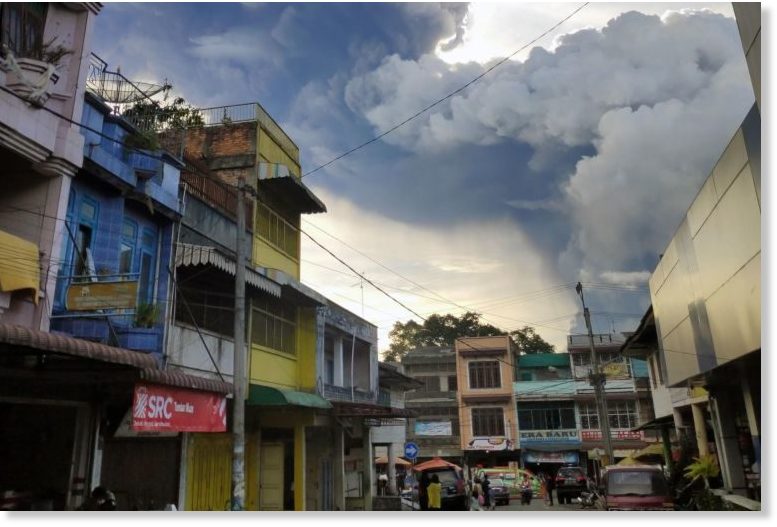
Mount Sinabung erupts in western Indonesia - ash spewed 7km high

Mount Sinabung spewing thick volcanic ash into the sky, as seen from Karo, on June 9, 2019.
© AFPMount Sinabung spewing thick volcanic ash into the sky, as seen from Karo, on June 9, 2019.

A column of thick ash was spewed 7km high into the sky from the crater of Mount Sinabung volcano on Sumatra Island of western Indonesia on Sunday (June 9), the country's national volcanology agency said.

The volcano began belching ash and smoke at 4.28pm Jakarta time, followed by a spread of hot ash to the southeast and south of the crater by up to 3.5km and 3km respectively, the agency said in a statement.

The agency, however, said there was so far no report of damages or casualties.